
In today’s data-driven economy, networks are under constant pressure to move more traffic, support more applications, and do it all with less power. As cloud services expand, AI workloads grow, and data centers become more interconnected, conventional electrical switching architectures are increasingly challenged by bandwidth demand, latency sensitivity, and energy consumption.
Optical switching has emerged as a practical response to these pressures. By moving traffic in the optical domain, operators can reduce unnecessary conversion steps and improve network efficiency. For organizations evaluating next-generation infrastructure, the Optical Circuit Switch is gaining attention as a strategic component for scaling performance without proportionally increasing complexity or power usage.
The main benefits of Optical Circuit Switch technology are lower latency, improved scalability, reduced power consumption, better bandwidth efficiency, and greater infrastructure flexibility.
To understand why this matters, it helps to look beyond the surface of “faster networking” and examine how optical circuit switching changes the economics and engineering of modern connectivity. The sections below explain the five core benefits in practical terms, along with the scenarios where this technology creates the most value.
If you are exploring data center interconnect, high-performance computing, or next-generation network architectures, the advantages of optical networking solutions are worth a closer look. The key is not just moving bits faster, but building a network fabric that can adapt to demand while remaining efficient and reliable.
1. Lower Latency for Time-Sensitive Traffic
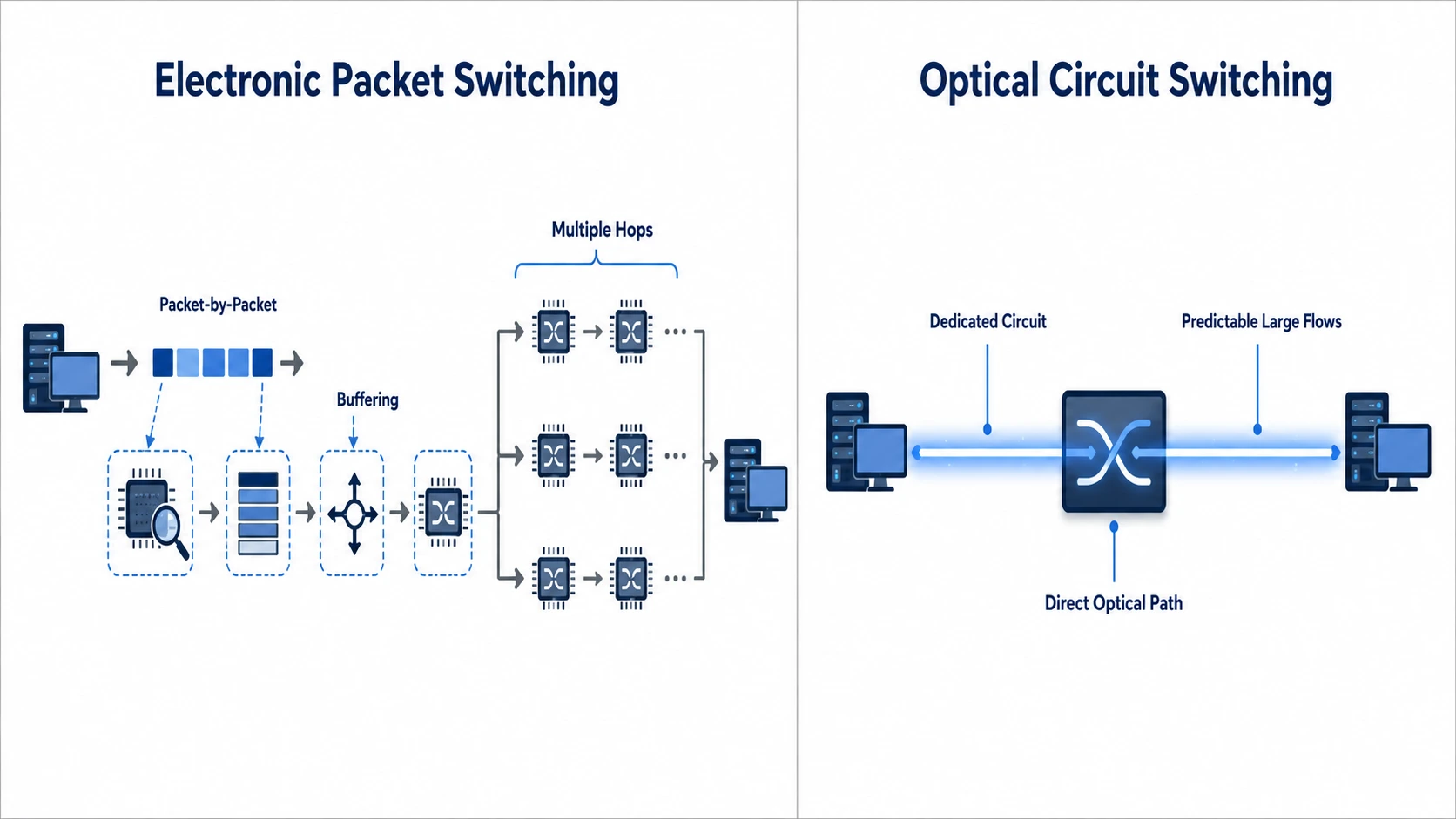
Optical Circuit Switch reduces latency primarily by eliminating the electronic processing, buffering, and queueing delays that accumulate at each hop in traditional packet-switched networks.
Latency matters whenever applications depend on rapid response times. In financial trading, AI model synchronization, distributed storage, telecom backbone routing, and high-performance computing, even small delays can affect throughput and user experience. Conventional packet-based systems require optical-to-electrical-to-optical (O-E-O) conversion, buffering, and per-packet routing decisions at every switching node. These processing steps introduce variable delays that can range from microseconds to tens of microseconds per hop depending on traffic load. Optical circuit switching avoids much of this overhead by creating a direct optical path between endpoints, bypassing intermediate electronic processing entirely.
This makes the technology especially attractive for workloads that are predictable, high-volume, and performance-sensitive. Once a circuit is established, traffic can flow with minimal processing overhead. It should be noted that the propagation delay through the fiber itself — approximately 5 microseconds per kilometer — remains a fundamental physical constraint that OCS does not eliminate. The latency advantage of OCS comes from removing the variable switching and queueing delays, not from changing the speed of light.
A practical example is a data center environment where large data sets must be transferred between compute clusters and storage arrays. Instead of forcing the traffic through multiple layers of electronic switching — each adding its own processing delay — an optical circuit can support sustained transfers with significantly reduced cumulative latency. That benefit is not just technical; it translates into better job completion times and more efficient utilization of expensive infrastructure.
Another important point is consistency. It is one thing to achieve low latency in isolated tests; it is another to maintain it under real-world traffic conditions. Optical circuit switching helps by offering a stable path with fewer processing variables, which is valuable for applications that are sensitive to microbursts, queue buildup, or routing instability.
For network architects, the message is clear: if your use case depends on predictable response times, reducing conversion and processing overhead can be more important than simply increasing raw bandwidth.
2. Better Scalability for Growing Network Demands
Optical Circuit Switch improves scalability by allowing networks to expand capacity and connectivity without relying solely on larger, more power-hungry electronic switching layers.
Scalability is one of the biggest challenges in modern network design. Traffic grows unevenly, application requirements change quickly, and infrastructure budgets rarely expand at the same pace as demand. Traditional approaches often solve scaling problems by adding more switches, more ports, or higher-speed electrical fabrics. While effective in the short term, this can create a costly and complex architecture as the environment grows.
Optical circuit switching offers a different path. Instead of converting all traffic into electrical signals for routing, it can establish direct optical connections between devices, racks, or even sites. This model is well suited to environments where large flows must be moved efficiently between endpoints, such as data center interconnects, AI training clusters, and backbone links.
The scalability advantage becomes especially visible in large facilities where traffic patterns are not uniform. Some applications generate sustained east-west traffic; others need temporary high-capacity links during peak workloads. Optical circuit switches can be used to create flexible connectivity that matches demand more precisely, helping operators avoid overbuilding every part of the network for worst-case scenarios.

Key scalability advantages
| Scalability Factor | Optical Circuit Switch Benefit |
|---|---|
| Port utilization | Enables more efficient use of high-capacity links |
| Network expansion | Supports larger fabrics with fewer conversion stages |
| Traffic adaptability | Can be reconfigured for changing workload patterns |
| Infrastructure growth | Reduces the need for excessive electronic switching layers |
Another scaling benefit is architectural simplicity. As networks become more complex, operations teams face greater challenges in provisioning, troubleshooting, and maintaining performance. By reducing dependence on multiple layers of electrical switching, optical circuit-based designs can simplify the path to higher capacity. That can make future expansion more manageable, particularly in environments that anticipate rapid growth.
This does not mean optical circuit switching replaces every form of electronic switching. Rather, it complements other infrastructure elements by handling the traffic types and link patterns where optical paths are most efficient. For businesses planning long-term network expansion, that flexibility can be a major advantage.
3. Lower Power Consumption and Reduced Heat
Optical Circuit Switch lowers power consumption because it reduces the amount of electrical processing required to move traffic through the network.
Power efficiency has become a critical metric in network and data center planning. As densities rise and workloads become more demanding, operators must manage electricity costs, thermal load, and cooling capacity. Traditional electronic switching systems consume power not only to forward traffic but also to convert signals, process packets, and maintain high-speed switching fabrics. Those requirements increase operational expenses and can strain cooling systems.
Optical circuit switching addresses part of this problem by keeping traffic in the optical domain for longer. The switching fabric itself — typically based on MEMS mirror arrays — draws negligible power once circuits are established, since the mirrors require minimal energy to hold their position. This means the OCS switching core consumes far less power than an equivalent electronic switch fabric performing the same interconnect function. It should be noted that the optical transceivers (pluggable optics) connected to OCS ports consume comparable power to those used in electronic switches; the power savings come from the switching fabric itself, not from the transceivers.
This power benefit matters for both cost and sustainability. Data centers are under pressure to improve energy efficiency while continuing to support higher traffic loads. Organizations that can reduce power draw without sacrificing performance often gain more flexibility in facility planning, equipment selection, and operating budget allocation.
A useful way to think about this is in terms of wasted work. If a network path forces traffic through multiple layers of conversion and buffering, each step adds energy cost. Optical circuit switching removes some of that waste by creating a more direct transmission route. That makes it an appealing option for infrastructure teams focused on improving performance per watt.
In large network environments, energy efficiency is not only a cost issue. It is also a capacity issue, because lower power use can free up cooling and rack resources for future growth.
There is also an indirect thermal benefit. Less electrical processing generally means less heat generation, which can reduce cooling demands and support more stable operating conditions. In high-density environments, thermal management often becomes a limiting factor long before physical space runs out. Any technology that helps ease that burden can have a strong business case.
For organizations planning future-proof infrastructure, power efficiency should not be treated as an afterthought. It is part of the total cost of ownership, and optical circuit switching can play a meaningful role in reducing that burden.
4. Higher Bandwidth Efficiency for Large Data Flows
Optical Circuit Switch improves bandwidth efficiency by enabling high-capacity paths for long-lived or predictable traffic flows without excessive packet handling overhead.
Bandwidth efficiency is not just about how much capacity a link supports. It is also about how effectively that capacity is used. In many networks, traffic patterns include a mix of small packets, bursty workloads, and large sustained transfers. Standard switching systems are good at handling highly dynamic traffic, but they are not always the most efficient choice for every flow type. When large data streams need to move continuously between known endpoints, optical circuit switching can be a better fit.
Because circuits create dedicated paths, they can support substantial data movement with less contention and fewer switching interruptions. This is particularly useful for workloads such as backup replication, scientific computing, media transfer, and distributed training. In these cases, the network is not simply carrying many small independent requests; it is moving large volumes of data where continuity and throughput matter more than per-packet routing flexibility.
One of the biggest advantages here is reduced overhead. Electronic packet switching must inspect, buffer, and forward each packet, which can create processing bottlenecks under heavy load. Optical circuit switching establishes a path so traffic can flow more directly, allowing the network to devote its resources to throughput rather than repeated decision-making.
Where bandwidth efficiency matters most
- Large file replication between sites
- AI model training synchronization
- High-performance computing data exchange
- Continuous media and content movement
- Storage-intensive enterprise workloads
This does not mean optical circuit switching is ideal for every type of traffic. Short, unpredictable, or highly interactive flows may still be better served by packet-based systems. But for traffic that is substantial and stable, circuit-based optical connectivity can deliver excellent bandwidth efficiency.
For network planners, the important point is that not all bandwidth is consumed equally. Some workloads justify a dedicated optical path because the value of sustained throughput far exceeds the flexibility of dynamic packet routing. In the right scenario, this can significantly improve overall infrastructure utilization.
5. Greater Infrastructure Flexibility and Future Readiness
Optical Circuit Switch provides greater flexibility because it allows networks to be reconfigured more easily as traffic patterns, applications, and business priorities change.
Modern infrastructure must adapt quickly. Cloud adoption, hybrid work, edge computing, AI acceleration, and cross-site data movement all create shifting connectivity requirements. Networks that are rigid or overdependent on fixed electrical architectures can become expensive to modify and difficult to optimize. Optical circuit switching offers a more adaptable approach by enabling direct optical paths that can be reassigned according to operational needs. The switching time required to establish or reconfigure these paths varies by technology — typically ranging from tens of microseconds to a few milliseconds — which is important context when evaluating suitability for dynamic workloads.
This flexibility is especially valuable in environments where workloads are temporary or seasonal. For example, a research cluster may need one traffic pattern during training cycles and another during archiving or collaboration phases. A data center may need to shift capacity between internal workloads and external interconnects depending on demand. Optical circuit switches make it easier to redesign connectivity without rebuilding the entire physical network.
Flexibility also supports future readiness. Technology roadmaps rarely stay still. New protocols, faster interconnects, and larger traffic demands can quickly expose the limitations of static network designs. By incorporating optical circuit switching into the architecture, businesses gain a foundation that can be adapted rather than replaced.

Benefits of flexible optical infrastructure
| Flexibility Need | Optical Circuit Switch Advantage |
|---|---|
| Reconfiguration | Supports changing circuit assignments |
| Workload balancing | Adapts to new traffic distributions |
| Expansion planning | Accommodates future capacity requirements |
| Operational agility | Helps align connectivity with business priorities |
In practical terms, this means fewer disruptive changes when the network needs to evolve. Instead of redesigning large sections of the infrastructure, teams can adjust the optical circuit layout to match new requirements. That can improve agility while lowering the operational burden on network engineers.
Flexibility is often overlooked because it is less visible than latency or bandwidth. But over time, it may be the benefit that matters most. A network that can adapt quickly is more valuable than one that performs well only under a narrow set of assumptions.
When Optical Circuit Switching Makes the Most Sense
Optical Circuit Switch is most valuable in high-capacity environments where traffic patterns are predictable, latency-sensitive, or heavy enough to justify dedicated optical paths.
Not every network needs optical circuit switching, and that is an important distinction. The technology delivers the strongest value in scenarios where large data flows are frequent, performance is critical, and operational efficiency matters. For example, hyperscale data centers, AI and machine learning clusters, telecom backbones, scientific research networks, and large enterprise interconnects are often strong candidates.
In these environments, the benefits discussed above work together. Lower latency improves responsiveness, scalability supports growth, reduced power consumption lowers operating costs, bandwidth efficiency improves throughput, and flexibility makes the architecture easier to evolve. The more demanding and predictable the traffic, the more compelling the case becomes.
It is also worth noting that optical circuit switching works best as part of a broader networking strategy. Many organizations will continue to use packet switching for general traffic while deploying circuit-based optical paths for heavy or recurring flows. This hybrid approach can offer the best of both worlds: flexibility where needed and efficiency where it matters most.
Before making a deployment decision, network teams should evaluate workload patterns, growth projections, power budgets, latency requirements, and operational complexity. That assessment will reveal whether optical circuit switching is a strategic fit or whether another architecture is more appropriate.
Choosing the Right Optical Switching Strategy
The right optical switching strategy depends on matching network architecture to traffic behavior, performance goals, and long-term infrastructure plans.
Selecting the best architecture is not simply a matter of choosing the fastest component. It requires understanding how the network is actually used. Some organizations need dynamic packet routing for unpredictable traffic. Others need dedicated optical paths for sustained high-volume transfers. In many cases, the optimal design combines multiple switching approaches.
A structured evaluation can help guide the decision:
- Identify the largest traffic flows and where they occur.
- Measure latency sensitivity across critical applications.
- Estimate current and future power consumption.
- Determine how often the network needs reconfiguration.
- Compare operational complexity across possible designs.
If the results show that a significant portion of traffic is predictable and high-volume, optical circuit switching may offer strong value. If flexibility and short-flow handling dominate the workload, a more traditional architecture may remain essential.
In other words, the best solution is not always the one with the most advanced label. It is the one that aligns with your operational reality and growth strategy.
Conclusion
Optical Circuit Switch delivers five major benefits: lower latency, better scalability, lower power consumption, higher bandwidth efficiency, and greater infrastructure flexibility.
These advantages make it a compelling option for modern network environments that need to move large volumes of data efficiently while keeping costs and complexity under control. As applications become more distributed and performance expectations continue to rise, optical circuit switching can help organizations build networks that are faster, cleaner, and more adaptable.
For businesses planning long-term infrastructure investments, the real value lies not only in performance gains but also in the ability to scale intelligently. A well-designed optical strategy can reduce waste, support future growth, and create a stronger foundation for next-generation workloads.
FAQ
1. Is Optical Circuit Switch the same as packet switching?
No. Optical circuit switching creates a dedicated optical path between endpoints, while packet switching routes individual data packets dynamically through shared network resources.
2. What types of networks benefit most from Optical Circuit Switch?
It is most useful in high-capacity environments such as data centers, AI clusters, telecom backbones, research networks, and other systems with large predictable traffic flows.
3. Does Optical Circuit Switch replace all electronic switches?
Usually not. Many networks use a hybrid design, combining optical circuit paths for high-volume traffic with electronic switching for flexible packet-based communication.