
As data center traffic continues to surge driven by AI training, high-performance computing, and real-time analytics, traditional electronic packet switching infrastructure is hitting hard limits in latency, power efficiency, and scalability. Network architects are searching for alternative switching paradigms that can handle predictable, high-volume traffic flows without adding unnecessary processing overhead. The search for a more efficient switching architecture has brought optical circuit switching (OCS) into the spotlight as a complementary technology for next-generation networks.
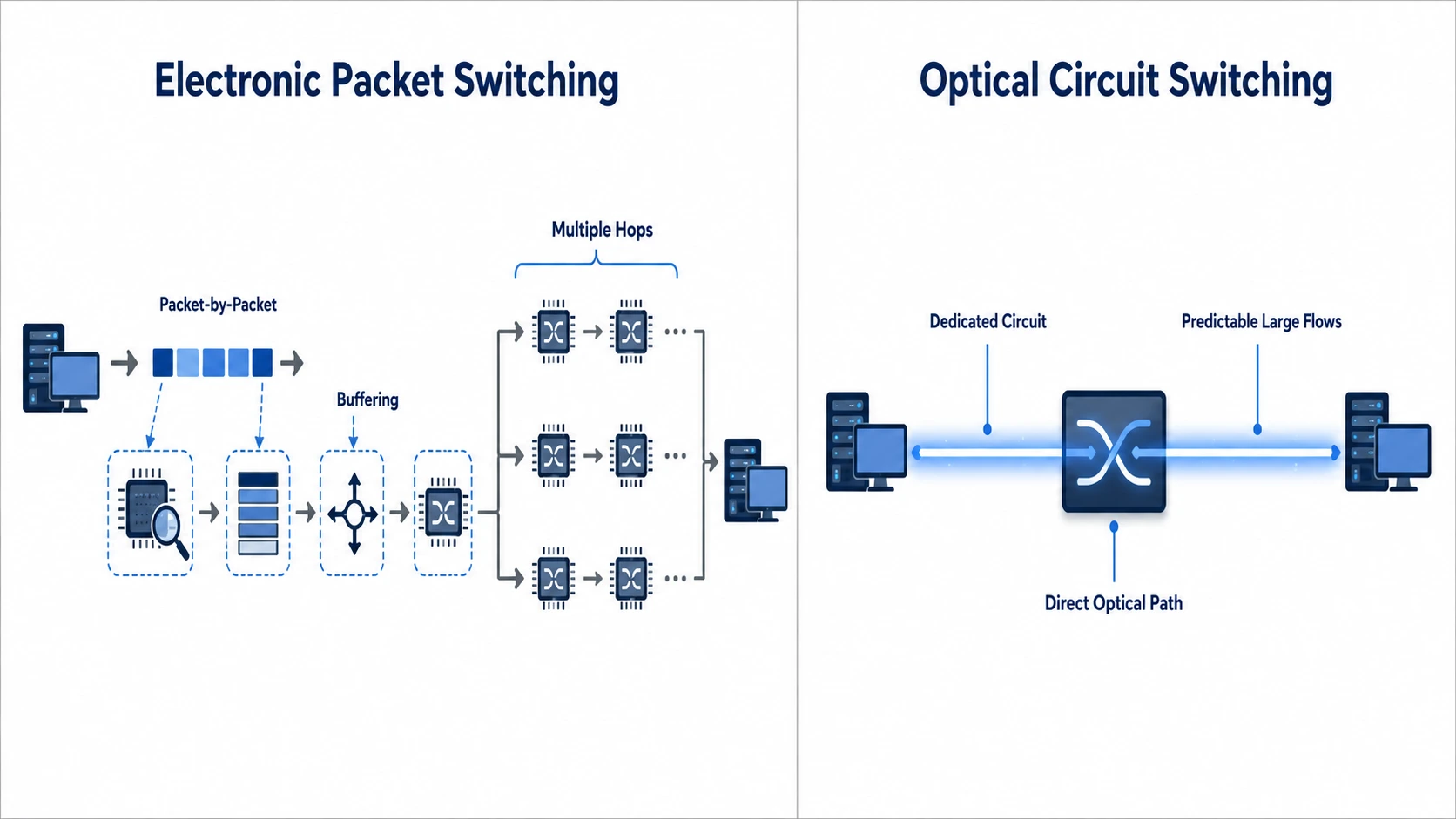
Optical Circuit Switching (OCS) is a switching technique that establishes a direct optical path between network endpoints using optical cross-connect technology, allowing data to travel entirely in the optical domain without electrical conversion at intermediate switching points. Unlike packet switching which inspects and forwards individual packets, OCS creates dedicated light paths for high-volume traffic flows, delivering dramatically lower latency, reduced power consumption, and deterministic performance for predictable communication patterns. When integrated with an optical transport network, OCS enables network operators to scale capacity while maintaining energy efficiency and service quality.
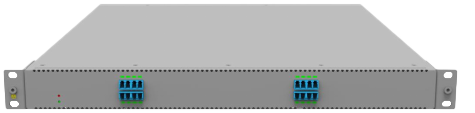
How Does Optical Circuit Switching Work?
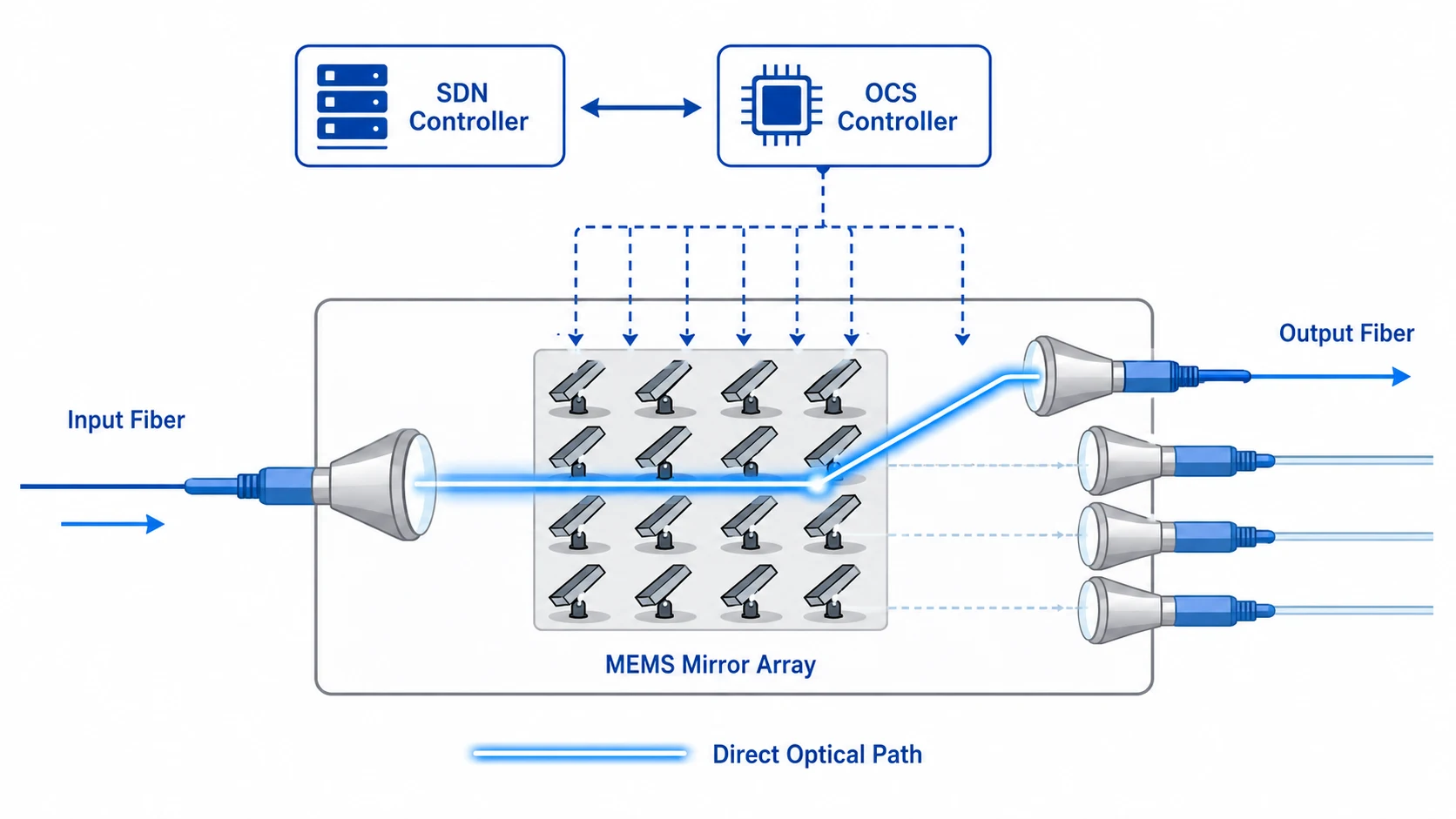
Optical circuit switching works by using optical cross-connect (OXC) or MEMS-based mirror arrays to physically reroute optical signals from an input fiber to an output fiber, creating a transparent light path that remains fixed for the duration of a data transmission session. The switching fabric operates entirely in the optical domain, meaning data signals never leave their optical format from source to destination.
An OCS system consists of three primary components: optical switching fabric, control electronics, and interface optics. The optical switching fabric is the core of the system. In modern OCS deployments, this is typically built using Micro-Electro-Mechanical Systems (MEMS) mirror arrays — tiny mirrors mounted on microscopic actuators that tilt to redirect light beams from one fiber port to another. When a circuit needs to be established, the control electronics calculate the optimal path and instruct the MEMS mirrors to position themselves. Depending on the specific technology and scale, the switching operation takes place in tens of microseconds to a few milliseconds, after which the light path remains stable and transparent.
The control layer of an OCS system interfaces with the network’s software-defined networking (SDN) controller. When the controller identifies a large, predictable traffic flow that would benefit from circuit switching — such as a long-running data center interconnect session — it sends a request to the OCS controller to establish a dedicated light path. Once established, that path carries data at native line rate without any intermediate processing. No buffering, no packet inspection, no forwarding decisions — just light traveling from one end to the other.
OCS fabrics are inherently transparent and rate-independent. Because the switching fabric does not touch the data content or format, a single OCS fabric can simultaneously handle 10G, 100G, 400G, and 800G wavelengths without modification. As optical transport systems evolve toward higher data rates, OCS infrastructure remains relevant because the switching fabric itself is protocol-agnostic. It should be noted that this transparency applies to the switching fabric itself; at higher rates or longer distances, optical signal integrity factors such as insertion loss and polarization-mode dispersion must still be managed within the overall link budget.
What Are the Key Benefits of Optical Circuit Switching?
Optical circuit switching delivers five core benefits: lower latency by eliminating electronic processing, higher scalability through port-count independence from data rate, reduced power consumption per bit, better bandwidth efficiency for predictable flows, and greater infrastructure flexibility through reconfigurable optical topologies.
Lower Latency
The most measurable benefit of OCS is latency reduction. In a conventional electronic switch, every packet must traverse the ingress pipeline, be buffered in shared memory, have its header processed for forwarding decisions, and then be queued for egress. This process introduces per-hop latency measured in microseconds to tens of microseconds depending on switch load. In multi-hop topologies, this accumulates significantly.
OCS eliminates all of this. Once an optical circuit is established, the data path consists of nothing but fiber and passive optical elements. The propagation delay is determined solely by the speed of light through the fiber medium — approximately 5 microseconds per kilometer. For typical intra-data-center distances, OCS delivers end-to-end latency in the low microsecond range, with the primary advantage coming from eliminating the queueing, buffering, and processing delays that dominate electronic switch latency.
Reduced Power Consumption
Power is becoming the dominant constraint in data center expansion. Electronic switches consume significant power per port, with much of that energy dissipated as heat in the switching fabric and signal processing circuitry. A typical 100G Ethernet switch port consumes 5–10 watts, and a fully loaded chassis can draw several kilowatts.
OCS switching fabrics are fundamentally more energy-efficient because they do not process data. The power consumption of a MEMS-based OCS is dominated by mirror actuation and control electronics, which remain constant regardless of the data rate passing through the fabric. A single OCS port typically consumes under 1 watt, and the entire system’s power scales with the number of ports, not the bandwidth.
Scalability, Bandwidth Efficiency, and Flexibility
Electronic switch ASICs face fundamental scaling challenges. As port speeds increase — from 100G to 400G to 800G and beyond — the internal crossbar and buffer architectures must grow proportionally, driving up cost, power, and thermal complexity. OCS systems avoid this entirely because the switching fabric operates independently of the data rate. Future rate upgrades require only changes to the pluggable optics, not the switching infrastructure.
For predictable traffic flows such as storage replication, database synchronization, and AI training data distribution, packet switching introduces unnecessary overhead in the form of packet headers, buffer management, and forwarding table lookups. OCS creates a direct path that carries the entire flow with near-zero overhead, maximizing effective bandwidth utilization.
OCS also enables software-defined optical topologies that can be reconfigured in real time. Using Optical DCI networks, network operators can dynamically adjust connectivity patterns between data center pods, clusters, or sites based on changing workload demands.
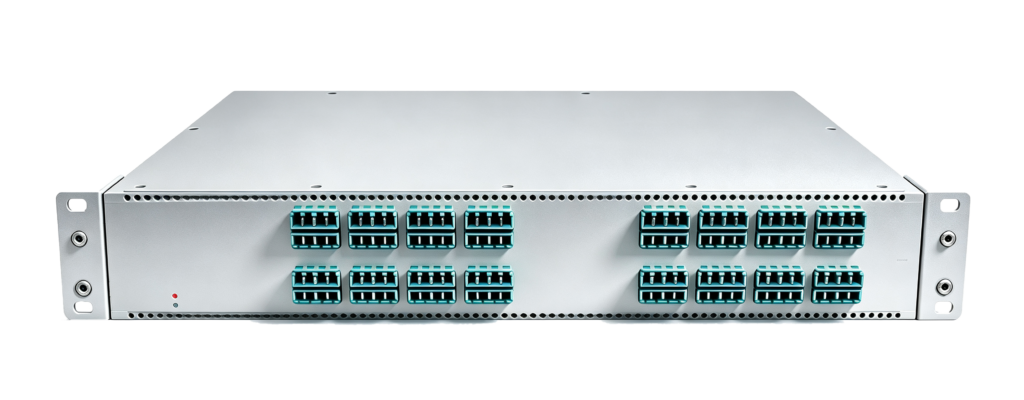
Optical Circuit Switching vs. Packet Switching: Key Differences
| Aspect | Optical Circuit Switching | Electronic Packet Switching |
|---|---|---|
| Data unit | Entire optical circuit flow | Individual packets |
| Latency per hop | Nanoseconds (propagation only) | Microseconds to milliseconds |
| Power per 100G port | Under 1 watt | 5–10 watts |
| Rate dependency | Independent (1G to 800G+) | ASIC-dependent per generation |
| Traffic suitability | Predictable, long-duration flows | Bursty, unpredictable traffic |
| Switching time | Milliseconds to establish | Nanoseconds per packet |
| Protocol transparency | Full (any optical signal) | Protocol-specific forwarding |
The most important distinction is that these technologies are complementary rather than competitive. A well-designed network uses packet switching for bursty, short-lived, and unpredictable traffic while offloading large, persistent flows to OCS for efficiency and performance.
What Are the Main Use Cases for Optical Circuit Switching?
Optical circuit switching is most valuable in environments where large, predictable data flows dominate network traffic: data center interconnect, AI and machine learning training clusters, high-performance computing, and video production and broadcast.
Data Center Interconnect
DCI is the most commercially significant use case for OCS today. Organizations operating multiple data centers must constantly synchronize data across geographic distances. These flows are typically large (terabytes to petabytes per session), long-running, and highly predictable. Using OCS to establish direct optical paths between data centers eliminates the latency and power overhead of intermediate electronic switches. Modern DCI Platforms increasingly integrate OCS capabilities to offer flexible wavelength routing between facilities.
AI Training and HPC Clusters
AI training workloads exhibit unique traffic patterns. Compute nodes exchange massive parameter updates during iterative phases, generating sustained, predictable traffic flows that can persist for seconds or minutes. OCS can establish dedicated circuits between GPU clusters during these phases, ensuring deterministic bandwidth and minimal latency variation. As OCS switching times continue to decrease into the tens-of-microseconds range, this technology becomes increasingly viable for the fine-grained communication patterns seen in distributed AI training. HPC clusters running parallel simulation workloads benefit from the same architecture — the job scheduler often knows which nodes will communicate and when, allowing OCS to pre-establish dedicated circuits and reduce job completion times.
Video Production and Broadcast
Remote production workflows in media and entertainment require deterministic, high-bandwidth connectivity between production facilities. Live video feeds, uncompressed raw footage transfers, and multi-camera contribution links benefit from the guaranteed bandwidth and zero-jitter characteristics of OCS circuits.
How Does OCS Fit Into Modern Data Center Architecture?
OCS does not replace the existing packet-switched data center fabric. Instead, it operates as an optical transport layer beneath the conventional IP/Ethernet network, providing high-speed optical bypass paths for flows that the SDN controller identifies as suitable for circuit switching.
A typical deployment places OCS switches at the top-of-rack or middle-of-row level alongside traditional leaf switches. The SDN controller monitors traffic patterns and identifies heavy elephant flows that persist for more than a few seconds. When such a flow is detected, the controller instructs the relevant leaf switches to redirect the flow to the OCS fabric while the OCS establishes a direct path to the destination leaf. The flow then bypasses the electronic switching hierarchy entirely.
The architecture leverages data center interconnect principles extended into the intra-campus domain. Flows that would normally traverse multiple electronic switch hops instead travel through one or two OCS hops with zero electronic processing. The control plane integration between SDN, OCS, and the existing network fabric is critical to making this work seamlessly.
What Are the Limitations of Optical Circuit Switching?
Despite its clear advantages for specific use cases, optical circuit switching has limitations that prevent it from becoming a universal switching solution: millisecond-scale circuit establishment time, lack of statistical multiplexing efficiency for bursty traffic, optical signal quality constraints, and higher initial deployment complexity.
The most fundamental limitation is switching time. While OCS can establish a circuit in milliseconds, this is orders of magnitude slower than the nanosecond-scale forwarding decisions of an electronic packet switch. This makes OCS unsuitable for traffic patterns that change rapidly or consist of short-lived flows.
Optical signal quality is another constraint. As optical signals pass through MEMS mirrors, fiber connectors, and splitters, they accumulate insertion loss. In large OCS fabrics, the cumulative loss can require optical amplification, adding cost and complexity. The signal-to-noise ratio must be carefully managed, particularly for higher-order modulation formats used in coherent optics.
Deployment complexity remains a practical barrier. OCS systems require integration with existing network management and SDN control planes, specialized optical engineering knowledge, and custom cabling infrastructure. For smaller organizations without dedicated optical engineering teams, this can be a significant hurdle.
FAQ
Does optical circuit switching require special fiber optic cabling?
No, OCS works with standard single-mode fiber (SMF) cabling already deployed in most data centers and telecom networks. However, careful fiber management — including clean connectors, proper patch panel routing, and insertion loss budgeting — becomes more important because OCS fabrics add their own optical loss. Most deployments use standard LC/APC or SC/APC connectors with low-loss polished endfaces.
Can optical circuit switching and packet switching coexist in the same network?
Yes, this is the most common deployment model. OCS is deployed as an additional optical layer alongside the existing packet-switched fabric, not as a replacement. An SDN controller monitors traffic, identifies flows suitable for circuit switching, and dynamically routes them through the OCS fabric while leaving bursty, short-lived traffic on the packet-switched network.
How reliable are MEMS-based optical circuit switches compared to electronic switches?
MEMS-based OCS systems have proven highly reliable in production deployments, with mean time between failure ratings comparable to or exceeding enterprise-grade electronic switches. MEMS mirrors have no wear mechanisms during steady-state operation — once positioned, a mirror draws negligible power and experiences no mechanical movement. Modern sealed MEMS packages with inert gas filling have reduced mirror stiction risks to negligible levels in commercial products.