
Optical Transceiver Wavelengths are one of those topics that seem simple at first, then quickly turn into a maze of numbers, distances, and fiber types. Still, in real network planning, wavelength choice often decides whether a link is clean, stable, and cost-effective—or frustratingly underperforming. That is why common wavelength values such as 850nm, 1310nm, and 1550nm keep showing up in optical designs across data centers, campus links, and metro networks.
At a practical level, wavelength is not just a label printed on a transceiver. It affects how light travels through fiber, how much signal loss occurs, and how far the connection can reliably reach. In other words, the wavelength is part of the network design, not just a spec sheet detail.
What Optical Transceiver Wavelengths Actually Mean
Why wavelength matters in fiber transmission
A transceiver emits light at a specific wavelength, usually measured in nanometers. That light is the carrier for the data. Different wavelengths behave differently inside fiber, especially when distance increases or when the link moves from multimode to single-mode.
The reason this matters is fairly straightforward: fiber is not a perfectly neutral path. Some wavelengths experience less attenuation, while others are better suited to short-reach, lower-cost deployments. That is why two modules with the same data rate can have very different reach limits.
The practical impact on network planning
From an engineering perspective, wavelength influences several things at once:
- Signal attenuation
- Chromatic dispersion
- Maximum transmission distance
- Fiber type compatibility
- Overall deployment cost
That combination is why a wavelength decision should never be made based on speed alone. A 10G, 25G, or 400G link still needs the right optical profile behind it.
According to the IEEE 802.3 Ethernet standard, optical interfaces are defined with specific physical-layer characteristics, which helps explain why wavelength and reach are tightly linked in Ethernet deployments.
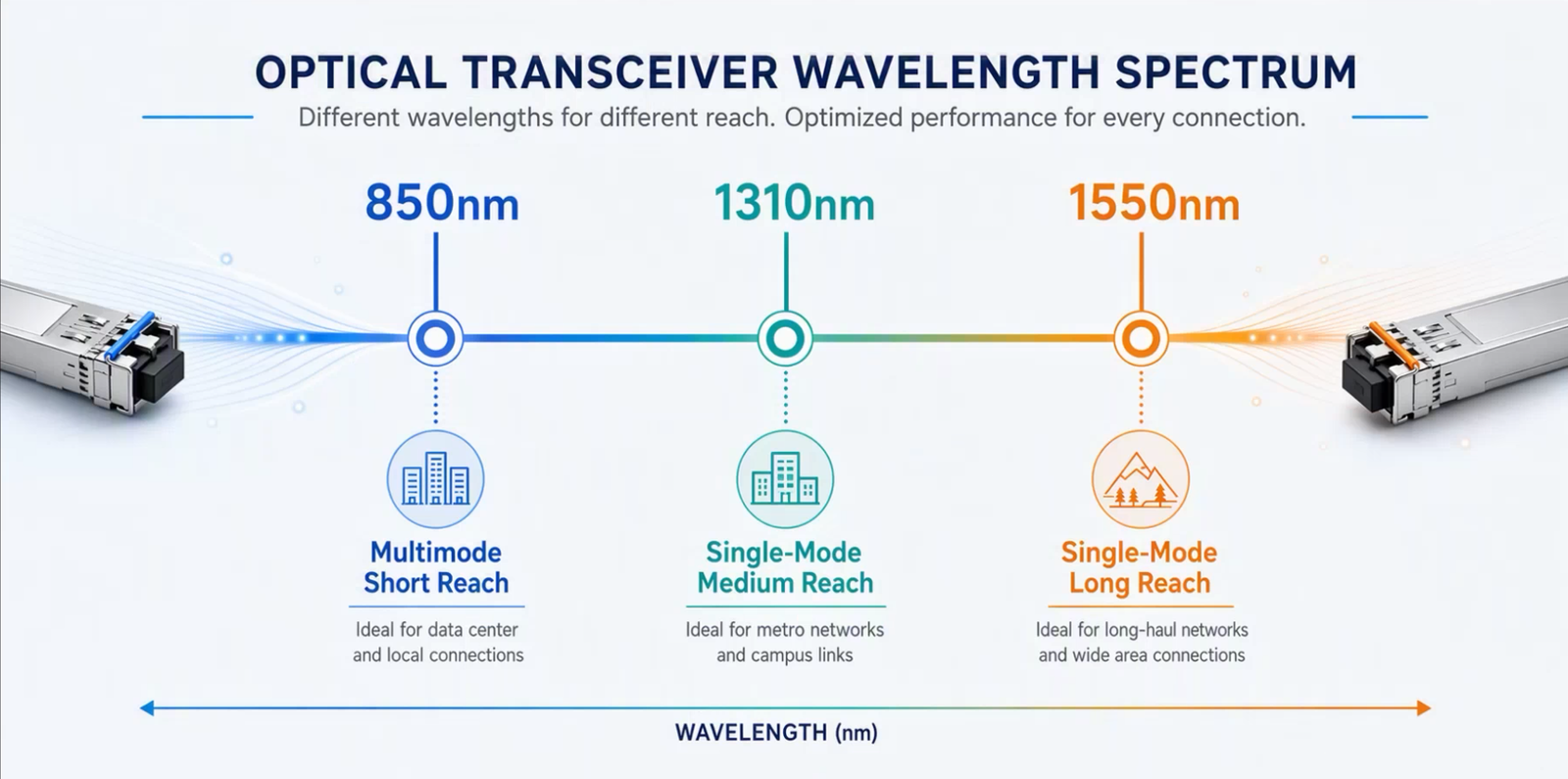
The Most Common Optical Transceiver Wavelengths
850nm
850nm is one of the most common wavelengths for short-reach multimode optics. It is widely used in data centers where links are relatively short and density matters more than long-distance transport.
It tends to be favored because multimode systems are usually simpler and more economical for short runs. The trade-off is obvious, though: 850nm is not designed for long-distance single-mode transmission.
1310nm
1310nm is a very common choice for short-to-medium reach over single-mode fiber. It often appears in enterprise and data center environments where longer links are needed without moving into full long-haul design territory.
This wavelength is popular because it offers a strong balance between reach and practicality. It is not unusual to see it used in standard Ethernet optics, especially where a clean, dependable connection is more important than extreme distance.
1550nm
1550nm is strongly associated with long-distance optical transport. It is often used in systems where lower attenuation over greater distances becomes essential.
This wavelength is especially useful in metro and long-haul applications, where every dB of loss starts to matter. In many deployments, 1550nm is the wavelength that makes the difference between a link barely working and a link that has proper operating margin.
Related LAN-WDM and parallel wavelength ranges
Modern high-speed optics may use sets of closely spaced wavelengths rather than a single traditional one. These ranges are often found in higher-capacity modules and parallel optical designs.
That is one reason newer systems are more complex than older point-to-point optics. A link might be built around several wavelengths working together instead of one simple channel.
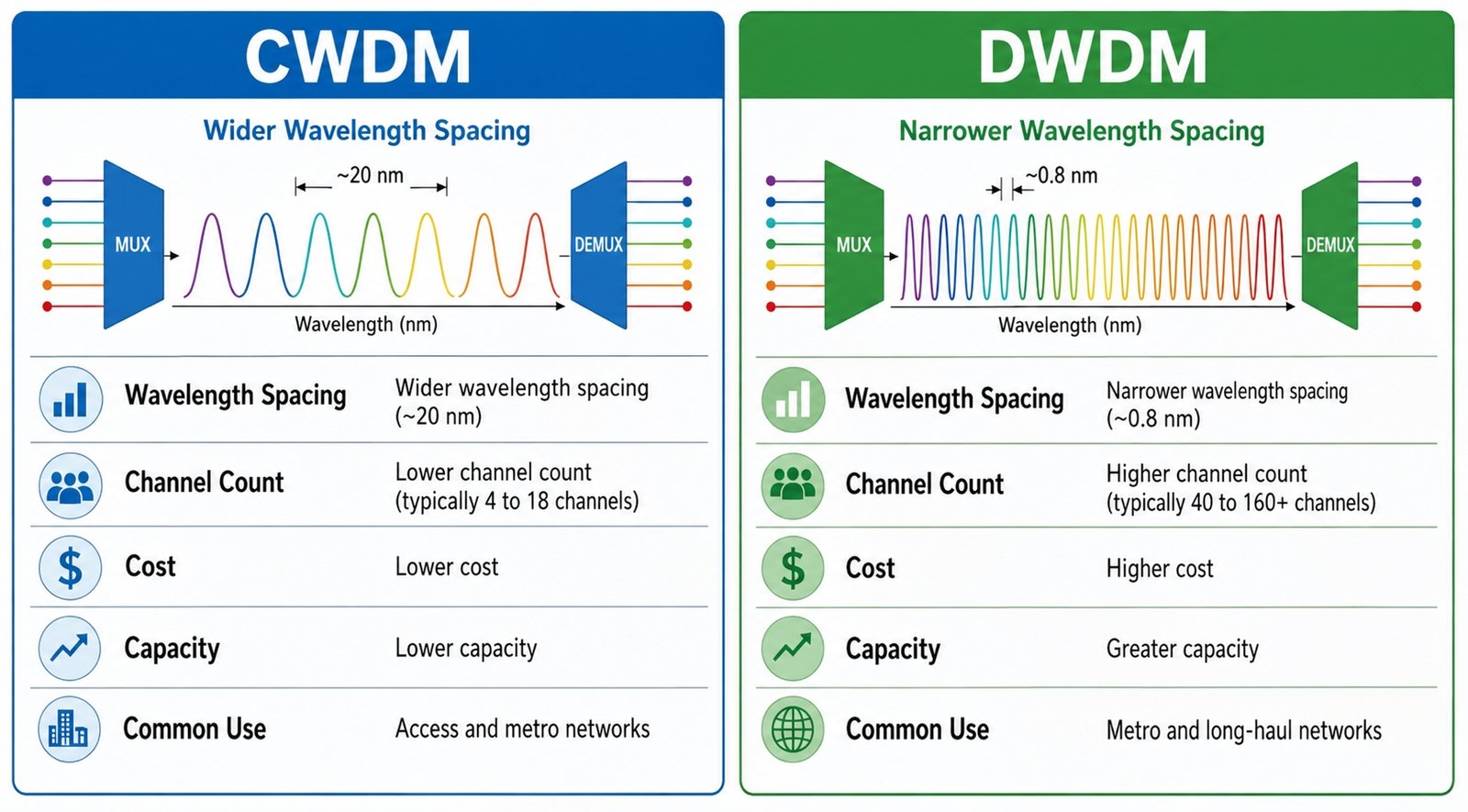
CWDM vs DWDM: How Wavelength Strategy Changes
CWDM overview
CWDM, or coarse wavelength division multiplexing, uses wider spacing between channels. That generally makes it simpler and more cost-effective than denser transport methods.
It is often used in metro or access networks where operators want to carry multiple services over a single fiber pair without investing in a very complex transport layer.
DWDM overview
DWDM, or dense wavelength division multiplexing, packs many channels much closer together. That creates far more capacity on a single fiber, but it also increases technical complexity and cost.
DWDM is the better fit when channel density matters and the network is built for serious transport capacity.
Quick comparison table
| Feature | CWDM | DWDM |
|---|---|---|
| Channel spacing | Wider | Narrower |
| Channel count | Lower | Higher |
| Typical cost | Lower | Higher |
| Common use | Access, metro | Metro, long-haul, backbone |
| Complexity | Simpler | More complex |
ITU-T recommendations are the usual reference point for wavelength grid planning in optical transport, especially when CWDM and DWDM systems need to align with standardized channel spacing.
How Wavelength Affects Reach, Fiber Type, and Loss
Distance and attenuation
Different wavelengths lose power at different rates as they travel through fiber. That loss, known as attenuation, is one of the main reasons certain wavelengths are better for short links and others for long ones.
In simple terms, the farther the signal has to go, the more important it becomes to choose a wavelength that can survive the journey with enough power left at the receiver.
Multimode vs single-mode fiber
This is where many deployment mistakes happen. Multimode fiber is typically paired with shorter-reach wavelengths like 850nm, while single-mode fiber is better suited to 1310nm and 1550nm ranges.
A quick reference table helps clarify the pattern:
| Fiber Type | Common Wavelengths | Typical Reach Profile |
|---|---|---|
| Multimode | 850nm | Short-reach, data center links |
| Single-mode | 1310nm | Short-to-medium reach |
| Single-mode | 1550nm | Long-reach and transport |
Dispersion and why some links fail unexpectedly
Even when the power budget looks fine, dispersion can still cause problems. That is especially true as distances increase and speeds climb.
This is one reason a link may appear “almost correct” on paper but still fail in practice. The wavelength may be acceptable, yet the dispersion profile is not favorable for the full design.
Practical selection checklist
Before selecting a module, it helps to check:
- Required transmission distance
- Fiber type already installed
- Target data rate
- Switch or router compatibility
- Optical budget margin
- Future expansion needs
These points sound basic, but they prevent a surprising number of field issues.
Common Wavelengths in Higher-Speed Modules
400G and 800G optics
At higher speeds, wavelength planning becomes more important because the optical system is doing more work per link. Some modules use parallel lanes, while others use more advanced modulation and tighter optical tolerances.
That is why high-speed environments often require closer attention to the exact module type, not just the headline bandwidth.
For teams upgrading infrastructure, a 800G Optical Module may be appropriate when higher port density and longer-term capacity planning are both part of the design.
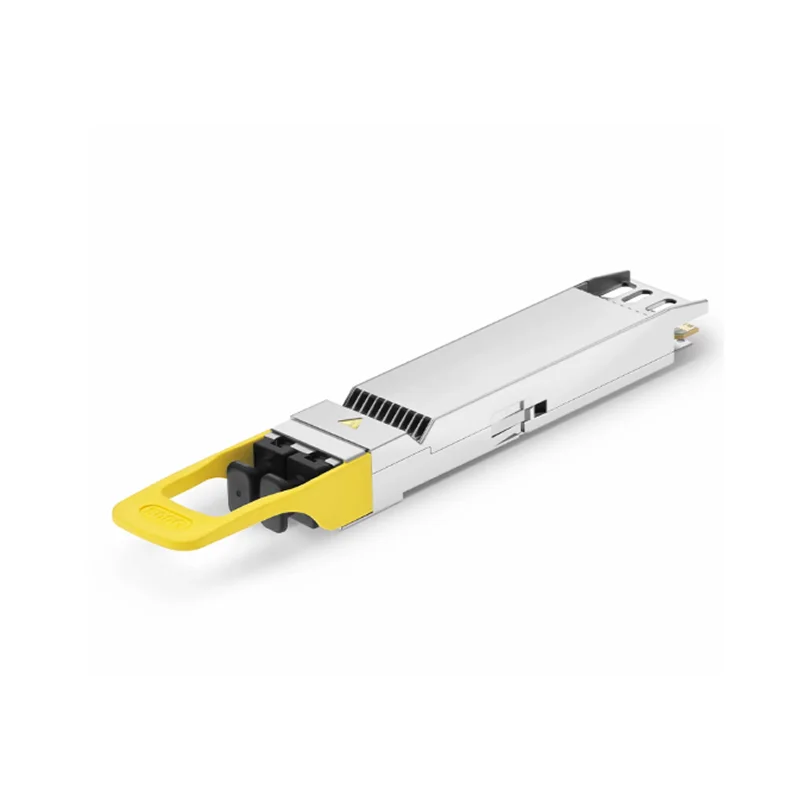
Where module selection fits into the bigger picture
Choosing a transceiver is never only about wavelength. It also depends on protocol, form factor, power budget, vendor interoperability, and fiber plant condition. For broader deployment planning, browsing a reliable Optical Transceiver Module category can help narrow the options by application rather than by guesswork.

How to Choose the Right Optical Transceiver Wavelength
Match the wavelength to the application
A simple rule of thumb works better than it should:
- Data centers: short-reach, high-density optics
- Campus networks: balanced reach and cost
- Metro networks: stronger single-mode options
- Long-haul: transport-grade wavelengths and tighter planning
That is not a perfect formula, but it is usually close enough to avoid the most common mistakes.
Avoid common buying mistakes
Some of the most frequent errors include:
- Choosing by speed only
- Ignoring fiber type
- Overlooking link budget
- Assuming all single-mode optics behave the same
- Forgetting about vendor compatibility
When to consult the datasheet
The product datasheet is still the most reliable source for real operating limits. It typically lists supported distance, transmit power, receive sensitivity, and operating wavelength range.
That detail is especially important when planning upgrades, because two modules that look similar can behave very differently once installed.
Real-World Tips for Deployment and Troubleshooting
Signs the wavelength choice may be wrong
A wavelength mismatch does not always fail dramatically. Sometimes the symptoms are subtle:
- Link flaps intermittently
- Errors increase under load
- Reach falls short of expectations
- The port comes up, but performance feels unstable
Simple troubleshooting steps
When a link behaves oddly, a short checklist often helps:
- Clean the connectors
- Confirm polarity
- Verify the exact transceiver model
- Check DOM readings if available
- Match the fiber type to the module
- Compare the actual distance with the rated limit
Those basics solve more problems than many people expect.
Conclusion
Optical Transceiver Wavelengths are more than technical labels. They influence reach, loss, compatibility, and the real-world reliability of an optical link. In most cases, 850nm fits short-reach multimode applications, 1310nm serves many standard single-mode deployments, and 1550nm becomes the better option when distance and optical margin matter most.
The safest approach is to match wavelength to fiber type, distance, and system architecture rather than treating all optics as interchangeable. That simple habit tends to prevent costly mistakes and makes network upgrades far more predictable.
If you want, the next step can be a flowchart or an explanatory diagram prompt for this article.
FAQ
Can different wavelengths share the same fiber pair?
Yes, if the system is designed for wavelength multiplexing. In practice, this is common in CWDM and DWDM environments, where multiple channels run over the same physical fiber without interfering, provided the optical plan is correct.
Why do some transceivers use multiple wavelengths for one port?
Because parallel optics and advanced modulation can distribute the signal across several lanes or channels. This is especially useful at higher data rates, where using one simple optical path is no longer the most efficient design.
Are longer wavelengths always better for long-distance links?
Not always. While 1550nm is often preferred for longer reach, the best choice still depends on the full optical budget, fiber quality, dispersion limits, and the exact network application.