
An Optical Transceiver is one of those network components that tends to stay out of sight until something slows down, drops, or refuses to connect. Then suddenly it matters a lot. In modern communication systems, these small modules do a surprisingly heavy job: they move data quickly, reliably, and over distances that copper just cannot handle as well. That’s why they show up everywhere from enterprise switches to carrier gear and larger-scale optical transport systems.
At a glance, the idea sounds simple. Electrical data goes in, light comes out, the light travels through fiber, and then the process reverses on the other end. But the real value is in how neatly the module performs that conversion while staying compact, fast, and relatively efficient. In practice, the device is doing a lot of timing and signal handling behind the scenes, which is easy to overlook until network traffic starts to climb.
What Is an Optical Transceiver?
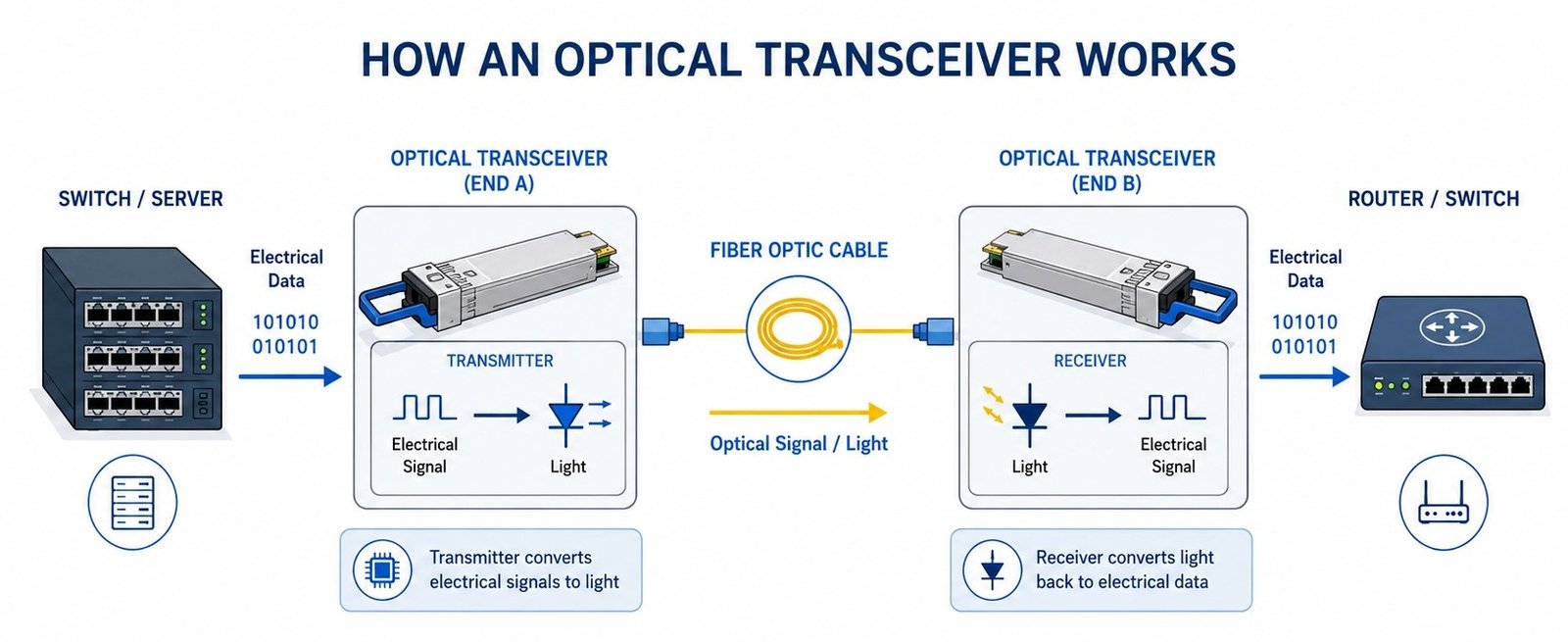
An optical transceiver is a combined transmitter and receiver in a single package. It takes electrical signals from a switch, router, server, or other device and turns them into optical signals for transmission over fiber optic cable. On the receiving side, it does the opposite: it converts incoming light back into electrical data the equipment can understand.
That’s the short version, anyway. The reason this matters is that optical fiber is excellent for carrying data quickly with low loss and low interference. So instead of sending long electrical signals over a cable that may pick up noise, an optical transceiver shifts the task to light, which is much better suited for high-speed links.
A few characteristics make these modules so widely used:
- They support high data rates
- They can handle different distances
- They come in multiple form factors
- They fit into network gear without taking up much room
.webp)
How an Optical Transceiver Works Step by Step
The working principle is straightforward once broken into stages.
Electrical data enters the modulee
The host device sends an electrical signal into the transceiver. This signal represents the digital information that needs to move across the network. At this point, it is still just an electronic pulse, not light.
The transmitter converts it to light
Inside the module, the transmitter side uses a laser diode or similar light source to create optical pulses. These pulses are modulated to represent the data. In other words, the module is encoding bits into light patterns.
Light travels through fiber
The optical signal then moves through fiber optic cable. Depending on the distance and design, that may be multimode fiber for shorter runs or single-mode fiber for longer spans. The signal stays in light form while traveling, which helps preserve speed and reduce interference.
The receiver converts light back to electrical data
At the far end, a photodetector receives the light and turns it back into electrical signals. Those signals are sent to the host device, which reads the data and continues processing it.
It sounds almost too clean, but that conversion process is precisely what makes these modules so useful. A well-designed transceiver keeps the signal stable enough for the network equipment to interpret correctly, even when data rates are high and distances are not especially forgiving.
Main Components Inside an Optical Transceiver
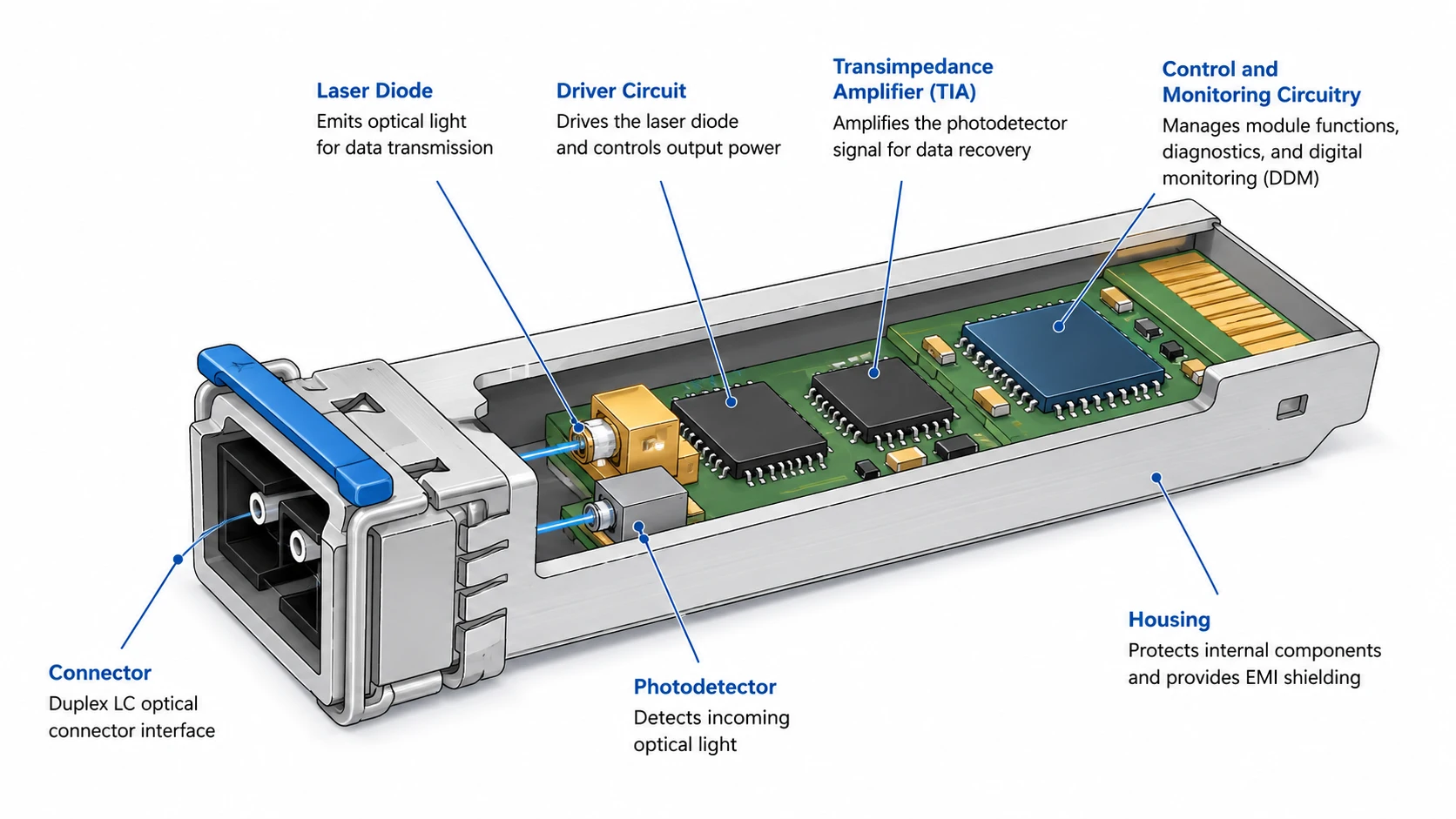
A typical module is more compact than most people imagine, but several important parts work together inside it.
This internal mix is why optical modules are not just “light plugs.” They are active devices with signal conditioning, monitoring, and precision alignment all packed into a small enclosure. Even a minor mismatch in one area can affect performance more than expected.
| Component | Function | Why it matters |
|---|---|---|
| Laser diode / light source | Converts electrical input into optical output | Determines wavelength and transmission quality |
| Photodetector | Converts incoming light back into electrical signals | Essential for reliable reception |
| Driver circuit | Prepares and regulates the transmit signal | Helps maintain consistent output |
| Transimpedance amplifier (TIA) | Amplifies weak received signals | Improves sensitivity on the receive side |
| Control and monitoring circuitry | Tracks status, power, temperature, and diagnostics | Helps with management and troubleshooting |
| Connector and housing | Interfaces with the host system and fiber | Ensures physical compatibility and protection |
Different Types of Optical Transceivers
Different networks need different module types, so the market has developed a fairly wide range of options. The form factor often depends on speed, port density, and the equipment it needs to fit into.
Common examples include:
- SFP
- SFP+
- QSFP+
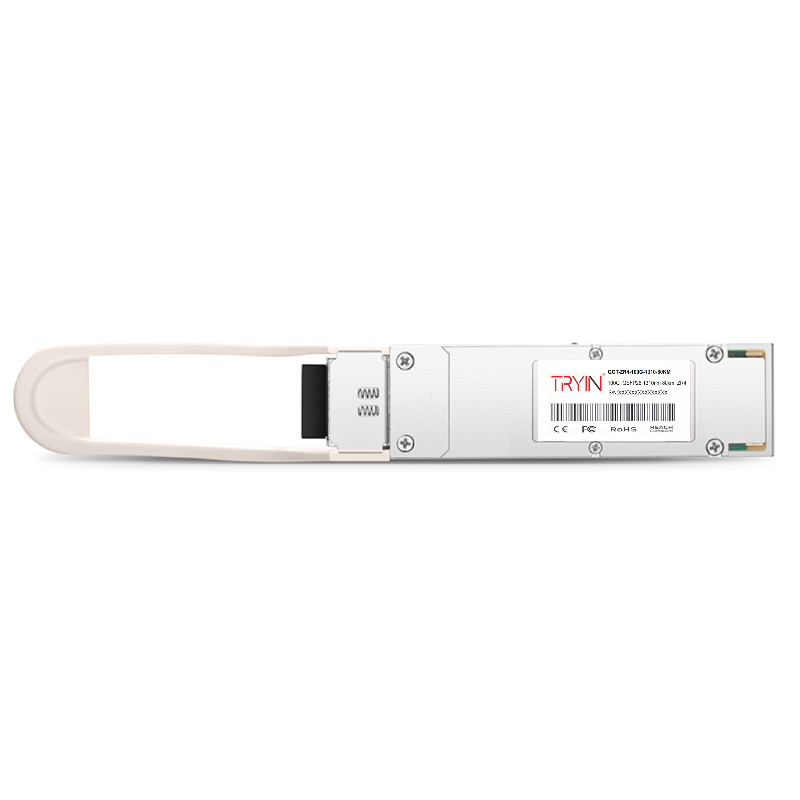
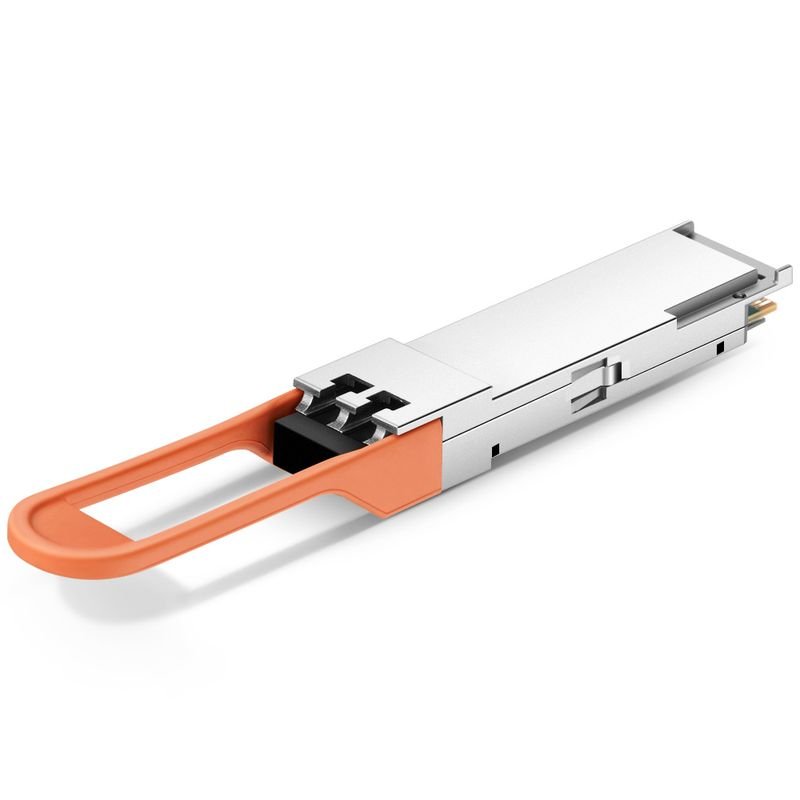
- QSFP28
- CFP and related high-capacity formats
For instance, a 10G Optical Module is a familiar choice in many 10G deployments where bandwidth is important but a full migration to higher-speed platforms is not yet necessary. In many environments, this kind of module provides a practical balance between capability and cost.
Short-reach vs. long-reach modules
Not every module is built for the same distance. Short-reach transceivers are commonly used inside data centers or across nearby buildings, while long-reach versions are suited to more distributed infrastructure.
A few things usually change between them:
- Wavelength
- Fiber type
- Optical power budget
- Receiver sensitivity
That is one reason compatibility matters so much. Two modules may look almost identical from the outside, yet be intended for very different link lengths.
Where Optical Transceivers Are Used
These modules are everywhere once the network gets serious about speed.
- Data centers
- Telecom backbones
- Enterprise networks
- Campus interconnects
- Industrial connectivity
- Transportation and monitoring networks
In many deployments, they serve as the quiet link between switches, routers, and fiber infrastructure. That includes large optical transceivers product categories that span multiple form factors and transmission standards.
Why they’re so common in high-speed networks
There are a few practical reasons they keep showing up:
- They support high bandwidth without bulky cabling
- They help keep latency low
- They are relatively energy efficient
- They scale well as networks expand
- They fit neatly into compact hardware
That mix is difficult to beat. Copper still has its place, but once distance and throughput begin to rise, optical links tend to become the more elegant option.
What Affects Performance?
Performance depends on more than just the module itself. In real installations, the entire link matters.
The main factors include:
- Fiber quality and cleanliness
- Distance between endpoints
- Wavelength compatibility
- Connector condition
- Host device support
- Ambient temperature
- Whether the fiber type matches the module
Even a very capable transceiver can struggle if the cable plant is dirty, bent too tightly, or mismatched with the optical specification. That tends to be one of those issues that looks mysterious at first, then turns out to be something simple like a contaminated connector or incorrect fiber pairing.
Common signs of trouble
- Weak or unstable links
- Increased errors
- Link not coming up at all
- Performance dropping over longer distances
- Incompatible module-to-device pairing
These problems are often symptoms rather than root causes. A network may appear to blame the module, when the actual issue is somewhere in the fiber path or in configuration support at the host level.
How to Choose the Right Optical Transceiver
Selecting the right module is partly about speed, partly about distance, and partly about compatibility. It is easy to focus only on the data rate, but that leaves out a few details that matter just as much.
A practical checklist
- Match the speed to the network requirement
- Confirm the form factor fits the equipment
- Check the wavelength and distance rating
- Make sure the fiber type matches
- Verify vendor or switch compatibility
- Consider future expansion needs
For anyone comparing options, it helps to review product families like optical-transceivers in the context of the full network design rather than treating them as interchangeable parts. Small differences in reach or standard support can make a big difference later.
One thing that often gets overlooked
Compatibility is not only about physical fit. Two modules can slide into the same port and still fail to work properly if the host device expects a different coding, wavelength, or link mode. That is especially relevant in mixed-vendor environments, where not every system behaves exactly the same way.
Why the Technology Still Matters
It would be easy to think of optical transceivers as routine hardware, but they remain central to modern connectivity in ways that are easy to underestimate. As cloud traffic grows, AI workloads expand, and data centers become denser, the pressure on network infrastructure keeps increasing almost continuously. More applications are moving to distributed environments, more devices are communicating at once, and more data needs to travel farther without delay. In that context, fast optical links are no longer just a technical preference — they are becoming a basic requirement for keeping systems responsive and scalable.
What makes this especially important is that modern networks are not only handling more traffic, but also more demanding traffic. Large file transfers, virtualization, machine learning pipelines, streaming services, and real-time analytics all place heavier expectations on bandwidth and latency. Optical transceivers help meet those expectations by supporting stable, high-speed communication over fiber with far less interference than traditional copper-based alternatives. They also give network designers more flexibility when planning upgrades, since capacity can often be improved without rebuilding the entire architecture from scratch.
In practice, this is why optical transceivers continue to matter so much: they quietly support the performance, efficiency, and growth that modern digital systems now depend on.
The appeal is pretty clear:
- They carry more data over longer distances
- They help keep networks compact
- They support upgrades without redesigning everything
- They work across many network layers
The broader ecosystem around them also continues to expand. From enterprise deployment to carrier-grade builds, optical modules remain tightly connected to optical transport systems that need dependable, high-speed signal movement.
In a way, the technology is a good example of engineering that does not try to be flashy. It simply gets a difficult job done repeatedly, which is usually the mark of something genuinely useful.
Conclusion
An optical transceiver may be small, but its role in a network is anything but minor. By converting electrical signals into light and then back again, it makes fast, reliable fiber communication possible across short and long distances. That simple conversion process supports everything from enterprise networks to large-scale carrier infrastructure, and it is easy to see why these modules remain so widely used.
What stands out most is how much depends on getting the details right. Speed, wavelength, distance, fiber type, and compatibility all matter more than they may first appear. In practice, the right module is not just the one that fits the port — it is the one that fits the network design as a whole. For that reason, understanding how an Optical Transceiver works is useful not only for technicians, but also for anyone making decisions about modern connectivity.
If you want to learn more about Optical Transceiver,you can read What Is an Optical Transceiver? A Beginner’s Guide
FAQ
Can an optical transceiver be used in equipment from a different brand?
Sometimes yes, sometimes no. Cross-compatibility depends on coding, firmware behavior, and the way the host device validates the module. Some systems are flexible, while others are more restrictive.
What makes one module better for diagnostics than another?
Modules with stronger monitoring support usually provide more visibility into temperature, voltage, and optical levels. That can make fault-finding much easier in larger networks.
Do all optical modules handle the same kind of fiber?
No. Some are designed for multimode fiber, others for single-mode fiber, and the physical and optical requirements are not interchangeable. Matching the module to the cable is a basic but very important step.