
In modern networks, traffic does not simply “move through the internet” in a vague way. Behind cloud services, 5G connections, video platforms, enterprise data backup, and financial transactions, there is usually a high-capacity fiber transport layer carrying huge amounts of information from one point to another.
That is where optical transport systems come in.
In simple terms, optical transport systems are used to carry large volumes of data over fiber optic networks in a reliable, scalable, and manageable way. They are commonly found in telecom networks, data center interconnects, metro networks, enterprise private lines, and multi-service transmission environments.
For many organizations, the question is not only “What are optical transport systems?” but also “When are they actually needed?” The answer depends on bandwidth, distance, service type, network growth, and how much reliability the network must provide.
What Are Optical Transport Systems?
An optical transport system is a network platform designed to transmit data over optical fiber. It may include technologies such as DWDM, OTN, transponders, muxponders, amplifiers, optical protection, and network management functions.
In daily network planning, it usually sits between the raw fiber infrastructure and upper-layer services such as IP, Ethernet, storage traffic, or private line services.
A typical optical transport system can help carry:
- Ethernet services
- IP network traffic
- Storage and backup data
- Video transmission
- Enterprise private line services
- Mobile backhaul traffic
- Legacy services such as SDH/SONET in some networks
The main value is not just “sending data.” Routers and switches can also send data. The real value is sending very large amounts of data over long distances with better fiber utilization, better stability, and clearer network management.
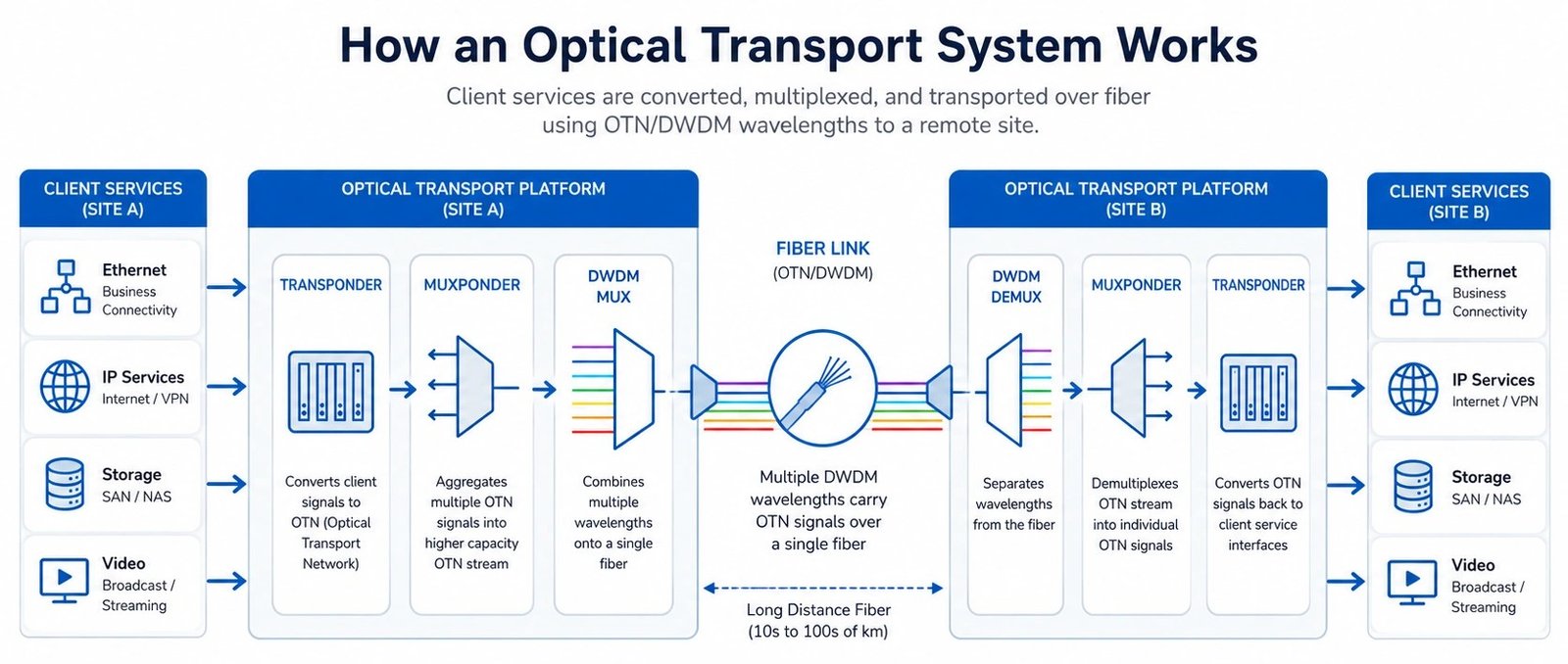
Main Uses of Optical Transport Systems
1. Data Center Interconnect
Data center interconnect, often called DCI, is one of the most important use cases for optical transport systems today.
A DCI platform is used to connect two or more data centers through high-speed optical links. This is especially important for cloud service providers, enterprises, content platforms, financial institutions, and organizations that need reliable data synchronization between locations.
Common DCI applications include:
- Cloud backup between data centers
- Disaster recovery and business continuity
- Storage replication
- Virtual machine migration
- High-speed data exchange between cloud regions
- Low-latency access between active-active data centers
For example, a company may operate one primary data center and one backup data center in another city. If the primary site has a failure, the backup site must take over quickly. Optical transport systems help make this possible by supporting high-bandwidth, low-latency, and stable connections between the two sites.
In this kind of environment, bandwidth demand can grow very quickly. A link that starts with 100G may need to expand to 400G or more later. Optical transport equipment gives network teams a more structured way to scale capacity without rebuilding the whole fiber network.
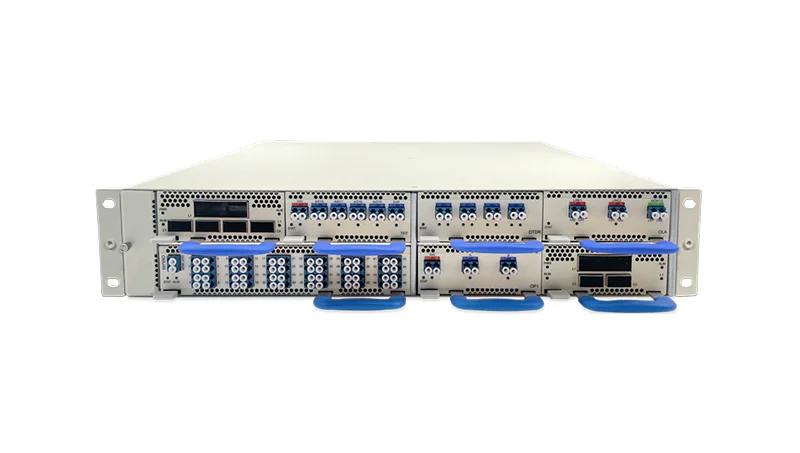
2. Telecom Backbone and Metro Networks
Telecom operators and internet service providers use optical transport systems to build backbone and metro networks. These networks carry traffic from mobile users, broadband customers, enterprise customers, cloud platforms, and content services.
In backbone networks, the main challenge is distance and capacity. Traffic may need to travel across cities, regions, or even countries. Optical transport systems help carriers transmit this traffic over long-distance fiber links with high reliability.
In metro networks, the challenge is slightly different. A metro network may connect many sites within a city, such as data centers, business districts, mobile aggregation sites, and broadband access points. Here, traffic aggregation becomes very important.
Optical transport systems help operators:
- Increase bandwidth on existing fiber
- Combine multiple services into higher-speed wavelengths
- Monitor fiber and service performance
- Add protection paths for network resilience
- Reduce cost per transported bit
This is why optical transport is often seen as the foundation layer of a carrier network. It may not be visible to end users, but it carries the services that end users depend on every day.
3. 5G and Mobile Network Transport
5G networks require much more transport capacity than older mobile networks. More antennas, more users, more video traffic, and more low-latency applications all increase pressure on the fiber network behind the radio sites.
Optical transport systems can be used in different parts of mobile networks, including:
- Fronthaul
- Midhaul
- Backhaul
- Aggregation network
- Core network connection
In 5G transport, latency and timing are especially important. A mobile network cannot only have “enough bandwidth.” It also needs predictable performance, stable synchronization, and reliable transmission.
This is one reason why optical transport systems are often used by mobile operators when upgrading from 4G to 5G. They provide a scalable fiber layer that can support today’s traffic and leave room for future growth.
4. Enterprise Private Networks
Not every enterprise needs an optical transport system. A small office using regular internet access usually does not.
However, large enterprises often have more complex requirements. They may need private fiber connections between headquarters, branch campuses, production facilities, data centers, or disaster recovery sites.
Industries that commonly use optical transport solutions include:
- Finance
- Government
- Healthcare
- Education
- Manufacturing
- Energy
- Transportation
- Large technology companies
For these users, reliability and security are often just as important as bandwidth. A bank, for instance, may need stable private connections between trading systems and backup data centers. A hospital group may need to transfer large medical imaging files between sites. A university may connect several campuses and research centers with high-capacity fiber.
In these cases, optical transport systems provide a dedicated and manageable network layer instead of relying only on shared public network services.
5. Multi-Service Traffic Aggregation
Many networks do not carry just one type of traffic. They may need to transport Ethernet, storage, video, private line, and legacy services at the same time.
This is where a multi-service transport platform becomes useful.
A multi-service optical transport platform can aggregate different service types and map them into higher-speed optical channels. This is especially helpful for operators or enterprises that still need to support mixed service environments.
For example, one site may have several 1G Ethernet services, some 10G services, and a few legacy circuits. Instead of leasing or deploying separate fiber links for every service, a multi-service transport system can groom and carry these services more efficiently.
This kind of platform is often practical in metro access, enterprise private line, industrial networks, and carrier aggregation networks.

| Use Case | Typical Users | Main Requirement | Common Network Need |
|---|---|---|---|
| Data Center Interconnect | Cloud providers, enterprises, content platforms | High bandwidth and low latency | 100G/400G/800G optical links |
| Metro Transport | ISPs, carriers, city networks | Traffic aggregation | DWDM, OTN, protection |
| Long-Haul Backbone | Telecom operators | Distance and capacity | Coherent optics, amplification |
| 5G Transport | Mobile operators | Low latency and timing | Fronthaul, midhaul, backhaul |
| Enterprise Private Network | Finance, government, healthcare, campuses | Security and reliability | Private wavelength or private line |
| Multi-Service Transport | Carriers, enterprises, industrial networks | Mixed service grooming | OTN/muxponder platform |
Where Does a Zero-Touch DCI Platform Fit?
A Zero-touch DCI platform is designed for data center interconnect environments where fast deployment and simpler operation are important.
Traditional optical networks can require experienced engineers to configure wavelengths, services, protection, and performance parameters. In large carrier networks, this may be normal. But in some DCI scenarios, IT teams prefer something easier to deploy and maintain.
A zero-touch or simplified DCI platform can help with:
- Faster service provisioning
- Reduced manual configuration
- Easier deployment between data centers
- Lower operation and maintenance workload
- More consistent service setup
This is especially useful when a company needs high-capacity optical connectivity but does not want the network team to spend too much time on complex optical-layer configuration.
It does not mean optical networking becomes “effortless.” Fiber planning, distance, optical power, redundancy, and service design still matter. But automation and simplified management can make the system more practical for cloud and enterprise environments.

Conclusion
Optical transport systems are used whenever networks need to carry large amounts of data over fiber with reliability, scalability, and efficient management.
They are widely used in data center interconnect, telecom backbone networks, metro transport, 5G mobile networks, enterprise private networks, and multi-service aggregation. In some projects, the goal is simply to increase bandwidth. In others, it is about low latency, service reliability, private connectivity, or easier long-term expansion.
As cloud computing, AI workloads, video traffic, and 5G continue to grow, optical transport systems will remain an important foundation of modern digital infrastructure. They may not be the most visible part of the network, but they are often the layer that keeps everything moving.