
The modern digital landscape is under relentless pressure. Between cloud computing, the rollout of advanced 5G architectures, and massive data center replications, traditional fiber infrastructures are being pushed to their absolute physical limits. Years ago, the only way to handle a massive surge in data traffic was to bury more fiber-optic cables in the ground—a costly, disruptive, and logistically painful process. According to global telecommunications data tracking from ITU, worldwide internet traffic has scaled exponentially, making traditional cable-laying strategies entirely unsustainable.
Enter DWDM (Dense Wavelength Division Multiplexing). This backbone technology serves as the silent engine behind modern high-speed information networks. Instead of treating a strand of fiber as a single-lane road, it transforms that same strand into a massive, multi-lane highway by splitting light into distinct wavelengths. This allows terabytes of data to move across oceans and continents seamlessly, without requiring a single shovel to hit the dirt.
What is DWDM and Why Does Modern Networking Rely on It?
At its core, DWDM is an optical multiplexing technology used to increase bandwidth over existing fiber networks. It works by combining and transmitting multiple signals simultaneously at different wavelengths on the very same fiber. In the world of optical networking, these distinct wavelengths are often referred to as “lambdas,” acting as independent, isolated transmission pathways.
Standard fiber systems typically utilize a single wavelength to carry a single data stream. What makes dense wavelength division multiplexing unique is the “density” part of its name. By narrowing the spacing between wavelengths, a single physical fiber pair can simultaneously carry dozens, or even over a hundred, distinct optical channels. To ensure these networks remain operational and protected from physical degradation, operators often pair these configurations with sophisticated optical fiber sensing and optical monitoring systems to detect fiber strain or tampering in real time.
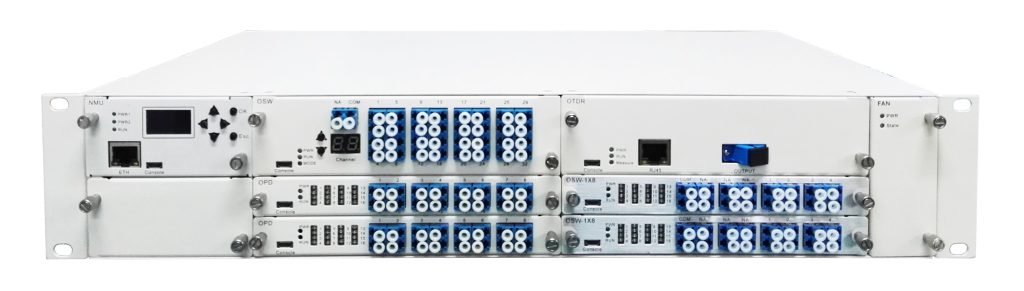
Inside the DWDM Ecosystem: 4 Critical Components Working Together
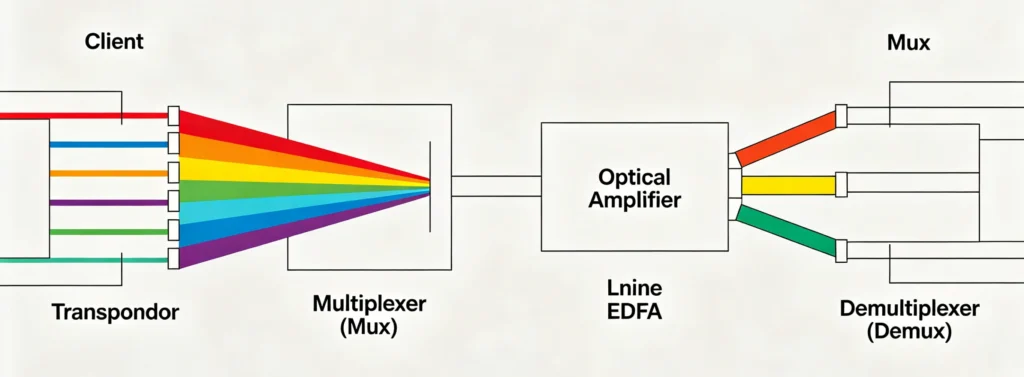
Understanding how this technology operates requires looking past the fiber cable itself and focusing on the ecosystem that manipulates the light. The transmission process isn’t a single mechanical event; it is a carefully orchestrated sequence involving four core components.
1. Transponders
The journey begins at the edge of the network. Standard client-side equipment—such as enterprise routers, switches, or legacy SDH systems—outputs optical signals designed for short distances. These are usually wide, non-specific wavelengths. The transponder accepts these client signals and converts them into highly precise, specific wavelengths that conform to the strict ITU grid required for dense multiplexing.
2. Multiplexers (Mux)
Once the transponders have generated these specific, tightly packed wavelengths, they arrive at the Multiplexer. The Mux acts as a funnel. It takes these multiple independent channels of light and merges them into a single aggregate beam, launching them simultaneously onto a single fiber strand.
3. Optical Amplifiers (EDFA)
As light travels over long distances—sometimes hundreds or thousands of kilometers—it naturally loses strength due to fiber attenuation. In older topologies, the signal had to be converted back into an electrical signal, cleaned up, and converted back into light.
Modern optical transport systems bypass this limitation entirely by utilizing Erbium-Doped Fiber Amplifiers (EDFAs). These devices boost the entire multi-wavelength optical signal directly in the optical domain, ignoring the data formats and eliminating the latency caused by electronic processing.
4. Demultiplexers (Demux)
When the combined beam arrives at its destination, the process must be reversed. The Demultiplexer receives the aggregate stream and splits the combined wavelengths back out into their individual, isolated paths. From there, another set of optical transceivers or transponders converts those lambdas back into client-compatible signals for local routing.
Comparing DWDM with Alternative Transmission Technologies
To truly appreciate its place in infrastructure design, it helps to compare it against alternative approaches like CWDM (Coarse Wavelength Division Multiplexing) and standard, non-multiplexed fiber.
| Feature | Standard Fiber | CWDM | DWDM |
|---|---|---|---|
| Wavelength Spacing | N/A | Wide (typically 20 nm) | Tightly Packed (≤ 0.8 nm) |
| Channel Capacity | 1 Channel | Typically 8 to 18 Channels | Up to 80+ Channels per fiber pair |
| Transmission Distance | Short to Medium | Short to Medium (≤ 80 km) | Long-Haul to Ultra-Long-Haul (≥ 1000 km) |
| Amplification Support | Limited | Hard to amplify effectively | Native (via inline EDFAs) |
| CapEx / OpEx Profile | Low initial / High expansion cost | Cost-effective for simple regional loops | Higher initial setup / Exceptionally low scaling cost |
The Strategic Advantages Driving Industry Adoption
The technical mechanics are impressive, but the business case is what drives actual deployment. Decision-makers choose this technology for three primary reasons:
Massive Scalability: When bandwidth demands spike, a network operator doesn’t need to dig up roads. They simply provision a new lambda on their existing equipment.
Protocol Transparency: Because the system operates entirely at the physical layer of light, it does not care what data format is running inside a wavelength. It can carry 5G traffic, video streams, enterprise Ethernet, and legacy telecom protocols simultaneously without interference.
Optimized CapEx and OpEx: Leveraging existing fiber infrastructure maximizes the return on previous capital investments while minimizing the operational overhead of managing physical assets.
Targeted Product Applications in Today's Market
The commercial deployment of this technology typically aligns with three high-density networking environments, each demanding distinct performance characteristics from modern optical transport systems:
Automated Data Center Interconnect (DCI): Hyper-scale cloud providers and large enterprises rely on specialized, low-latency platforms to sync massive datasets between facilities. Modern network architectures favor a “zero-touch” approach, leveraging intelligent software to automate optical power balancing and channel provisioning without manual intervention.
Metro and Regional Cloud Networks: Within metropolitan areas, multi-wavelength optical DCI solutions form the backbone of distributed cloud architectures. These setups provide the high-capacity, long-distance pipelines required to connect edge data centers with central corporate offices, ensuring seamless data availability.
Multi-Service Telecom Infrastructure: For telecommunication carriers, managing a unified backbone means handling mixed traffic types simultaneously. A single physical infrastructure must handle 5G mobile backhaul, high-security government private lines, standard enterprise Ethernet, and legacy telecom traffic, routing each service within its own dedicated optical channel.
Conclusion
Ultimately, DWDM represents much more than a clever way to squeeze extra speed out of glass cables. It serves as the foundational architecture for the next generation of global connectivity, enabling automated, high-resilience systems capable of scaling alongside human innovation. For deeper technical breakdowns on the evolving standards of these optical architectures, industry engineering whitepapers from organizations like the IEEE provide comprehensive global research on next-generation scaling.
FAQ
What is the primary difference between CWDM and DWDM in high-capacity networks?
The core distinction lies in channel spacing and capacity. CWDM uses wider spacing (typically 20 nm), which allows for cheaper, uncooled lasers but limits total capacity to around 18 channels over shorter distances. The dense alternative uses incredibly tight spacing (≤ 0.8 nm), packed into the low-loss C-band spectrum, enabling hundreds of channels to travel thousands of kilometers with optical amplification.
Can DWDM technology support quantum key distribution or sensitive optical monitoring?
Yes. Because each wavelength operates as an isolated physical pathway, operators can dedicate specific lambdas to highly sensitive applications, such as quantum cryptographic keys or advanced monitoring signals, without interfering with the primary commercial data streams running on adjacent wavelengths.
How does the integration of EDFA enhance a long-haul DWDM infrastructure?
An EDFA (Erbium-Doped Fiber Amplifier) amplifies all the optical channels within its operational band simultaneously without converting them into electrical signals. This eliminates the need for expensive, latency-inducing optical-electrical-optical (O-E-O) regeneration equipment along long-haul routes, drastically lowering both CapEx and ongoing operational maintenance costs.