
In DWDM networks, the term ROADM comes up often, and for good reason. ROADM, short for Reconfigurable Optical Add-Drop Multiplexer, has become a central building block in flexible optical transport. Rather than forcing technicians to physically reroute fiber every time traffic changes, a ROADM lets selected wavelengths be added, dropped, or passed through dynamically. That shift may sound small, but in practice it changes how large-scale optical networks are operated.
Understanding DWDM First
DWDM stands for Dense Wavelength Division Multiplexing. It is a transmission method that carries many optical channels over a single fiber by using different light wavelengths. Each wavelength acts like a separate lane on the same road, which is why DWDM is so useful in bandwidth-heavy environments.
This approach is widely used in:
- Long-haul carrier networks
- Metro backbone rings
- Data center interconnect links
- Large enterprise transport environments
The main advantage is simple enough: more capacity without laying more fiber. According to Cisco’s DWDM overview, wavelength-based transport remains one of the most efficient ways to scale optical infrastructure as demand keeps rising.
Why wavelength channels matter
Each wavelength in a DWDM system can carry traffic independently, which makes routing and service delivery more efficient. That structure also creates a need for intelligent control. Once dozens of wavelengths are traveling across the same fiber, manually handling each one becomes cumbersome. This is exactly where ROADM enters the picture.
What ROADM Means in DWDM
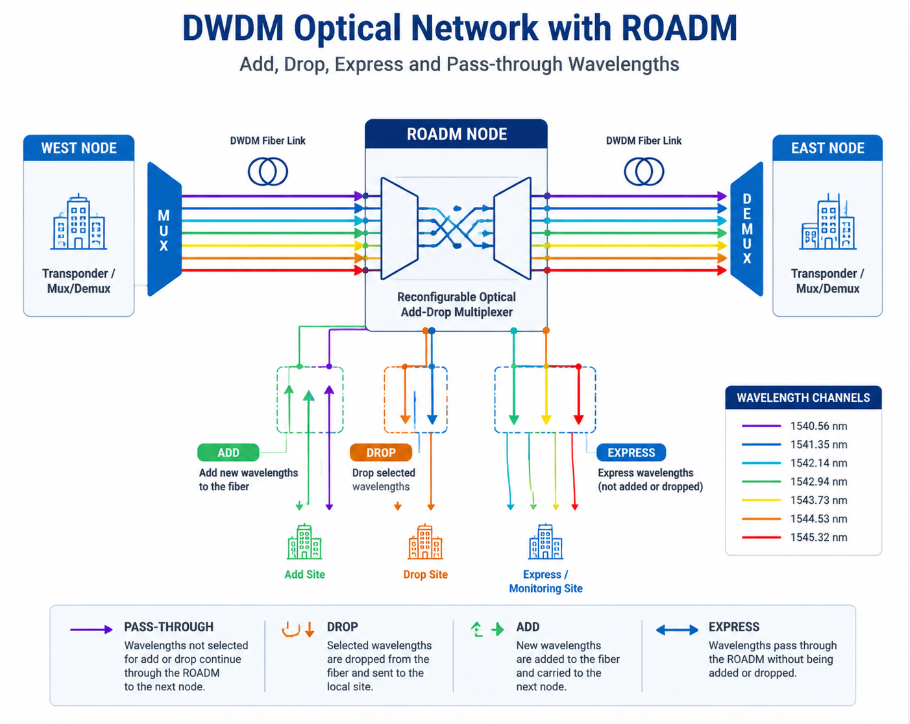
A ROADM is a network element that allows operators to remotely manage individual wavelengths without converting everything into electrical signals first. In plain terms, it gives the network the ability to decide which optical channels should continue forward, which should be dropped at a site, and which should be inserted into the fiber path.
A basic way to think about it:
- Add a wavelength into the network
- Drop a wavelength for local use
- Pass through wavelengths that are not needed at that node
That flexibility makes ROADM especially valuable in networks where traffic patterns change often. Instead of building a static optical path and living with it, the network can be adjusted as demand evolves.
ROADM vs. fixed add-drop
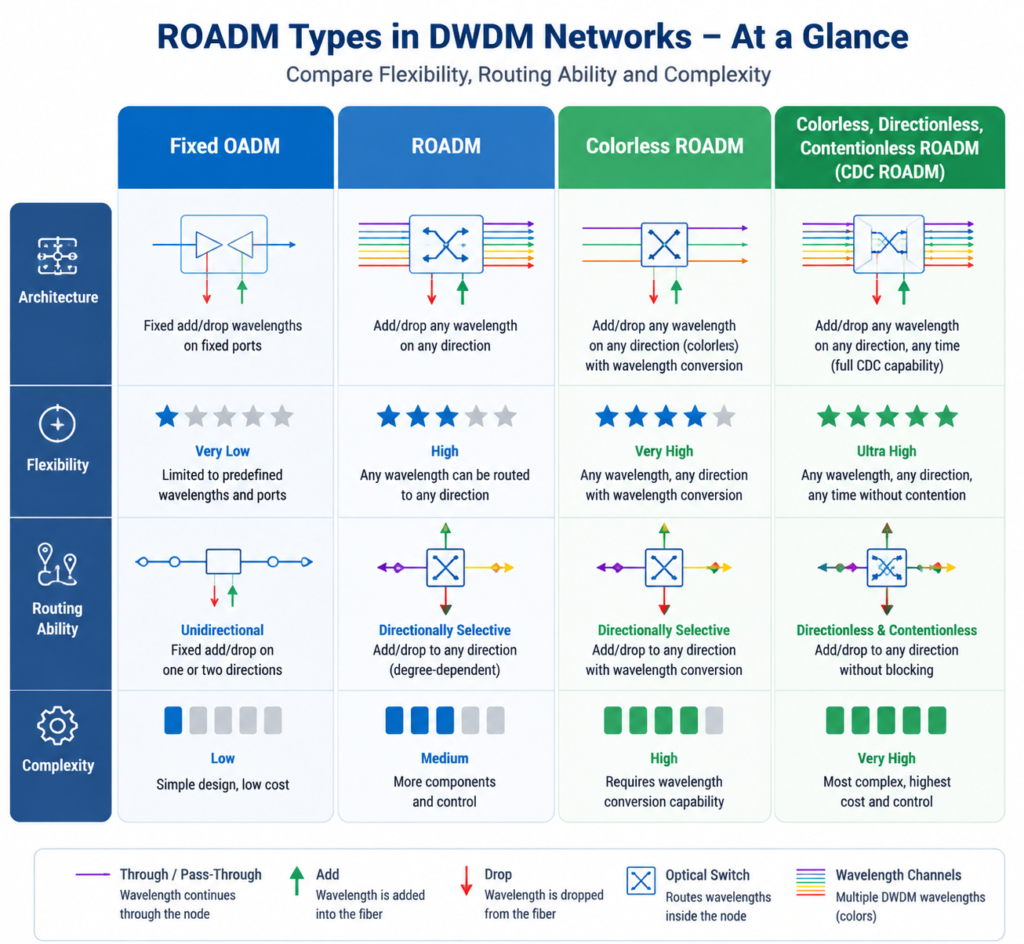
A fixed optical add-drop design can only handle preplanned channels at specific points. A ROADM, on the other hand, supports remote reconfiguration. That difference seems modest on paper, but it has a major operational impact. Service turn-up is faster, restoration is easier, and network expansion becomes less disruptive.
How a ROADM Works
At the heart of most ROADM systems are wavelength-selective components that can direct optical signals to the right port or fiber direction. The exact implementation varies by vendor and architecture, but the core idea remains the same: optical channels are switched at the wavelength level.
Common signal paths in a ROADM node
- Express path – the wavelength continues through the node to another destination
- Drop path – the wavelength is removed locally
- Add path—a new wavelength is inserted into the line
- Pass-through path – the wavelength remains on the main route without being terminated
This is what makes ROADMs so useful in meshed or ring-based transport designs. Instead of treating every node as a hard endpoint, the optical layer becomes more dynamic.
| Feature | Fixed OADM | ROADM |
|---|---|---|
| Remote reconfiguration | No | Yes |
| Wavelength-level routing | Limited | Yes |
| Operational flexibility | Low | High |
| Suitability for dynamic networks | Moderate | Strong |
| Manual intervention needed | More often | Less often |
Main Types of ROADMs
Not all ROADMs are built the same way. The architecture usually depends on how many directions the node connects to and how advanced the add/drop behavior needs to be.
Degree-based ROADM design
A “degree” refers to the number of directions a node can connect to in the optical mesh.
- 2-degree ROADM: common in simple line or ring topologies
- 4-degree ROADM: useful in metro and regional mesh networks
- 8-degree and higher: designed for more complex, highly connected optical transport environments
Higher-degree designs increase routing flexibility, though they can also add complexity and cost.
Advanced ROADM capabilities
Modern systems often include features such as:
- Colorless: any wavelength can be assigned to any port
- Directionless: traffic can be routed to any direction from the node
- Contentionless: multiple same-wavelength signals can be handled more flexibly
These features are especially useful in scalable networks where service demands are unpredictable. Nokia’s optical transport materials also highlight the growing need for flexible wavelength routing in modern carrier networks.
Why ROADM Matters in DWDM Networks
The short answer is agility. The more practical answer is that ROADM changes how optical networks are managed day to day.
Key benefits
- Faster provisioning of new services
- Less manual fiber patching
- Easier rerouting during failures or maintenance
- Better support for network growth
- Improved efficiency in large metro and backbone systems
That flexibility matters even more as traffic becomes less predictable. A network that can adapt without repeated physical intervention tends to be easier to scale and operate.
A closer look at operational value
In older or simpler optical designs, even a small service change might require planning a fiber move, validating a patch panel, and scheduling field work. In a ROADM-based DWDM network, many of those changes can be handled remotely, which saves time and lowers the chance of human error.
ROADM, Transceivers, and Optical Transport Systems
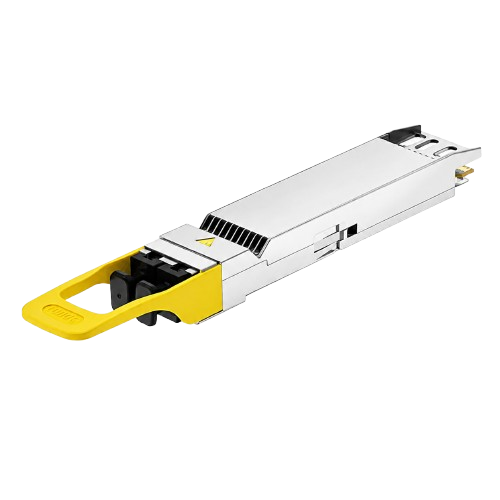
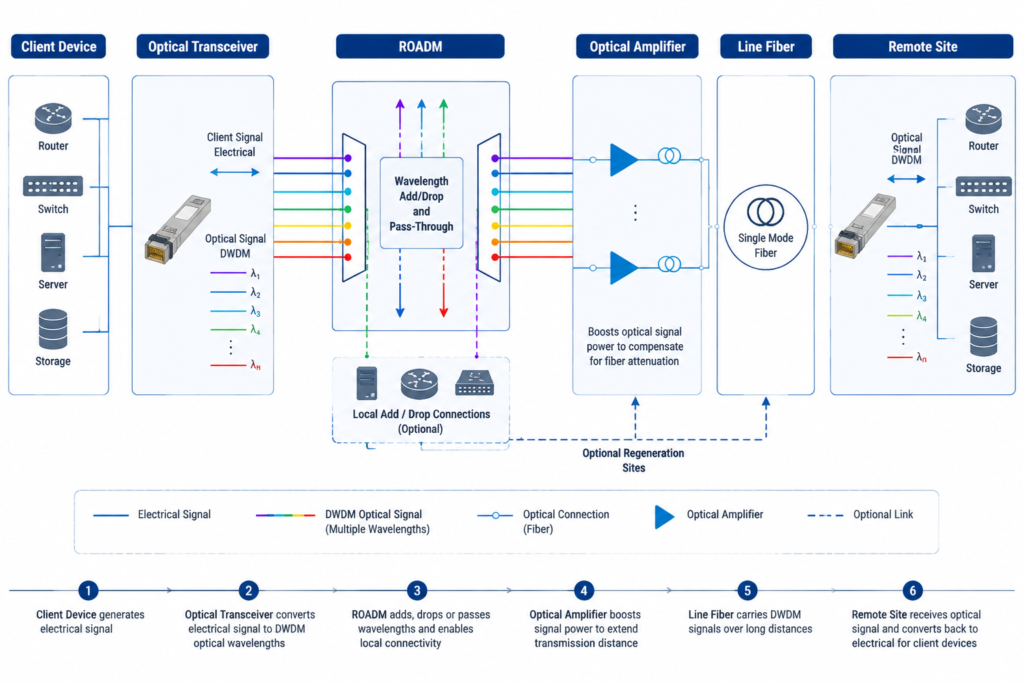
ROADMs do not work alone. They sit inside a broader optical ecosystem that includes line systems, mux/demux components, amplifiers, and transceivers. The transceiver is especially important because it turns client traffic into optical signals that can be launched into the DWDM network.
In practical deployments, the choice of optics must match the wavelength plan and reach requirements of the line system. That is why DWDM SFP+ transceivers are often discussed alongside ROADM architectures. They are one part of the larger design, but an essential one.
For network planners, it also helps to view ROADM as part of a broader family of optical transceiver modules and transmission gear that all need to interoperate cleanly.
Where these components fit
| Component | Role in the network |
|---|---|
| Transceiver | Converts client data into optical signals |
| ROADM | Routes wavelengths dynamically |
| Optical amplifier | Extends reach and compensates for loss |
| Line system | Carries and manages optical channels across fiber |
| Transport platform | Integrates and controls the full optical layer |
The wider platform perspective matters because a ROADM is rarely deployed as a standalone device. It is usually part of larger Optical Transport Systems designed for scale, resilience, and service flexibility.
Common Challenges and Design Considerations
ROADM systems offer clear advantages, but they also introduce design complexity. That is why planning still matters.
Important factors to consider
- Optical power budget: too much loss can degrade performance
- OSNR: signal quality must remain within acceptable limits
- Wavelength planning: not every channel arrangement works equally well
- Vendor compatibility: multi-vendor environments can be tricky
- Cost: advanced ROADMs can increase deployment expense
These concerns are often discussed by network engineers because the operational gain is real, but so is the need for careful engineering. A ROADM network that is poorly planned can end up more complicated than a simpler fixed design.
Signal quality trade-offs
Each additional optical component can introduce insertion loss or impairments. In dense systems, that becomes a serious consideration. So while ROADMs improve flexibility, the design still has to respect attenuation, amplifier placement, and channel performance.
Real-World Use Cases
ROADM is commonly deployed where network demand changes often or where service restoration needs to happen quickly.
Typical scenarios
- Carrier backbone expansion: adding capacity without redesigning the full fiber layout
- Data center interconnect: supporting shifting traffic between sites
- Metro ring protection: restoring traffic around a failed segment
- Regional mesh networks: enabling efficient wavelength-level routing across multiple sites
These use cases explain why ROADM has become such a standard part of contemporary DWDM architecture. It supports both growth and resilience, which is a useful combination.
Conclusion
ROADM is one of the most important building blocks in modern DWDM networks because it brings wavelength-level flexibility to optical transport. Instead of relying on static paths, operators can route, add, and drop wavelengths dynamically, which makes the network easier to expand and manage.
For dense metro networks, carrier backbones, and data center interconnect environments, that flexibility is often more than a convenience. It is a practical requirement. As optical networks continue to scale, ROADM will likely remain a core technology for making DWDM systems more agile, efficient, and service-ready.
FAQ
Is ROADM the same as DWDM?
No. DWDM is the transmission technology that carries many wavelengths over one fiber, while ROADM is a network element that routes those wavelengths dynamically within the DWDM system.
Can ROADMs work with any optical transceiver?
Not automatically. The transceiver must match the wavelength plan, distance, modulation format, and line system requirements of the network. Compatibility is a design issue, not just a hardware one.
When is a ROADM not needed?
A ROADM is usually unnecessary in small, static links where traffic rarely changes and simple point-to-point transport is enough. In those cases, a fixed design can be more cost-effective.