
AI is rewriting the traffic profile of the modern data center. Training large models produces massive bursts of east-west traffic between GPUs, and fabrics that comfortably carried ordinary application traffic are now the bottleneck. Many operators that standardized on 400G optics only a few years ago are already reviewing whether their interconnect can keep pace, which puts the choice between a 400G and an 800G optical transceiver at the center of capacity planning.
Upgrade to 800G when a new AI training or HPC cluster, port exhaustion at the spine, or a switch refresh forces the issue, and keep buying 400G optical transceivers for links that will remain at 400G. For most operators the right move is not a wholesale replacement but a phased migration: 800G at the spine first, with breakout configurations allowing existing 400G and 100G optics to keep working below it. If your fabric still has headroom, staying at 400G until the next refresh is the more economical choice.
The sections below explain what changes technically at 800G, which signals indicate it is time to upgrade, and how a mixed 400G/800G fabric can make the transition gradual instead of disruptive.
Why AI Workloads Are Pushing Networks Beyond 400G
AI training generates heavy east-west traffic between GPUs in synchronized bursts, and that pattern removes the oversubscription margin most 400G fabrics were designed around. When the interconnect cannot keep accelerators supplied with data, idle GPUs burn money, so bandwidth demand per rack is climbing faster than any routine refresh cycle.
Traditional data center traffic follows a north-south pattern, with users and applications moving data in and out of the facility. AI clusters invert this balance.
East-West Traffic and the End of Oversubscription
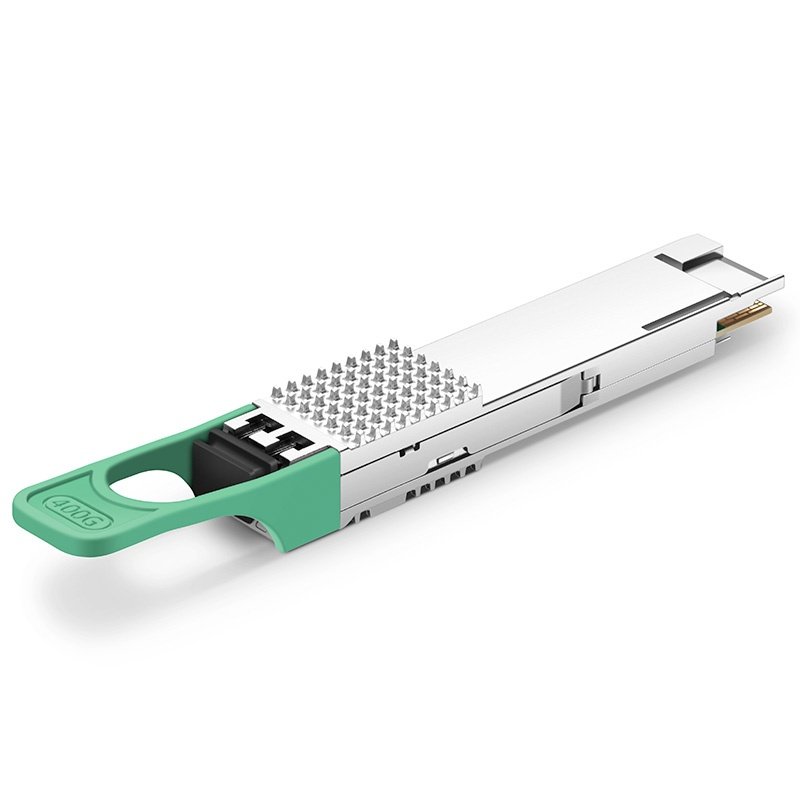
During model training, gradients and parameters must be synchronized across thousands of GPUs after each training step. This creates short, intense bursts of east-west traffic that can saturate links designed with a 3:1 or higher oversubscription ratio. AI fabrics typically drive oversubscription down toward 1:1, which multiplies both the number of high-speed ports and the volume of 400G Optical Transceiver Module inventory a single cluster consumes.
Where the Bandwidth Squeeze Hits First
The pressure appears first at the spine layer, where aggregated leaf traffic converges, and in data center interconnects that link training sites together. A fabric that has run out of spine ports cannot buy its way out by adding more leaf switches, which is why the highest-capacity links are usually upgraded first.
400G vs 800G Optical Transceivers: Key Technical Differences
An 800G transceiver is a hot-pluggable optical module that transmits 800 gigabits per second, most commonly across eight 100G electrical lanes using PAM4 modulation, packaged in an OSFP or QSFP-DD form factor. Compared with a 400G optical transceiver, it doubles the capacity per port, changes the lane structure, raises power draw, and shifts the form factor decision toward modules built for denser or hotter operation.
The two rates were standardized together, so both remain current technology.
| Attribute | 400G Optical Transceiver | 800G Optical Transceiver |
| Aggregate data rate | 400 Gb/s | 800 Gb/s |
| Typical lane structure | 4x100G (or 8x50G) | 8x100G |
| Modulation | PAM4 | PAM4 |
| Common form factors | QSFP-DD, OSFP, QSFP112 | QSFP-DD、OSFP |
| Typical module power | Roughly 9 to 14 W | Roughly 16 to 25 W |
| Ethernet standard | IEEE 802.3bs / 802.3cu | IEEE 802.3df |
Lane Structure and Modulation
A common 400G module uses four 100G electrical lanes, while 800G doubles this to eight 100G lanes. Both rely on PAM4 modulation, which encodes two bits per symbol. The eight-lane structure enables flexible breakout, but it also means more lanes to manage for signal integrity. Released in 2024, the IEEE 802.3df standard defines specifications for 800 Gb/s Ethernet, together with physical layer parameters for 400 Gb/s Ethernet. It validates that these two data rates are engineered to work alongside one another.
Form Factors: QSFP-DD vs OSFP
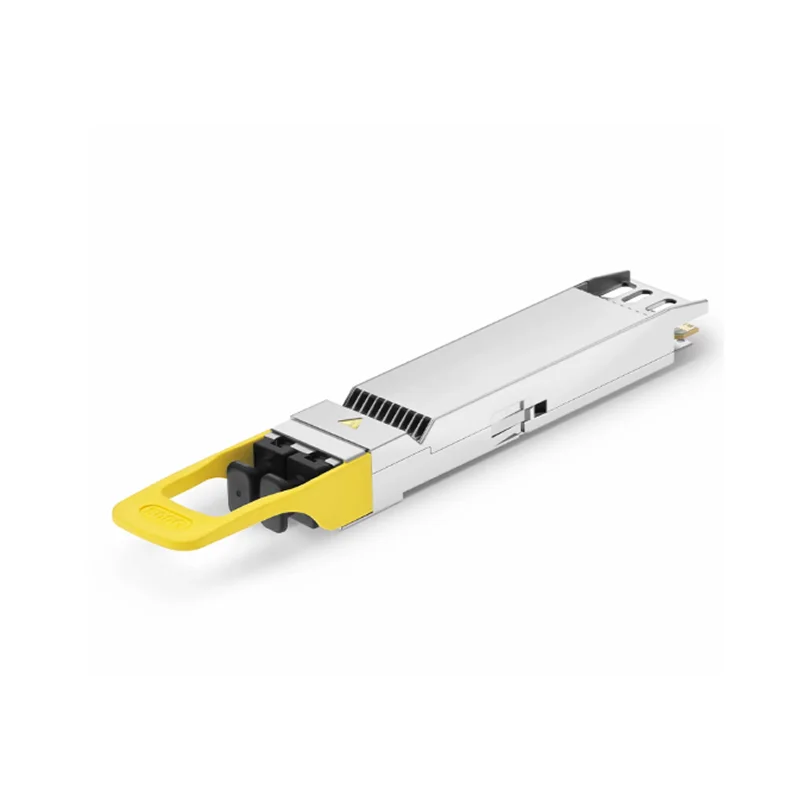
At 800G, the form factor choice becomes more consequential. OSFP800 is physically larger and offers more room for heat dissipation, while QSFP-DD800 is more compact and supports denser panel layouts, although cooling becomes more challenging. Modules of both types are built to Multi-Source Agreement specifications, which keeps modules from different suppliers interchangeable. When evaluating an 800G Optical Transceiver Module, the deciding factors are your switch platform and rack cooling capacity, not the form factor alone.
Power and Cooling Requirements
Although power per bit actually falls at 800G, power per module rises sharply. A rack that runs comfortably with a full complement of 400G optics may need airflow adjustments, higher-capacity power feeds, or liquid-assisted cooling before it can carry 800G modules at full density. Power and cooling audits should therefore precede any 800G procurement.
When Should You Upgrade to 800G?
The trigger is a defined workload, not the calendar. Plan the move to 800G when you are building a new AI or HPC cluster, when spine ports are running out, or when a switch generation refresh makes 800G uplinks available at little marginal cost. If none of these conditions applies, 400G remains a fully standardized, cost-effective choice.
Clear Signals It Is Time to Move
- A new AI training cluster is being designed, and the fabric can be built around 800G from day one
- Spine port utilization is approaching exhaustion and adding leaf switches is no longer economical
- A scheduled switch refresh offers 800G-capable platforms, making the incremental cost of higher-rate uplinks small
- Job completion times are being limited by interconnect bandwidth rather than GPU compute
When Staying at 400G Makes Sense
There is little value in buying capacity well before it is needed. Optics depreciate, lane rates continue to evolve, and unused modules generate no return. If your workloads are general enterprise applications with predominantly north-south traffic, or your 400G fabric still has headroom, deferring the upgrade frees budget for workloads that actually need the capacity.
Greenfield vs. Brownfield Upgrade Paths
A greenfield cluster is the simpler case because the fabric is designed around 800G from the start. Brownfield upgrades are more nuanced: spine and leaf switches rarely change at the same time, so both rates must run together during the transition. An operator already at 400G can move incrementally, while an operator still running a 100G fabric must decide whether to step to 400G first or introduce 800G at the spine and break it out to slower links below.
Running 400G and 800G Together: How Breakout Eases the Migration
Breakout lets a single 800G port operate as one 800G link, two 400G links, or eight 100G links, so an 800G spine can connect directly to existing lower-speed equipment. An upgrade therefore does not strand the optical transceiver inventory you already own, and it can actually increase short-term demand for 400G and 100G modules on breakout links.
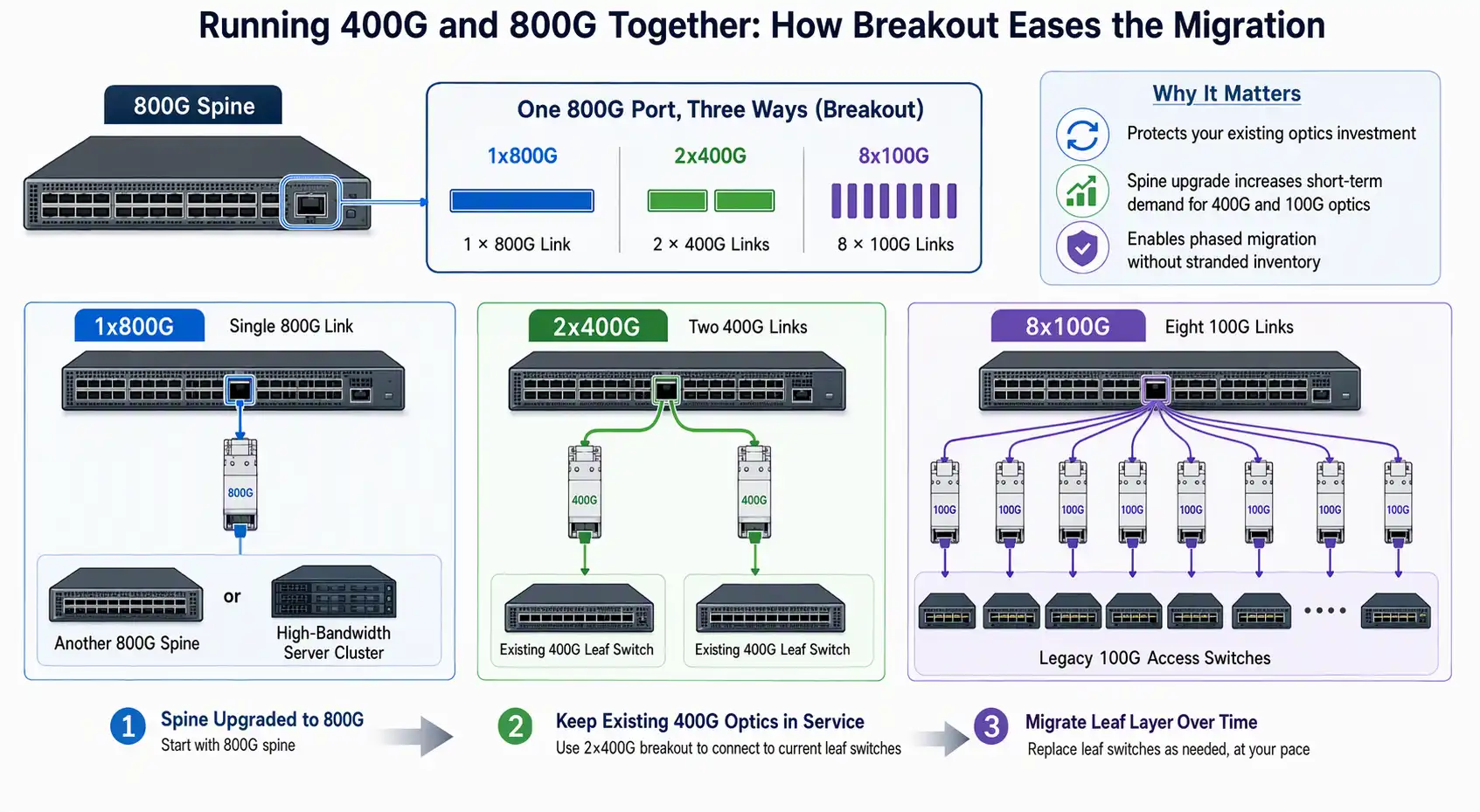
On supported platforms, one 800G port can be configured in three ways:
- 1x800G, a single 800G link for spine-to-spine or high-bandwidth server connections
- 2x400G, two separate 400G links that keep existing 400G optics in service
- 8x100G, eight separate 100G links for legacy access layers
This flexibility is the practical foundation of phased migration. The spine moves to 800G first, existing 400G optics continue to terminate breakout links, and replacement happens only as individual leaf switches are refreshed. Budget for the 400G modules alongside the 800G ones, because a spine upgrade typically raises, rather than eliminates, demand for lower rates.
Cost and Planning Realities of an 800G Rollout
Budget for the whole link, not just the module. An 800G rollout adds cabling, power, and cooling costs, and lead times for platform-coded or long-reach modules can delay a deployment more than unit pricing does. Total cost of ownership, not transceiver price alone, should drive the decision.
Three planning realities deserve attention. First, cabling and cooling changes often exceed the cost of the optics themselves, particularly when an 800G module requires different connector types or more parallel fibers. Second, lead times are easy to underestimate: modules needing specific coding for your switch platform, or uncommon reach requirements, can extend delivery well beyond standard catalog parts. Third, the next generation is already visible, with IEEE P802.3dj defining 200G-per-lane signaling and 1.6T Ethernet, which should shape your planning horizon without postponing capacity a workload needs today. If you are weighing the technology in more depth, a dedicated overview of 800G Transceivers covers the module types and their applications in detail.
Frequently Asked Questions
Which transceiver will support up to 40 Gbps links?
A QSFP+ optical transceiver supports 40 Gbps links, either as a 4x10G parallel lane structure or through breakout to four 10G SFP+ connections. QSFP+ SR4 and LR4 variants cover 40G over multimode and single-mode fiber respectively. In modern AI fabrics, 40G has largely been relegated to legacy access layers, as most networks have moved to 100G and above.
Should you skip 800G and wait for 1.6T?
Generally no, if a defined workload needs the capacity now. 1.6T Ethernet is still completing the standards process, and waiting means absorbing months of constrained cluster performance. If your workloads do not need the bandwidth, the better question is whether you need to upgrade at all, since 1.6T planning only matters once your fabric is already saturated at 800G.
Do 800G transceivers require different fiber cabling?
Often yes. Depending on the variant, an 800G module may use 16-fiber MPO connectors for parallel optics, or duplex single-mode fiber with coherent or higher-rate serial lanes. The connector and fiber type differ from many 400G deployments, so a cabling survey should be part of any 800G migration plan.
Meta Description: Compare 400G vs 800G optical transceiver options for AI data centers. Learn key technical differences, costs, and the right time to upgrade your network.