
Training large AI models has pushed cluster networking to its physical limits. As accelerator counts scale toward tens of thousands, the collective communication that dominates distributed training generates enormous east-west traffic, while the electrical packet switches forming the network spine consume an ever larger share of the data center power budget. Optical Circuit Switching has emerged as one of the most consequential architectural answers to this challenge.
Optical Circuit Switching (OCS) establishes direct, all-optical paths between endpoints without converting signals to electricity, delivering near-zero latency, zero jitter, roughly 40 percent lower network power, and full rate transparency. Its trade-offs are millisecond-scale reconfiguration, no packet inspection or buffering, and significant control-plane complexity. In production AI clusters, OCS complements electrical switching rather than replacing it: it typically replaces the spine layer, reconfigures pod topologies between jobs, and provides rapid fault isolation.
The sections below explain how the technology works, why AI clusters benefit from it, where its limitations lie, and how operators are deploying it today.
What Is Optical Circuit Switching (OCS)?
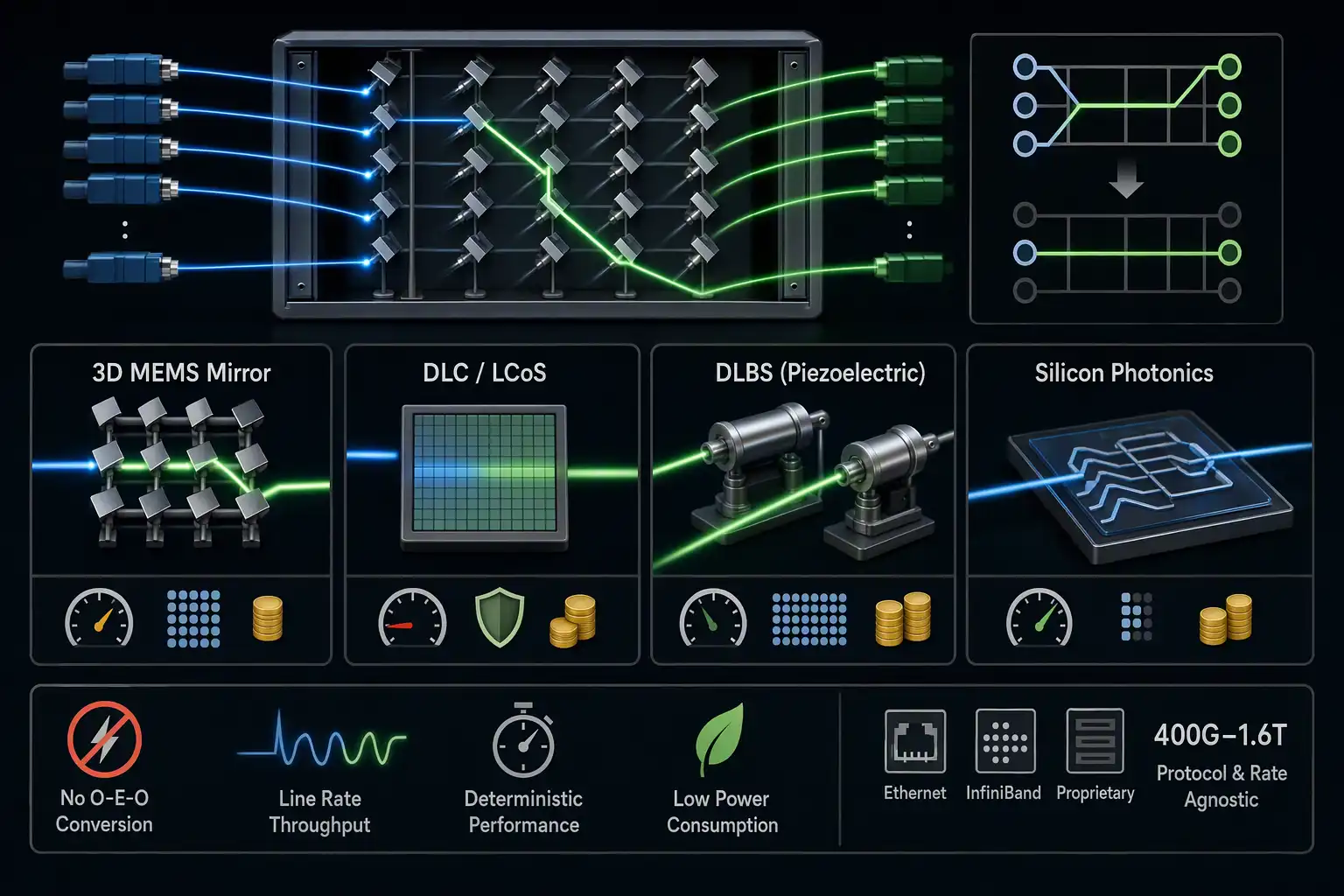
Optical Circuit Switching is a Layer 1 technology that redirects light between fiber ports without optical-electrical-optical (O-E-O) conversion, so signals cross the fabric at line rate with deterministic performance and minimal power draw.
Where a packet switch parses and buffers traffic in silicon, an OCS behaves like a dynamically reconfigurable fiber patch panel. It applies the classic principle of circuit switching to the optical domain: a path is provisioned first, then data flows through it with no per-packet processing.Four mainstream routes dominate commercial designs:
- 3D MEMS mirror arrays. Microscopic mirrors tilt on two axes to steer free-space beams from any input fiber to any output fiber. This is the most mature approach, offering hundreds of ports — 300×300 units are in volume production — at the cost of millisecond-scale switching.
- Digital liquid crystal (DLC/LCoS). An all-solid-state design with no moving parts, delivering the highest reliability at the cost of slower switching, in the hundreds of milliseconds.
- Direct light beam steering (DLBS), piezoelectric. Piezoelectric actuators displace fiber collimators directly, giving the lowest insertion loss and the highest port counts, up to 576×576, at the cost of alignment precision and unit cost.
- Silicon photonics switches. On-chip waveguides reconfigure much faster, though insertion loss and crosstalk currently limit port scale.
Because the switch never touches the signal, it is indifferent to protocol and line rate: one fabric can carry Ethernet, InfiniBand, or proprietary protocols at 400G through 1.6T without hardware replacement. For component-level fundamentals, this Optical Circuit Switching OCS primer offers a deeper introduction.
The contrast with electrical packet switching (EPS) is fundamental:
| Attribute | Optical Circuit Switch (OCS) | Electrical Packet Switch (EPS) |
| Switching layer | Layer 1, all-optical | Layer 2/3, electronic |
| Signal handling | Transparent, no processing | Parsing, buffering, forwarding |
| Latency behavior | Near-zero, deterministic | Microseconds, congestion-dependent jitter |
| Power per device | On the order of 100 watts | Several kilowatts for comparable radix |
| Reconfiguration time | Milliseconds | Nanoseconds to microseconds |
| Rate dependency | None, survives transceiver upgrades | Tied to switching ASIC generations |
| Best fit | Predictable heavy flows, topology reconfiguration | Bursty, fine-grained, multi-tenant traffic |
Why AI Clusters Need Optical Circuit Switching
AI clusters need OCS because distributed training produces massive, predictable, long-lived flows that strain electrical spine layers, and because rate-transparent optical circuits let one fabric serve multiple transceiver generations without forklift upgrades.
East-West Traffic and Collective Communication
Distributed training is dominated by collective operations such as All-Reduce, in which every accelerator exchanges gradients with its peers simultaneously. The resulting traffic is almost entirely east-west, moves in large synchronized bursts, and follows patterns known before a job starts. This predictability is exactly what circuit switching exploits: because a job’s communication graph can be computed in advance, operators can provision optical paths that match the workload, and published research shows job-specific optical topologies improve large-model training performance several-fold over static configurations.
The Power and Scalability Wall
Electrical spines concentrate two compounding costs. Every O-E-O conversion and high-radix switching ASIC consumes power, and a large spine tier can approach the megawatt range. A Clos spine is also rate-coupled: when leaf links move from 400G to 800G, spine chassis must be upgraded in lockstep or the fabric throttles to the slowest generation. OCS breaks both constraints: an optical spine is rate-agnostic, so newer leaf generations are added incrementally while the same fabric serves older blocks, and removing the electrical spine from the hot path cuts interconnect energy dramatically.
Key Benefits of OCS for AI Clusters
The principal benefits of OCS for AI clusters are near-zero latency with zero jitter, 30 to 40 percent lower network power and cost, rate and protocol transparency, and the ability to reconfigure physical topologies for workload optimization and fault resilience.
Near-Zero Latency with Zero Jitter
Because light traverses the switch without conversion, queuing, or forwarding decisions, per-hop delay approaches the physical propagation limit and exhibits no congestion-induced jitter. Deterministic latency stabilizes collective communication synchronization, which directly affects how long large training jobs wait on the slowest link. For tightly coupled training and latency-sensitive inference, this predictability is often as valuable as raw speed.
Significant Power and Cost Savings
Eliminating the electrical spine removes both switching silicon and its surrounding O-E-O conversions: a single OCS draws on the order of 100 watts, versus several kilowatts for a comparable electrical chassis. Production evidence is compelling: published results from a hyperscale data center network that deeply integrated optical circuit switching reported about 30 percent higher throughput, 40 percent lower power, 30 percent lower cost, and 50 times less downtime than the best electrical alternatives. For a broader view, the 5 Benefits of Optical Circuit Switch extend this analysis.
Rate and Protocol Transparency
Because an OCS is a pure optical path, upgrading from 400G to 800G or 1.6T requires only new transceivers at the endpoints, not a new switch in the middle. Combined with wavelength division multiplexing (WDM), a single fiber pair carries many parallel circuits while the fabric remains unchanged. This decouples the network refresh cycle from the accelerator refresh cycle, a decisive advantage when accelerator generations change yearly but fabric cabling must last a decade.
Topology Reconfigurability and Fault Resilience
Because an OCS can rewrite the physical graph, a cluster can present each job with its ideal logical topology, then reconfigure for the next job in milliseconds. The same capability protects against failures: spare optical paths bypass failed components and restore intended bandwidth rather than leaving traffic on a degraded detour. In published reconfigurable-pod research, effective throughput of a 1,024-accelerator slice under realistic failure rates rose from roughly 25 percent with a static fabric to about 75 percent with optical reconfiguration.
Trade-Offs and Limitations of OCS
The main trade-offs of OCS are millisecond-scale reconfiguration that cannot follow bursty microflows, no packet inspection or buffering, physical limits on port count and insertion loss, heavy dependence on SDN control software, an immature standards ecosystem, and high upfront CAPEX that only pays back at high cluster utilization.
These limitations deserve honest evaluation before any deployment decision:
- Reconfiguration speed. Millisecond switching suits job-level and failure-driven path changes, not per-flow scheduling of unpredictable traffic.
- No packet awareness. An OCS cannot route, prioritize, multicast, or police traffic, so congestion management, multi-tenancy, and fine-grained scheduling must remain in electrical layers or the scheduler.
- Physical-layer constraints. Worst-case insertion loss of roughly 2 dB and finite port radix mean link budgets and fabric depth must be engineered carefully, since cascading stages compounds loss.
- Control-plane complexity. Realizing the benefits requires topology engineering, traffic engineering, and tight integration between SDN controllers, job schedulers, and collective communication libraries.
- Ecosystem and standardization. Management protocols and APIs are still consolidating, and multi-vendor interoperability remains limited, although open-compute standardization efforts are underway.
- Cost balance. Deployment CAPEX and engineering investment are recovered only when predictable training traffic keeps optical circuits well utilized.
How to Deploy OCS in AI Clusters
OCS is best deployed as a targeted complement to electrical switching: replacing the spine layer for power and cost relief, reconfiguring pod topologies between jobs, and providing shared spare optical paths for rapid fault isolation, rather than displacing packet switches everywhere.
Spine-Layer Replacement
The most proven pattern places OCS at the top of the fabric, replacing the electrical spine with a direct-connect optical layer while leaf tiers remain electrical. Clusters are built as modular pods that the optical fabric stitches together at full line rate, removing the most power-hungry tier from the data path, enabling incremental growth with heterogeneous pod generations, and letting transceiver upgrades proceed pod by pod.
Reconfigurable AI Pods
In this pattern, OCS units sit between hardwired accelerator groups and are programmed per job to create the topology each workload prefers, such as a torus, ring, or all-to-all slice. When a job finishes, the fabric reconfigures in milliseconds, converting the network from a fixed cost into a tunable resource and enabling isolated domains for concurrent jobs.
Fault Isolation and Rapid Recovery
Because failures are routine at cluster scale, a third pattern uses OCS for resilience: instead of duplicating every electrical path, a shared pool of spare optical circuits protects many components at once, and when a spine or leaf element fails, the controller re-steers light around it and restores designed bandwidth, shrinking the failure domain.
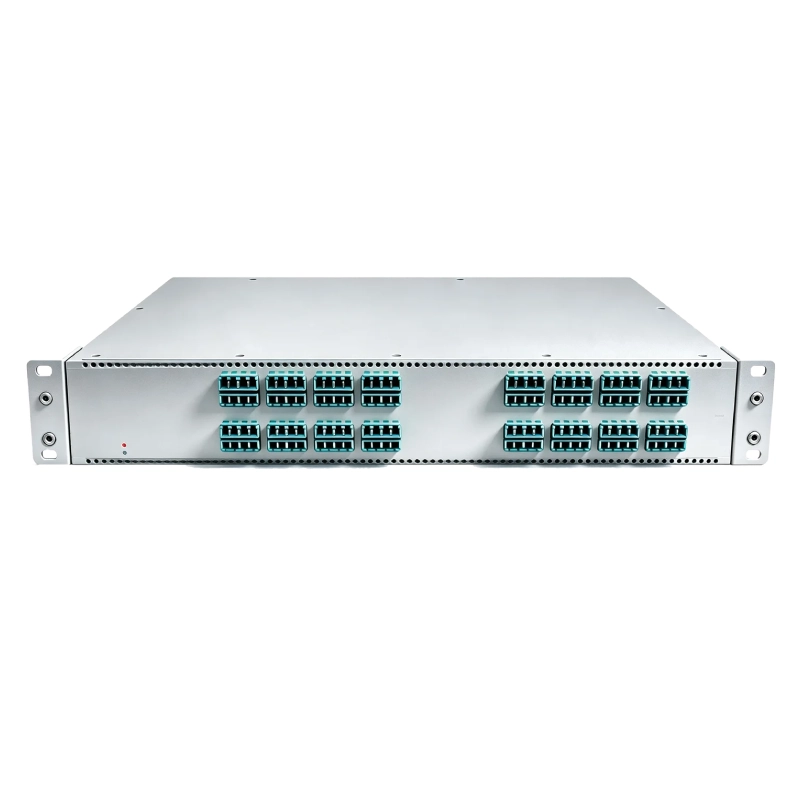
A practical deployment sequence looks like this:
- Profile training communication patterns to confirm traffic is predictable and heavy enough to justify circuits.
- Design the control plane first, including SDN integration with the job scheduler and collective communication libraries.
- Pilot OCS at the spine or between pods before scaling fabric-wide.
- Engineer the optical link budget, accounting for switch insertion loss, fiber runs, and WDM expansion headroom.
- Plan fiber management and rack layout for high-density optical cabling from day one.
Hardware selection matters as much as architecture. Port count, insertion loss, switching time, and control APIs vary significantly across OCS platforms, and the right choice depends on fabric depth, pod size, and the traffic profiles identified above.
Frequently Asked Questions
Can OCS completely replace electrical packet switches in AI clusters?
No. OCS and EPS solve different problems: OCS excels at moving predictable, high-volume flows through reconfigurable physical paths, while electrical switches remain necessary for bursty traffic, fine-grained scheduling, protocol processing, and multi-tenant isolation. Current architectures converge on hybrid optoelectronic fabrics in which each layer does what it does best.
How fast can an OCS reconfigure an optical path?
Mainstream MEMS-based units complete a path change in milliseconds, thousands of times slower than electrical switching yet far faster than any job-level topology change. This makes OCS ideal for reconfiguration between training jobs, scheduled maintenance, and failure bypass. Emerging silicon photonics designs promise faster switching for finer-grained steering, though at reduced port counts today.
What is the market outlook for optical circuit switching?
The industry is transitioning from technology validation to early commercial deployment. Independent analysts project the OCS market to grow at more than 30 percent annually through 2030, when it is expected to exceed 8 billion US dollars, driven by hyperscale AI buildouts. Open-compute standardization and multiple new component suppliers are expected to lower adoption barriers and push OCS into enterprise AI clusters.