
As carrier backbones, regional transport rings, and data center interconnects carry ever-growing traffic, long-haul optical networks must push hundreds of gigabits per wavelength across amplified fiber spans that can stretch from a few hundred to more than a thousand kilometers. Along these routes, signal attenuation, chromatic dispersion, and optical signal-to-noise ratio (OSNR) degradation steadily erode link margin, which is why transceiver selection has become one of the most consequential decisions in optical network design. Dense wavelength division multiplexing (DWDM) addresses the capacity side of this challenge by packing many wavelengths onto a single fiber pair, and the DWDM transceivers that light those wavelengths determine how far and how efficiently that capacity can travel.
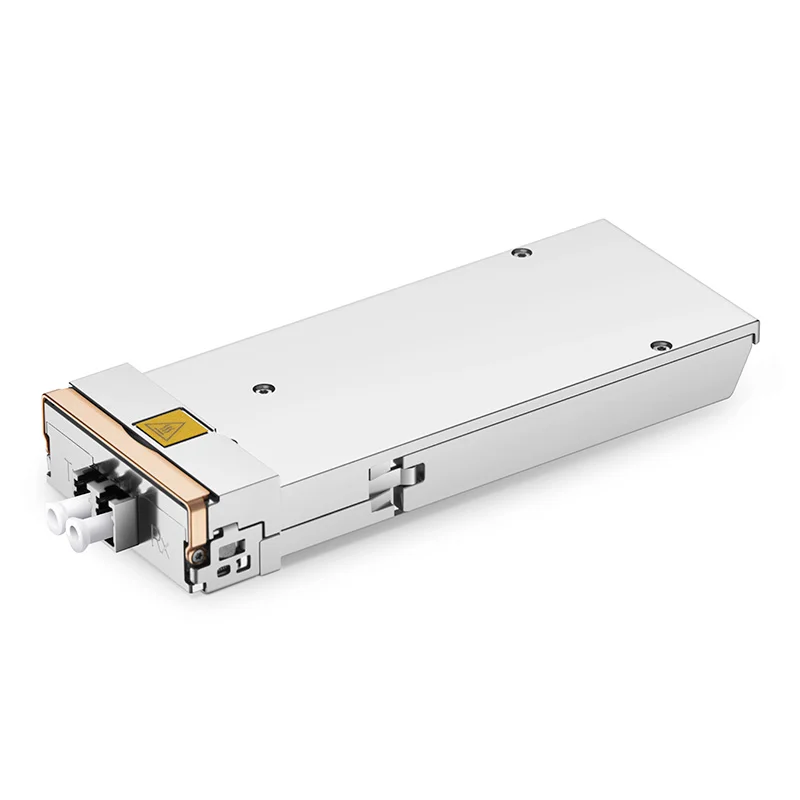
For most long-haul applications today, the best-performing DWDM transceivers are 400G and 800G coherent modules in the CFP2-DCO form factor, such as a 400G CFP2-DCO coherent optical module for regional and long-haul backbone links, or an 800G CFP2-DCO coherent optical module where traffic density and fiber scarcity justify higher per-wavelength capacity. These modules combine tunable C-band wavelengths, high-order coherent modulation, and embedded digital signal processing (DSP), allowing a single wavelength to span hundreds of kilometers between regeneration sites while coexisting with dozens of other channels on the same fiber.
The following sections explain how long-haul coherent DWDM transceivers work, how 400G and 800G modules compare in transmission distance and application scenarios, and which specifications and evaluation criteria matter most when matching a module to your actual network requirements.
What Is a Long-Haul DWDM Coherent Transceiver?
A long-haul DWDM coherent transceiver is a pluggable optical module that transmits data on a tunable C-band wavelength using coherent modulation and on-board DSP, enabling 400G or 800G per-wavelength transmission across amplified fiber spans of hundreds to more than a thousand kilometers. Unlike direct-detect modules, it recovers severely impaired signals digitally, which is what makes unregenerated long-haul transmission practical.
Coherent transceivers encode information in the phase, amplitude, and polarization of the light rather than intensity alone. Using modulation formats such as dual-polarization QPSK, 8QAM, and 16QAM, a coherent DSP chip at the receiver reconstructs the original signal even after the fiber has introduced attenuation, chromatic dispersion, and polarization effects over hundreds of kilometers. Powerful forward error correction (FEC) built into the DSP then cleans up residual bit errors, and real-time telemetry reports pre-FEC bit error rate, OSNR estimates, and dispersion levels so operators can monitor link health without taking services offline.
On the wavelength side, long-haul DWDM transceivers tune across the C-band on the standardized ITU-T DWDM frequency grid defined in G.694.1, typically 75 GHz at 400G and 150 GHz at 800G.This tunability lets a single module type serve any channel in a multiplexed system, simplifying sparing and wavelength planning. In the CFP2-DCO form factor, the coherent DSP is integrated inside the module itself, so the host transport platform can accept line-side coherent wavelengths directly, including the 400G CFP2-DCO Coherent Optical Module commonly deployed in amplified long-haul line systems with EDFA and ROADM infrastructure.
400G vs 800G DWDM Transceivers: Distance and Application Comparison
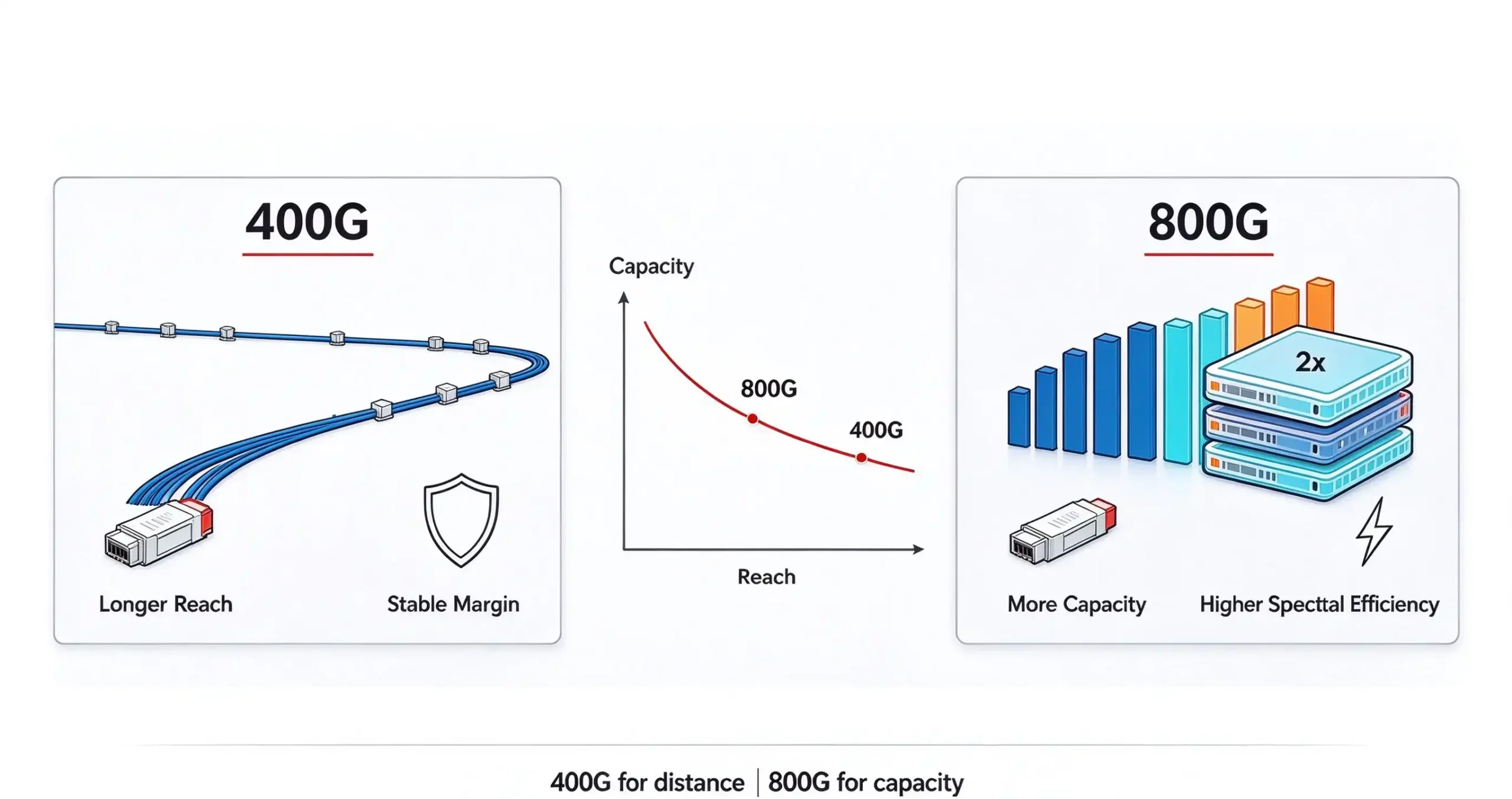
In general, 400G coherent modules reach farther per wavelength at conservative modulation, while 800G coherent modules double per-wavelength capacity and improve spectral efficiency, usually at the cost of shorter unregenerated reach at full rate and higher power consumption. The right choice depends on your link distance, traffic growth, fiber availability, and the amplifier design of your line system, because real-world reach varies significantly with modulation format, fiber condition, and the number of ROADM nodes a signal traverses.
400G Coherent Modules: The Long-Haul Workhorse
A 400G CFP2-DCO module typically runs 400G using DP-16QAM for regional distances, and can drop to 200G DP-QPSK to stretch regeneration-free reach toward the 1,000 km class on well-maintained, amplified fiber.This flexibility makes 400G a strong fit for carrier backbone transport, utility and railway long-haul networks, and regional data center interconnect where traffic grows steadily rather than explosively. Because 400G modules are mature and widely deployed, they also tend to offer predictable interoperability behavior and a proven upgrade path on existing DWDM shelves.
800G Coherent Modules: Maximum Capacity per Wavelength
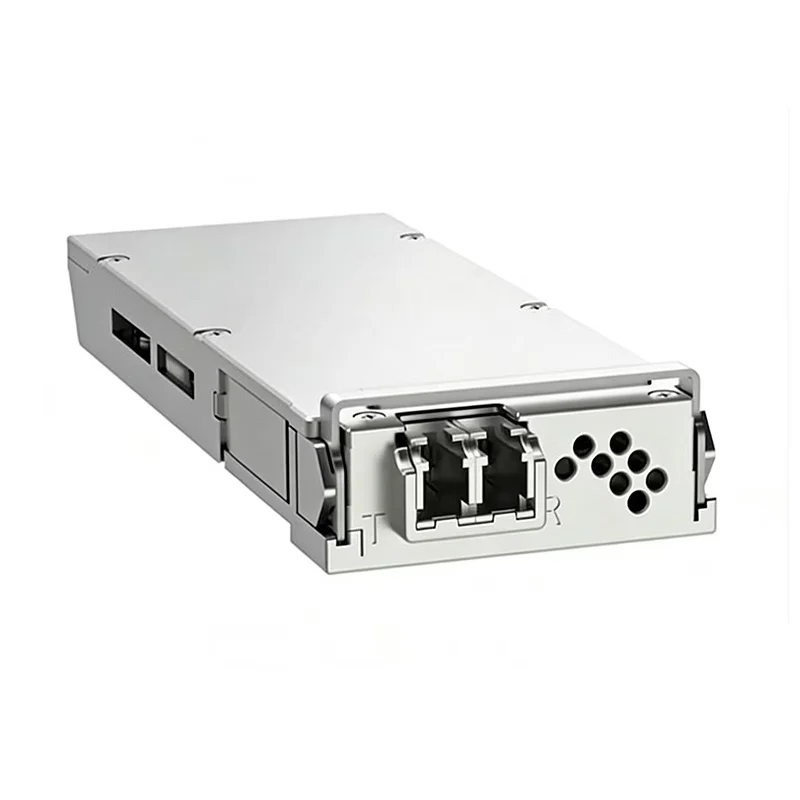
An 800G CFP2-DCO Coherent Optical Module doubles the line rate on each wavelength, which directly increases total system capacity when fiber pairs are scarce or dark fiber leases are expensive. To carry 800G, these modules generally rely on higher-order modulation or higher baud rates, both of which demand more OSNR; as a result, full-rate 800G transmission usually favors shorter long-haul and metro-regional spans, while extended-reach configurations may trade capacity for margin. Typical application scenarios include hyperscale data center interconnect, AI cluster back-end transport, and high-density backbone routes where improving cost per bit and spectral efficiency outweighs maximum reach.
Side-by-Side Comparison
| Parameter | 400G Coherent Module (CFP2-DCO) | 800G Coherent Module (CFP2-DCO) |
| Line rate per wavelength | 400G | 800G |
| Typical modulation options | DP-QPSK, 8QAM, 16QAM | 16QAM and above, or higher baud |
| Typical unregenerated reach | Longer at QPSK; regional at 16QAM | Generally shorter at full rate; flexible modes trade capacity for reach |
| Spectral efficiency | Moderate | Higher, more capacity per channel |
| Power consumption | Typically lower | Typically higher |
| Typical scenarios | Carrier long-haul, utility networks, regional DCI, backbone transport | Hyperscale DCI, AI infrastructure, capacity-constrained backbone routes |
Neither option is universally superior. When wavelengths must cross long amplified spans with multiple ROADM nodes, 400G at conservative modulation often provides the necessary margin. When the constraint is fiber capacity rather than distance, 800G usually delivers better economics per transmitted bit.
What Is the Difference Between ZR and ZR+ DWDM Transceivers?
ZR and ZR+ refer to classes of compact pluggable coherent optics defined by industry standards: ZR modules, such as those following the OIF 400ZR implementation agreement, target relatively simple point-to-point links of roughly 80 to 120 km, while ZR+ variants add higher launch power, stronger FEC, and flexible modulation to support amplified and ROADM-based networks over several hundred kilometers or more.
The OIF 400ZR specification prioritized multi-vendor interoperability for data center interconnect over short amplified or unamplified spans. ZR+ and OpenZR+ implementations extend that concept with multi-rate operation (100G to 400G) and greater optical budget headroom, making them suitable for metro and regional links. One practical limitation is thermal: QSFP-DD and OSFP pluggables are constrained by the power the host port can dissipate, which caps DSP performance and therefore reach. For extended long-haul and ultra-long-haul routes, many operators therefore continue to use CFP2-DCO modules in dedicated transport platforms, where the form factor and platform cooling support higher-performance DSP operation over greater distances.
What Specs Should You Check When Selecting Long-Haul DWDM Transceivers?
The specifications that matter most for long-haul DWDM transceivers are transmission distance and link budget, OSNR tolerance, modulation and FEC flexibility, power consumption, wavelength tuning range, form factor and host compatibility, and diagnostic telemetry. Checking these against your actual link design, rather than relying on datasheet maximums, is what separates a stable deployment from a marginal one.
Consider each of the following before committing to a module type:
- Transmission distance and link budget. Calculate end-to-end loss using fiber attenuation of roughly 0.25 dB/km at 1550 nm, mux and patch-panel insertion losses, amplifier gain placement, and an aging and repair margin of 2 to 3 dB. The module’s specified reach should be validated against this budget, not taken at face value.
- Modulation format and reach trade-off. Confirm which modulation states the module supports and how reach scales in each, since QPSK-oriented modes suit long spans while 16QAM and above maximize capacity on shorter routes.
- OSNR tolerance and FEC performance. Compare OSNR sensitivity at your target rate, and check whether pre-FEC BER monitoring is exposed so degradation can be caught before service impact.
- Power consumption and thermal design. Coherent modules draw significantly more power than client-side optics, and 800G modules typically draw more than 400G. Verify chassis power and airflow capacity at full configuration.
- Wavelength tunability and channel plan. C-band tunability across the ITU-T grid on 50 or 100 GHz spacing simplifies wavelength assignment and sparing as the network grows.
- Form factor and host compatibility. Confirm the host platform supports the module class, the required power class, and the management interface before ordering, since even technically compatible modules can behave differently across firmware versions.
- Digital diagnostics. Real-time visibility into transmit and receive power, temperature, pre-FEC BER, and OSNR estimates materially improves maintenance planning on long-haul routes.
How to Match DWDM Transceivers to Your Network Requirements
The most reliable selection method is to start from the link itself: measure or model the actual span distance, loss, and OSNR, project traffic growth over the system’s service life, and then choose the module class that meets those requirements with margin rather than choosing the highest rate available. A practical decision path looks like this:
- Metro or campus DCI up to roughly 120 km on clean dark fiber: simpler pluggable optics are often sufficient, and coherent ZR-class options can provide headroom where margin is uncertain.
- Regional links of roughly 120 to 600 km with amplification: 400G coherent modules at higher-order modulation generally balance capacity and cost effectively.
- Long-haul and ultra-long-haul backbones beyond 600 km: 400G coherent modules at conservative modulation, engineered with EDFA and ROADM support, typically provide the reach and stability these routes demand.
- High-density routes where fiber is the constraint rather than distance: 800G coherent modules usually improve spectral efficiency and cost per bit, provided the link budget supports full-rate operation.
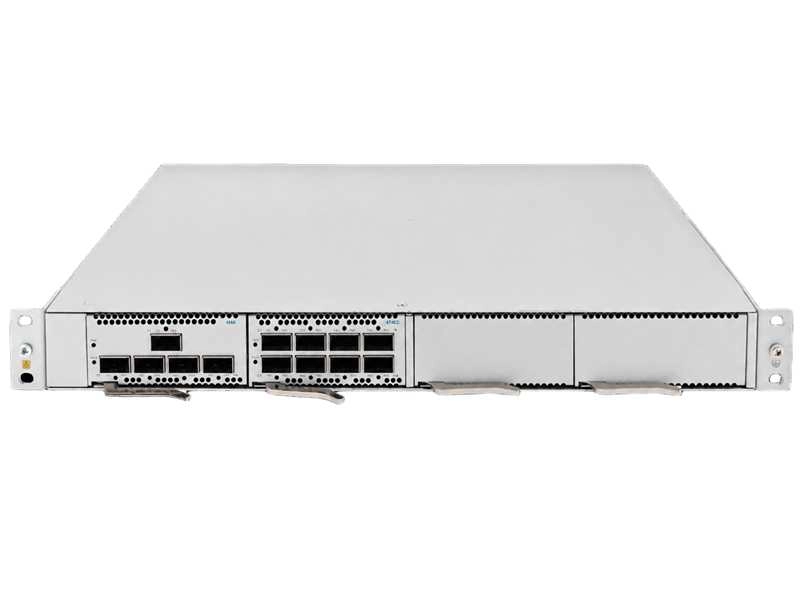
When evaluating suppliers, objective criteria matter more than brand familiarity: documented standards compliance, interoperability testing with your specific host platforms, transparent datasheets with worst-case values, access to engineering support for link budget review, and a clear lifecycle and warranty policy. A structured Long Haul Fiber Optic Solution design that integrates transceivers, amplification, and monitoring as one system is generally more dependable than selecting modules in isolation, because in coherent networking the module, the host, and the optical line system must perform together.
Frequently Asked Questions
Can I mix 400G and 800G wavelengths on the same DWDM system?
In many cases, yes. Because both module types tune across the same C-band ITU-T grid, they can share a fiber pair on separate channels, provided the line system’s amplifiers and ROADM filters support the required channel widths and the total channel plan respects the amplifiers’ gain bandwidth. Verify per-channel OSNR after commissioning, since higher-order-modulation channels are more sensitive to noise accumulation.
Do long-haul DWDM transceivers require external optical amplification?
Beyond roughly 100 to 120 km, most long-haul links do require EDFA amplification, and typically one amplifier per fiber span. Modern coherent DSP compensates chromatic dispersion digitally, so external dispersion compensation modules are generally no longer needed on new builds, but optical amplification remains necessary to overcome span attenuation on extended routes.
What fiber types work with long-haul DWDM transceivers?
Standard single-mode fiber such as ITU-T G.652 is the most common foundation for long-haul DWDM and generally works well with coherent transmission. Low-loss and ultra-low-loss fiber variants extend achievable reach by reducing span attenuation, while legacy G.653 dispersion-shifted fiber can complicate DWDM channel planning and may require careful wavelength selection.