
As cloud services, video streaming, and AI-driven workloads continue to multiply global data traffic, network operators and enterprises face a stubborn bottleneck: the demand for bandwidth grows far faster than the capacity of the fiber that has already been installed. Laying new fiber is slow, disruptive, and expensive, and in many metro areas the available duct space is already exhausted. Wavelength division multiplexing, the technology at the heart of modern fiber optic transport, was created to solve exactly this problem.
The purpose of wavelength division multiplexing (WDM) is to let a single optical fiber carry many independent data streams at the same time, with each stream riding on its own wavelength of light. By combining multiple wavelengths onto one fiber, WDM multiplies fiber capacity several times over without installing a single additional fiber strand, which makes it the most direct and cost-effective way to scale bandwidth in telecom networks, data centers, and enterprise campuses.
The sections below explain what WDM means, how it works, the specific purposes it serves, and the main benefit you gain when deploying it.
What Does WDM Mean?
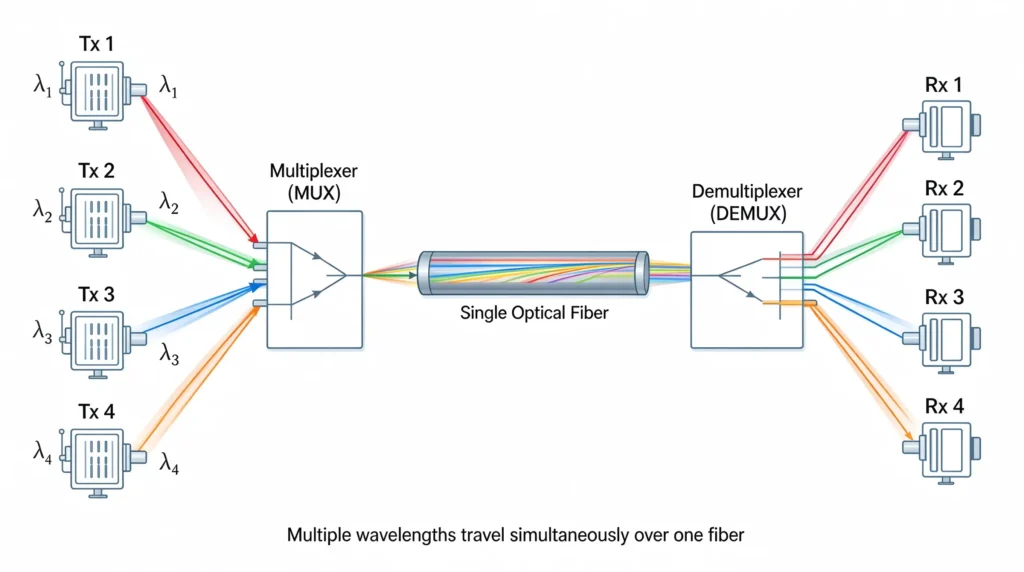
WDM stands for wavelength division multiplexing, a fiber optic transmission technique that combines multiple light signals of different wavelengths onto a single fiber so they can travel together without interfering with one another.
In an optical network, each wavelength of light behaves like an independent lane on a highway. A transmitter tuned to, for example, 1550.12 nm carries one data stream, while another tuned to 1550.92 nm carries a completely separate stream, and both travel down the same glass fiber simultaneously. Because light of different wavelengths does not mix, the receiver can cleanly separate the channels at the far end. This principle, described in detail by the Wikipedia entry on wavelength division multiplexing, is what allows one fiber to act like many virtual fibers.
The term itself is straightforward once broken apart:
- Wavelength: each optical channel occupies a distinct wavelength, often visualized as a distinct color of light.
- Division: the optical spectrum is divided into separate, standardized wavelength slots.
- Multiplexing: many channels are combined (multiplexed) into one shared physical medium.
Because each wavelength operates at full line rate, a single fiber that once carried one 10 Gbps stream can, with WDM, carry dozens or even hundreds of such streams in parallel.
How Does WDM Work?
WDM works by using a multiplexer to merge light signals of different wavelengths into one fiber at the transmitting end, and a demultiplexer to split those wavelengths back into individual channels at the receiving end.
A typical WDM transmission follows four steps:
- Signal generation: a laser or optical transceiver converts each electrical data stream into an optical signal at a precise, predetermined wavelength.
- Multiplexing: a multiplexer (MUX) combines all of these wavelengths and injects them into a single fiber as one composite optical signal.
- Transmission: the combined signal propagates along the fiber. On longer DWDM routes, optical amplifiers boost all wavelengths at once so the signal can span hundreds of kilometers without electrical regeneration.
- Demultiplexing: at the far end, a demultiplexer (DEMUX) filters the composite signal, separating each wavelength and directing it to the correct receiver.
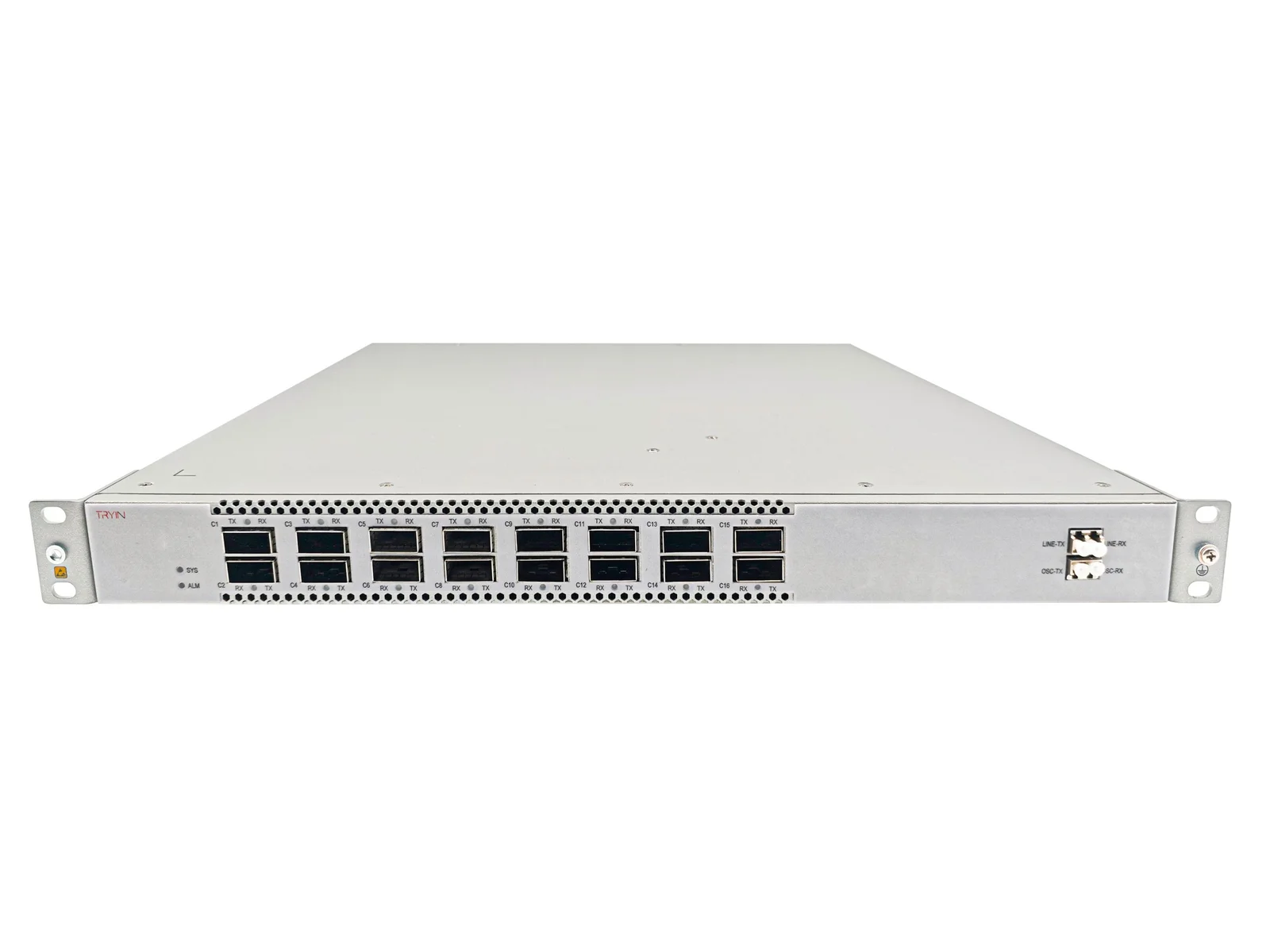
The transceivers, multiplexers, amplifiers, and demultiplexers involved are the core building blocks of a WDM system, and they typically operate as part of larger Optical Transport Systems that also handle framing, monitoring, and protection. For a deeper treatment of the underlying mechanism, see Wavelength Division Multiplexing: a step-by-step look at how light is combined, transported, and separated.
What Is the Purpose of WDM?
The core purpose of WDM is to maximize the usable capacity of existing fiber infrastructure by transmitting multiple independent channels over one fiber simultaneously, so that networks can grow without new construction, excessive cost, or service interruption.
That overarching purpose breaks down into four concrete objectives.
Multiply Fiber Capacity Without New Cabling
The most obvious purpose of WDM is capacity multiplication. A single fiber pair can carry 40, 80, or more than 160 wavelength channels, each running at 10 Gbps, 100 Gbps, or 400 Gbps. Instead of lighting 96 separate fiber pairs for 96 services, an operator lights 96 wavelengths on a single pair. In practical terms, this means the fiber plant a city installed a decade ago can still serve tomorrow’s traffic, because capacity is added inside the optical layer rather than in the ground.
Lower the Cost per Bit of Transmitted Data
WDM sharply reduces the cost of every gigabit moved. Renting or leasing dark fiber is priced per fiber pair, not per wavelength, so filling one pair with 96 channels divides that recurring cost by 96. The same logic applies to civil works: trenching, permits, and splicing are the largest expenses in fiber projects, and WDM makes most of that spending unnecessary because it reuses fiber that already exists. When traffic grows, adding a wavelength is a card or transceiver upgrade rather than a construction project.
Scale Networks Incrementally
Traffic forecasts are unreliable, and overbuilding a network “just in case” ties up capital. WDM allows capacity to be added wavelength by wavelength, in line with actual demand. An operator can start a link with a handful of channels and expand to a full spectrum as usage grows, protecting the original investment at every step. This pay-as-you-grow model is one reason WDM has become the default architecture for both carrier backbones and enterprise interconnects.
Enable Long-Haul and High-Speed Transport
Beyond raw capacity, WDM makes high-speed transmission over distance practical. Optical amplifiers can boost an entire band of wavelengths at once, allowing a single amplification site to serve dozens of channels across spans of 80 km or more. Without multiplexing, every one of those channels would require its own amplifier chain, its own fiber, and its own maintenance window. WDM concentrates them, which is why national backbone networks, submarine links, and metro aggregation rings all depend on it.
CWDM vs. DWDM: Two Ways to Achieve WDM
WDM is implemented in two main forms, coarse WDM (CWDM) and dense WDM (DWDM), which differ in channel spacing, capacity, reach, and cost, and each is optimized for a different class of network.
| Attribute | CWDM | DWDM |
| Wavelength range | 1270 nm to 1610 nm | Mainly C-band, about 1530 nm to 1565 nm |
| Channel spacing | 20 nm | 0.4 nm to 0.8 nm, per ITU-T standards |
| Typical channel count | Up to 18 | 40 to 96 or more, up to 160+ with C+L band |
| Typical reach | Up to about 80 km | Hundreds of km with amplification |
| Cost profile | Lower, uses uncooled lasers | Higher, uses temperature-stabilized lasers |
| Best fit | Short links, enterprise and access networks | Long haul, metro core, data center interconnect |
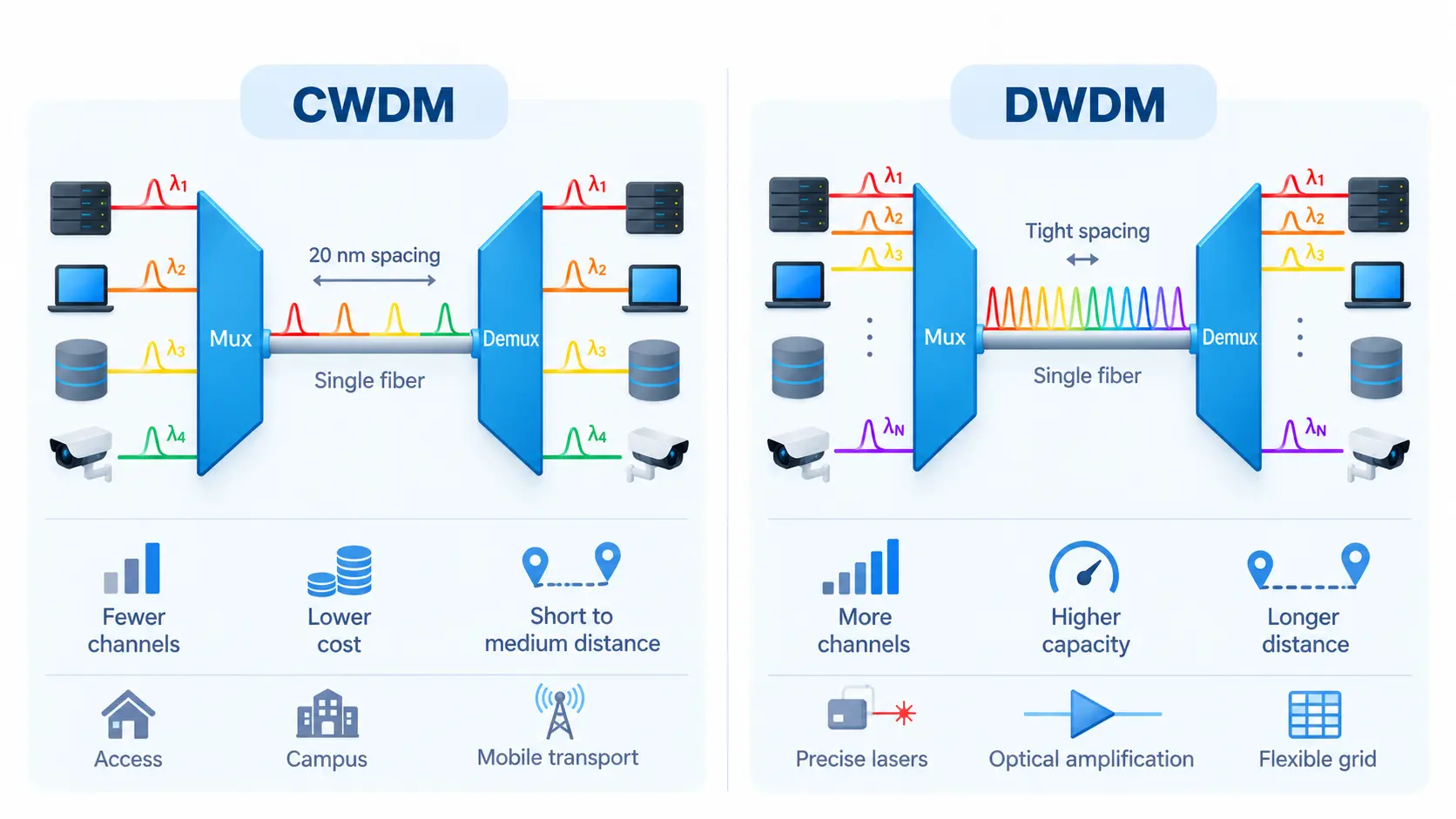
The narrower channel spacing in DWDM is defined by the ITU-T G.694.1 spectral grid recommendation, which packs many channels into the C-band where optical amplification works most efficiently. For guidance on choosing between the two approaches, this comparison of CWDM vs DWDM walks through the tradeoffs in capacity, distance, and budget.
What Is DWDM in Simple Terms?
In simple terms, DWDM means squeezing many colors of light very close together inside one narrow region of the spectrum so that a single fiber can carry a very large number of parallel conversations over long distances. If CWDM is a highway with a handful of wide lanes, DWDM is the same highway rebuilt with dozens of narrow, precisely marked lanes, each one a full-speed data channel, all sharing one roadbed.
What Is the Main Benefit of Deploying WDM Technology?
The main benefit of deploying WDM technology is that it multiplies the capacity of fiber you already own or lease, delivering far more bandwidth for a fraction of the cost and time of deploying new fiber, while remaining fully scalable for future growth.
The financial impact comes from three directions. First, capital expenditure falls, because capacity upgrades are confined to terminal equipment rather than civil construction. Second, operating costs fall, since managing 96 channels on one fiber pair is simpler, in space, power, and sparing, than managing dozens of parallel fiber links. Third, revenue opportunities expand, because unused wavelengths can be sold or provisioned quickly when new services are requested.
This combination explains why WDM is the foundation of nearly every modern optical transport network, from carrier backbones to data center interconnect. When planning a deployment, it is worth reviewing the full composition of modern Optical Transport Systems, since the multiplexers, amplifiers, and coherent transceivers you select determine how much of WDM’s potential capacity you can actually unlock.
FAQ
Does WDM require special fiber?
No. WDM runs over standard single-mode fiber, including the fiber installed decades ago. DWDM works in the C-band, where legacy fiber behaves normally, so it needs no changes. CWDM does reach down to 1271 nm, and on older G.652.A/B fiber the water-absorption peak near 1383 nm leaves only eight usable channels instead of eighteen — full 18-channel operation needs low-water-peak fiber (G.652.C or G.652.D).
Can WDM be combined with TDM?
Yes, and in practice the two are used together constantly. Time division multiplexing (TDM) packages many lower-rate signals into one higher-rate stream, and WDM then carries many of those streams in parallel on separate wavelengths. A single fiber can therefore multiply TDM’s gains: each of its dozens of wavelengths can itself be a TDM-aggregated channel, compounding total capacity.
How many channels can a single fiber carry with WDM?
It depends on the variant. CWDM supports up to 18 channels across its wide spectrum window. DWDM typically supports 40 to 96 channels in the C-band, and by also using the adjacent L-band, systems can exceed 160 channels on a single fiber pair. Each channel can operate at 100 Gbps or more, which is how terabit-scale transmission on one fiber becomes routine.