
Network traffic continues to grow as cloud services, video, mobile communications, and data-intensive applications consume more bandwidth. However, installing or leasing additional fiber can be expensive, time-consuming, or physically impractical. Network operators therefore need a way to obtain more capacity from the fiber infrastructure they already have.
Wavelength division multiplexing, or WDM, is an optical transmission technology that carries multiple independent data signals over the same fiber by assigning each signal a different wavelength of light. A multiplexer combines these wavelengths for transmission, and a demultiplexer separates them at the destination.
Understanding this process makes it easier to compare WDM technologies, evaluate their components, and select an appropriate system for a network.
What Is WDM and What Is Its Primary Purpose?
WDM is a method of dividing the optical spectrum into separate wavelength channels so that multiple data streams can travel through one fiber simultaneously. Its primary purpose is to increase fiber capacity without requiring a separate fiber for every connection.
Each wavelength functions as an independent channel. One channel might carry Ethernet traffic while another transports storage, voice, video, or other services. Because the channels remain optically separate, they can share the physical medium without combining their data.
This approach helps address fiber exhaustion, which occurs when available fiber strands can no longer support growing connection requirements. Instead of constructing or leasing another fiber route, an operator can add wavelengths to compatible optical transport systems.
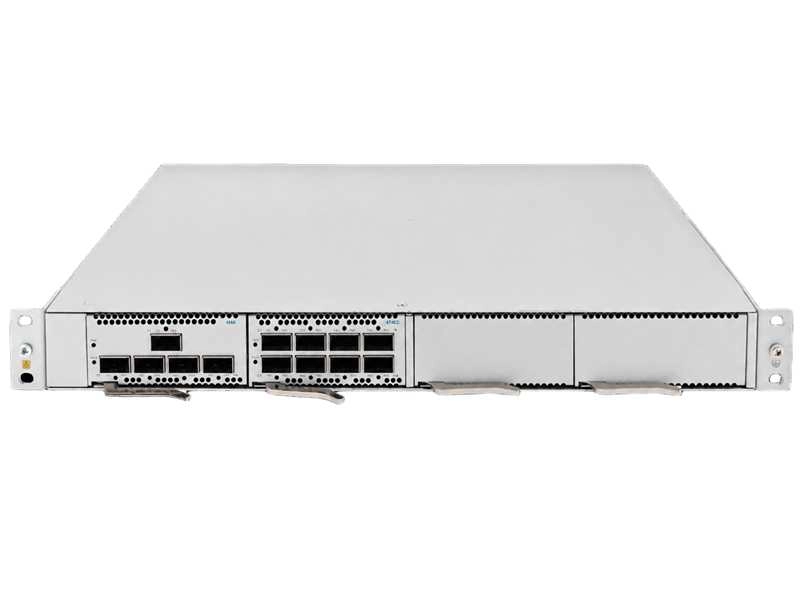
WDM increases the aggregate capacity of a link rather than automatically making an individual signal faster. The capacity of each channel still depends on its transceiver, modulation format, and network design. The advantage is that the capacity of several channels can be carried over the same fiber pair.
How Does Wavelength Division Multiplexing Work?
WDM works by converting separate data streams into optical signals with different wavelengths, combining those signals onto one fiber, transmitting them together, and separating them at the receiving end.
The basic process can be divided into four stages.
1. Generate Wavelength-Specific Optical Signals
A transmitter or optical transceiver converts an electrical data stream into light. Each transmitter uses a designated wavelength, sometimes described as a color, although the wavelengths used in telecommunications are generally outside the visible spectrum.
For example, one transceiver may transmit on one wavelength while several other transceivers operate on neighboring channels. As long as the channels meet the system’s wavelength plan and optical specifications, they can carry different services independently.
2. Combine the Wavelengths
A multiplexer receives the individual optical signals and combines them onto a common fiber. A useful analogy is a multilane highway: each wavelength occupies its own lane, while all lanes follow the same physical route.
The multiplexer does not merge the underlying data. It uses optical filters or related technologies to direct the wavelength channels into a shared transmission path.
3. Transmit and Manage the Channels
The combined WDM signal travels through the fiber. For short links, it may pass directly to the far-end equipment. Longer routes may require optical amplifiers to compensate for signal loss without first converting every channel back into an electrical signal.
At intermediate sites, an optical add-drop multiplexer can remove selected wavelengths or insert new ones while allowing the remaining channels to continue. Reconfigurable optical add-drop multiplexers provide more flexible, remotely controlled wavelength routing in complex networks.
4. Separate the Signals at the Destination
At the receiving end, a demultiplexer separates the combined signal into its original wavelength channels. Individual receivers then detect the assigned wavelengths and convert their optical signals back into usable electrical data.
The result is several independent connections operating over a fiber resource that would otherwise carry fewer services.
WDM vs. FDM: A Simple Comparison
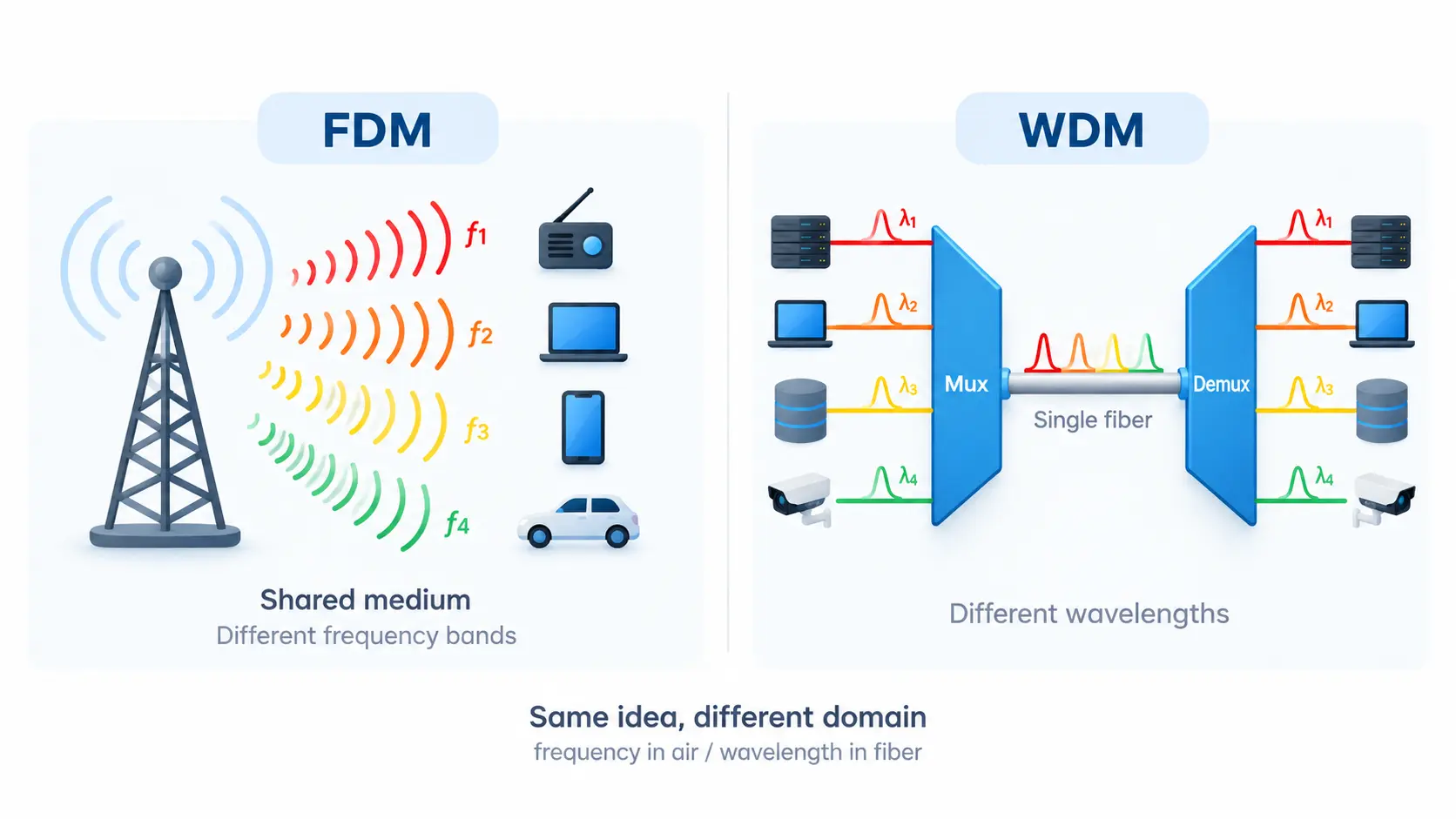
Frequency division multiplexing, or FDM, divides the available frequency spectrum of a shared medium into separate frequency bands. Radio stations demonstrate the basic idea: several stations transmit through the air at the same time, but each uses a different frequency.
WDM follows a similar principle in optical fiber. Because wavelength and frequency are mathematically related, WDM can be considered an optical form of frequency division multiplexing. The term wavelength is normally used because optical components are commonly specified by wavelength in nanometers, while dense optical channel grids are often defined by frequency in gigahertz or terahertz.
What Are the Main Types of WDM?
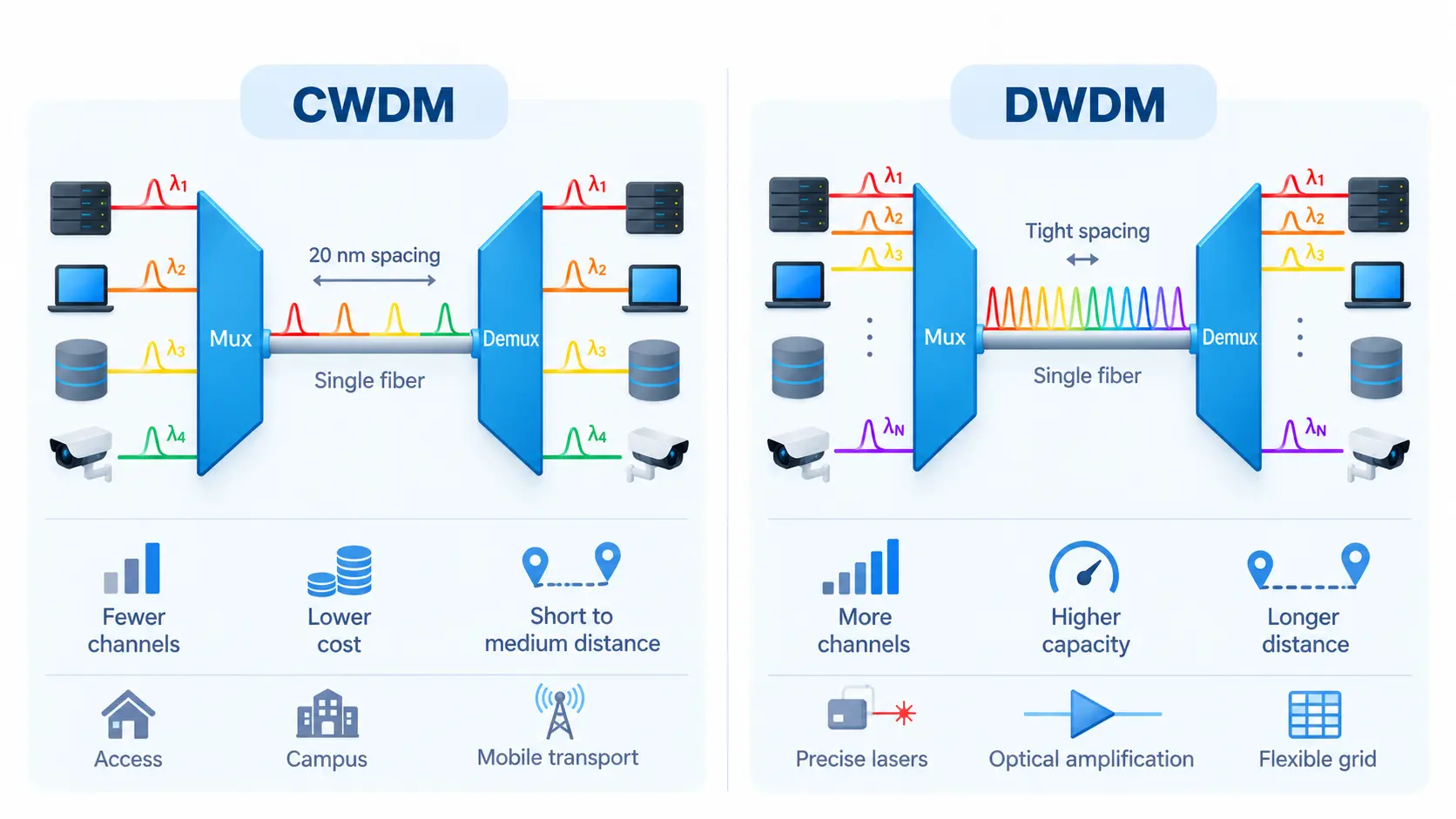
The two main types of WDM are coarse wavelength division multiplexing (CWDM) and dense wavelength division multiplexing (DWDM). CWDM uses wider channel spacing, while DWDM places channels closer together to support greater capacity.
What Is CWDM?
CWDM uses widely separated wavelengths, allowing systems to operate with less demanding laser stability and filtering requirements. The ITU-T G.694.2 recommendation defines a CWDM wavelength grid with 20 nm channel spacing.
Its relatively simple component requirements can make CWDM suitable for cost-sensitive applications with moderate channel counts and short-to-medium transmission distances. Typical uses include access networks, campus connections, mobile transport, and some metropolitan links.
What Is DWDM in Simple Terms?
DWDM packs more wavelength channels into a narrower portion of the optical spectrum. In simple terms, it places the lanes closer together so that more of them fit on the same fiber.
The narrower spacing requires precise lasers, tighter optical filtering, and more careful control of wavelength stability. In return, DWDM can support more channels, higher aggregate capacity, optical amplification, and longer transmission distances.
The ITU-T G.694.1 recommendation defines fixed and flexible frequency grids for DWDM applications. A flexible grid can allocate different spectral widths to channels according to their signal requirements.
CWDM vs. DWDM at a Glance
| Factor | CWDM | DWDM |
|---|---|---|
| Channel spacing | Wider | Narrower |
| Channel density | Lower | Higher |
| Typical reach | Short to medium | Metro to long haul |
| Laser requirements | Less stringent | High precision and stability |
| Optical amplification | Limited by design | Commonly supported |
| Relative complexity | Lower | Higher |
| Best suited for | Moderate-capacity, cost-sensitive links | High-capacity, scalable networks |
These characteristics are general guidelines. Actual capacity and reach depend on the selected wavelengths, fiber condition, optical budget, amplification, dispersion, and equipment design.
What Components Make Up a WDM System?
A WDM system generally includes wavelength-specific transceivers, multiplexers and demultiplexers, optical fiber, and any amplification or wavelength-routing equipment required by the network design.
Optical Transceivers
Transceivers convert electrical data into optical signals and convert received light back into electrical data. WDM-compatible optical transceiver modules must transmit on wavelengths that match the channel plan and filtering equipment.
Selection factors include wavelength, data rate, reach, output power, receiver sensitivity, form factor, and compatibility with the host equipment.
Multiplexers and Demultiplexers
A multiplexer combines wavelength channels, while a demultiplexer separates them. These functions are often integrated into one passive device at each endpoint. Because passive filters do not need to interpret the data, they can transport multiple protocols and data rates within their supported optical range.
OADMs, ROADMs, and Optical Amplifiers
An OADM adds or drops selected wavelengths at an intermediate location. A ROADM performs a similar function with remotely configurable wavelength paths, making it useful in networks where traffic patterns change.
Optical amplifiers strengthen groups of wavelength channels for longer transmission. Network designers must still account for insertion loss, noise, chromatic dispersion, nonlinear effects, and the optical power of every channel.
What Is WDM Used For?
WDM is used to increase the capacity and flexibility of fiber links in carrier, data center, enterprise, access, and mobile networks, especially when installing additional fiber would be costly or slow.
Metro and Long-Haul Networks
Telecommunications operators use WDM to aggregate traffic between cities, central offices, and regional network nodes. DWDM is particularly valuable on high-capacity or long-distance routes because optical amplification can extend transmission while many channels share the same fiber.
Data Center Interconnect
Data centers exchange large volumes of application, storage, backup, and replication traffic. WDM allows operators to add capacity incrementally by activating additional wavelengths rather than dedicating a new fiber pair to each service.
Access, Mobile, and Enterprise Networks
WDM can connect enterprise locations, support broadband access infrastructure, and carry mobile fronthaul or backhaul traffic. It is also useful when an organization leases a limited number of fiber strands and needs to maximize the return from that infrastructure.
The technology is valuable because it separates physical fiber capacity from individual services. A carefully designed WDM link can carry different protocols and data rates while allowing channels to be upgraded independently.
How Do You Choose Between CWDM and DWDM?
Choose CWDM when the required channel count and transmission distance are moderate and cost simplicity is a priority. Choose DWDM when the network requires greater capacity, longer reach, optical amplification, or substantial room for future growth.
A practical evaluation should consider the following factors:
- Capacity requirements: Estimate both current traffic and expected growth rather than sizing the system only for immediate demand.
- Transmission distance: Longer links may require amplification, dispersion management, or coherent transmission.
- Available fiber: Scarce or expensive fiber strengthens the business case for higher channel density.
- Upgrade strategy: Determine whether new channels must be added without interrupting existing services.
- Optical budget: Include fiber loss, connectors, splices, filters, and passive components.
- Operational requirements: Consider monitoring, wavelength management, redundancy, and remote configuration.
- Total cost: Compare equipment and operating costs with the expense of constructing or leasing more fiber.
A detailed CWDM vs DWDM assessment should therefore examine the complete link, not just the number of advertised wavelengths. The best option is the one that meets present performance needs while preserving a realistic and cost-effective upgrade path.
Frequently Asked Questions
Does WDM Require Special Optical Fiber?
WDM commonly operates over standard single-mode fiber, but compatibility cannot be assumed from fiber type alone. Designers must evaluate attenuation across the intended wavelength range, link distance, connector and splice losses, chromatic dispersion, and any legacy fiber characteristics. Testing the installed path is especially important before deploying high-capacity or long-distance DWDM.
Can WDM Carry Different Protocols and Data Rates?
Yes. WDM channels are generally independent of one another, so a properly designed system can transport different client protocols and data rates simultaneously. However, each channel must use compatible transceivers and remain within the optical power, wavelength, filtering, and reach limits of the line system.
Can WDM Operate Over a Single Fiber?
Yes. Bidirectional WDM can use different wavelengths for transmitting and receiving over the same fiber strand. This is useful when only one fiber is available, but it requires compatible filters and transceivers at both ends. Designers must also consider reflection, isolation, insertion loss, and the wavelength allocation for each direction.