
Wavelength division multiplexing (WDM) supports AI data center interconnects by packing many independent optical channels, each on its own wavelength, onto a single fiber. This multiplies the capacity of existing fiber many times over without laying new cable, and it lets operators scale bandwidth by adding wavelengths rather than adding fiber, which is why WDM has become an important optical transport technology for scaling high-capacity links between AI data center buildings, campuses, and geographically separated facilities.
To see why WDM matters so much to AI networks, it helps to understand how the technology works, what problem it solves, and where it is heading next.
What Is WDM and Why AI Makes It Essential
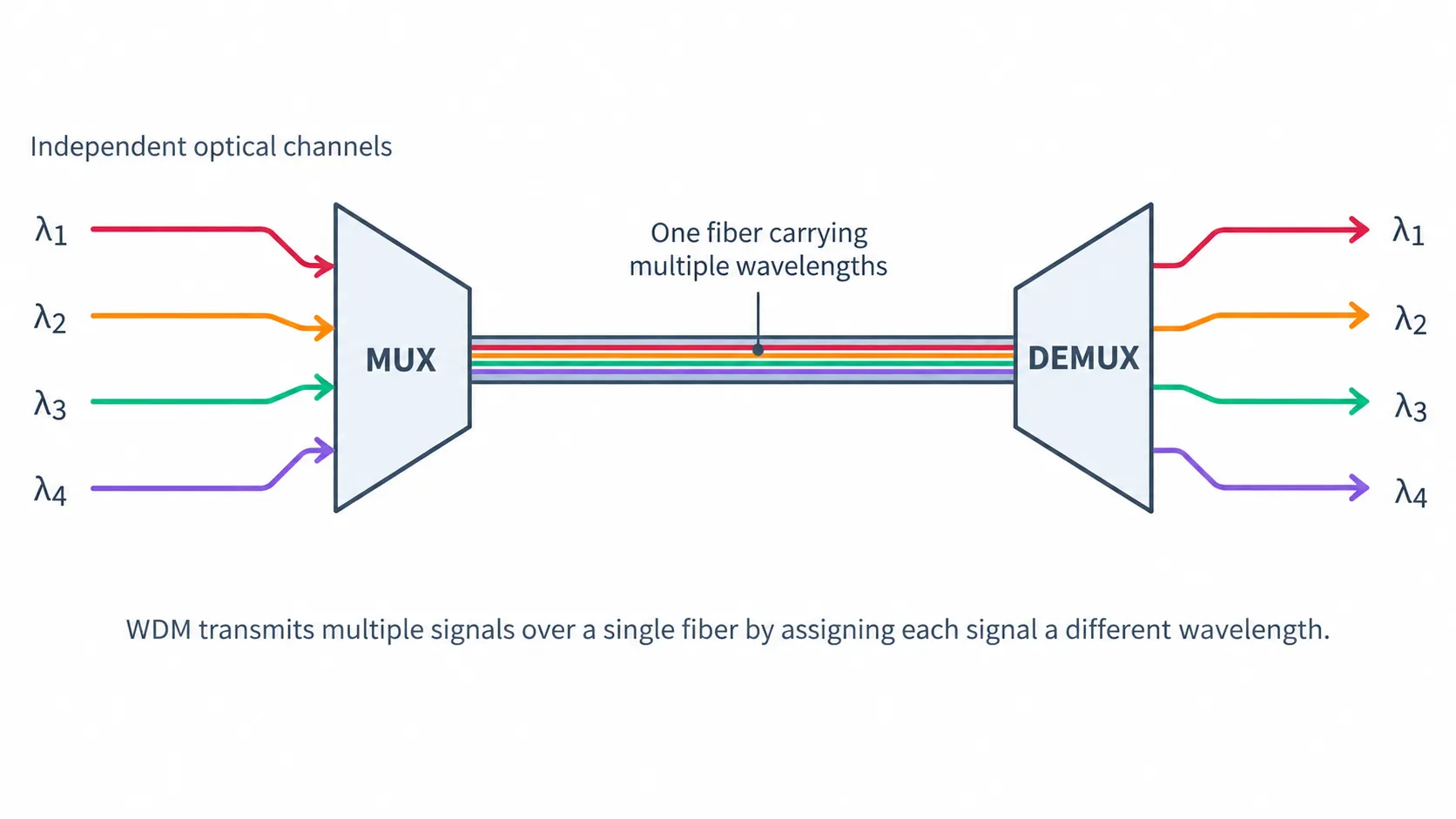
WDM is a fiber-optic technique that transmits multiple signals at the same time over one fiber by giving each signal a different wavelength, or color, of light.
In a conventional single-channel link, one transceiver sends one stream of data down a fiber on one wavelength, and every other byte of traffic needs its own fiber pair. WDM changes this by treating each wavelength as an independent lane. A multiplexer combines many wavelengths at the transmit end, a demultiplexer separates them at the receive end, and each lane carries a completely separate data stream in parallel.
The concept is simple but the payoff is enormous. Because each wavelength is independent, WDM is protocol-transparent: a 100G Ethernet signal, a storage channel, and a dedicated GPU synchronization flow can all ride the same fiber at the same time without interfering with one another. That transparency and parallelism are exactly what AI infrastructure needs, since AI networks carry many different traffic types over the same physical plant.
How WDM Packs Many Channels onto One Fiber
The mechanics come down to wavelength. Light in the infrared window used by optical networking is divided into many narrow wavelength bands. Modern dense systems can fit dozens of these bands, and in some deployments well over a hundred, onto a single fiber. Each band is a channel, and each channel can carry a full high-speed signal. A fiber that once carried a single 100 Gbps stream can therefore carry multiple terabits per second when many wavelengths are combined and amplified together.
Coarse WDM vs Dense WDM at a Glance
WDM comes in two main flavors. Coarse WDM (CWDM) spaces wavelengths far apart, typically 20 nm, which keeps components simple and inexpensive but limits the channel count to around 18 and the reach to shorter distances. Dense WDM (DWDM) packs wavelengths tightly together, commonly at 100 GHz or 50 GHz spacing, enabling far more channels and much longer reach through optical amplification. This distinction shapes where each is used in AI networks.
The Bandwidth Challenge Behind AI Workloads
AI training and inference generate east-west traffic that far exceeds what a single fiber can carry, and this traffic is what pushes WDM to the front of network design.
Modern AI clusters behave differently from traditional data centers. During training, large models are split across many GPUs using parallelism strategies that require frequent, synchronized exchanges of gradients and parameters. A single training run can generate many terabits per second of internal traffic, most of it flowing between servers rather than to the outside world. When a cluster grows beyond a single building, or when an organization runs multiple clusters across a campus, that traffic must travel over fiber between sites.
Fiber is the constraint. Digging new conduit and pulling new cable is slow, expensive, and often impossible in dense urban areas or in facilities that are already full. A single AI campus can require tens of thousands of optical links, and internal optical traffic is growing even faster than server count. There is also a latency dimension: a training job split across two buildings a hundred kilometers apart hits a latency wall long before it runs out of bandwidth, and every unnecessary hop adds delay that keeps expensive accelerators idle. Scaling all of this by simply adding more fibers is economically unsustainable, which is why operators turn to WDM to get more capacity, and cleaner direct paths, out of the fiber they already have.
How WDM Multiplies Fiber Capacity
WDM increases a fiber’s total throughput by multiplying the number of channels and the rate of each channel, so capacity scales without adding fiber.
The capacity of a WDM system is roughly the number of wavelengths multiplied by the data rate of each wavelength. A single-channel 400G link becomes a 3.2 Tbps link when eight 400G wavelengths share one fiber, and dense systems stack far more channels than that. Because each channel is independent, capacity can also be added incrementally: an operator lights only the wavelengths needed today and adds more later as AI demand grows, without ever touching the physical fiber.
| Configuration | Wavelengths | Per-Wavelength Rate | Total Capacity |
|---|---|---|---|
| Single channel | 1 | 400G | 400 Gbps |
| CWDM link | 8 | 100G | 800 Gbps |
| DWDM link | 40 | 100G | 4 Tbps |
| DWDM with 400G channels | 8 | 400G | 3.2 Tbps |
This same multiplication is what makes WDM the foundation of data center interconnect, where operators use dense wavelength schemes to join sites over distances that a short-reach link cannot cover. The technology is covered in more depth in our guide to DWDM for Data Center Interconnect.
WDM in Data Center Interconnect (DCI)
Data center interconnect uses WDM to bind multiple data centers into what behaves like one large, unified compute resource, which is essential for distributed AI training.
Data center interconnect (DCI) is the practice of linking two or more data centers so they can share workloads, replicate data, and act as a single logical pool. For AI, DCI becomes especially important as training clusters grow too large for one building or one power budget. A large model may be trained partly in one facility and partly in another, with the sites exchanging traffic continuously.
WDM is a key enabling technology because it allows operators to deliver multi-terabit capacity over limited fiber resources across metro and regional DCI links. Coherent DWDM systems can carry dozens of high-capacity wavelengths over the same fiber, with some systems supporting 80, 96, or more channels depending on the spectrum and channel plan. This gives distributed AI infrastructure high-capacity, predictable optical connectivity between sites, although physical distance still introduces propagation latency. Operators building this kind of fabric typically deploy a dedicated Optical DCI Networks Solution Series to multiplex and manage the wavelengths between sites.
Coherent Pluggable Optics: 400G, 800G and Beyond
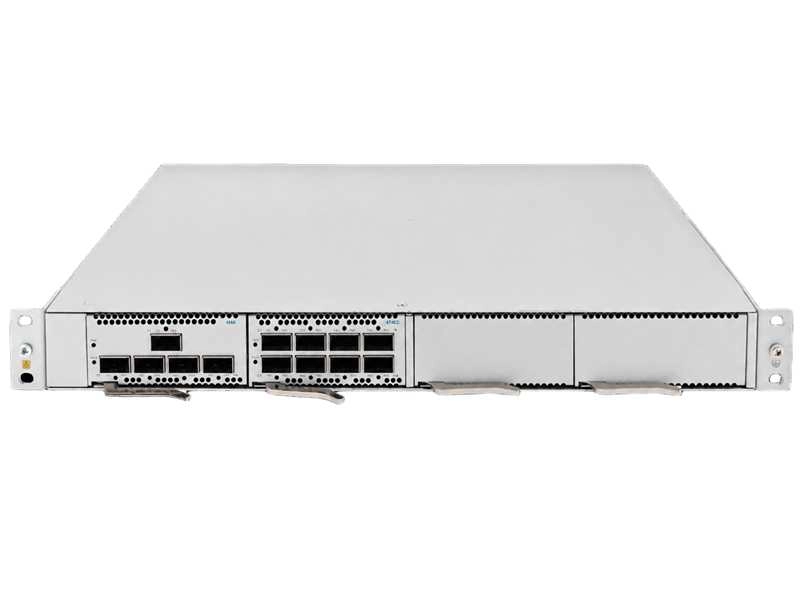
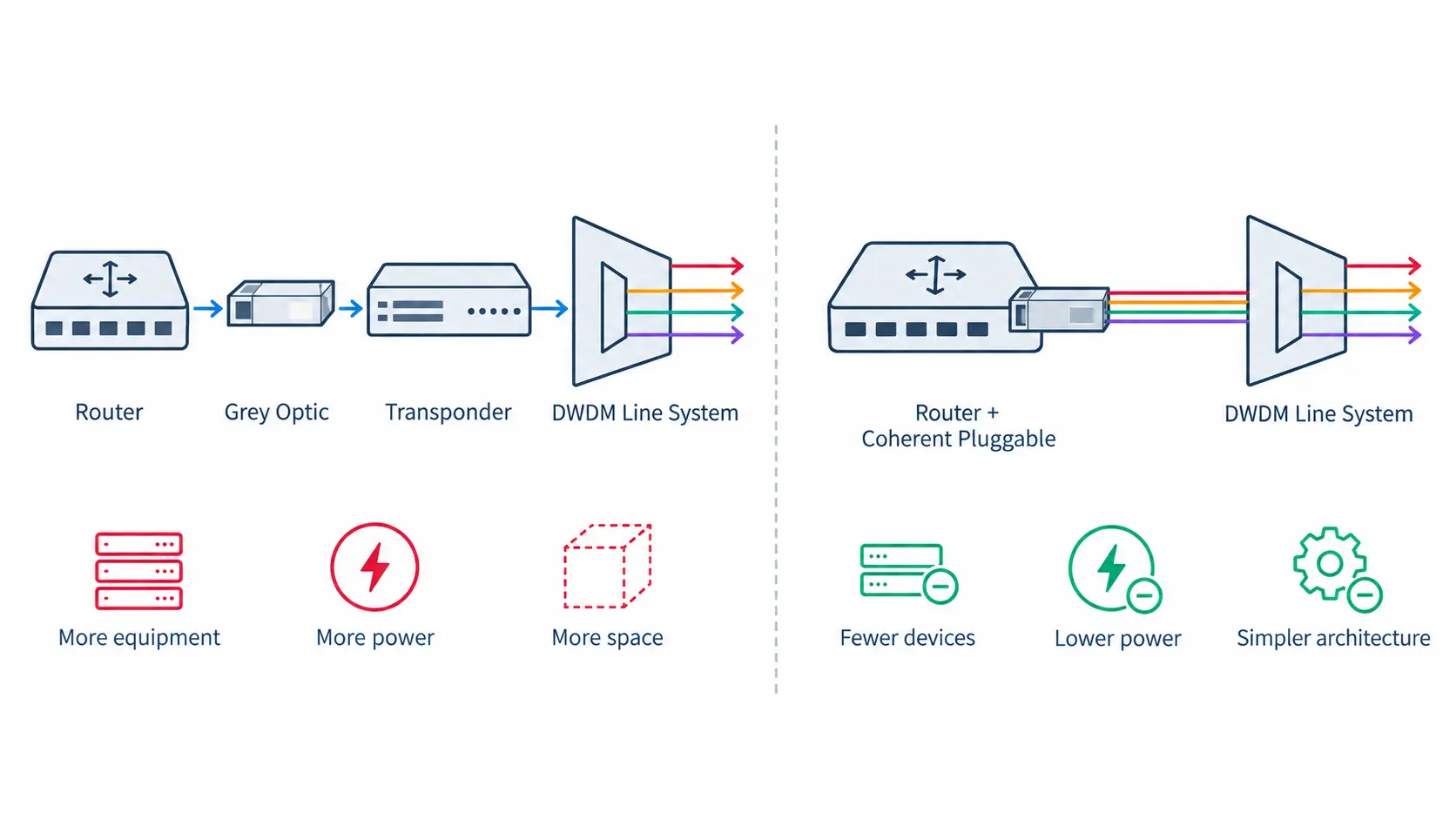
Coherent pluggable optics bring WDM directly into routers and switches, collapsing the traditional transponder shelf and letting 400G and 800G wavelengths travel between AI sites at far lower power and cost.
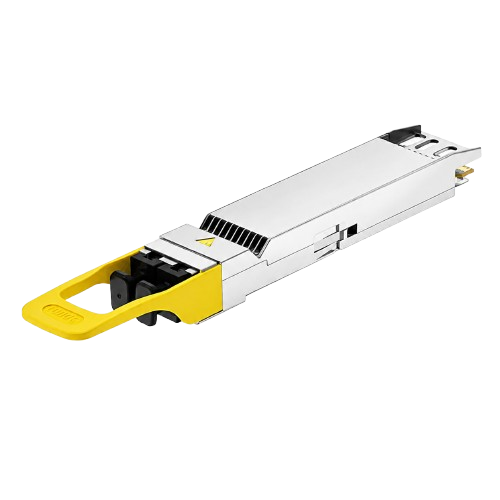
Coherent optics pair advanced digital signal processing (DSP) with sophisticated modulation to send and receive complex light waveforms, which is what allows a single wavelength to carry 400G or 800G over long distances. The defining shift has been packaging: once the DSP became small enough to fit inside a pluggable module, a coherent WDM wavelength could be generated directly from a router port instead of a separate transport shelf.
This change, often called IP over DWDM or IPoDWDM, simplifies the network. Instead of router to transponder to line system, traffic flows from router directly onto the DWDM line. Standards such as 400ZR and 800ZR define interoperable coherent optics for high-capacity point-to-point DCI, while OpenZR+ and vendor-specific coherent pluggables extend the concept toward regional and longer-reach applications. The result is a 400G or 800G coherent wavelength in the same faceplate that once held a short-reach grey optic, with meaningful savings in power and floor space. High-capacity modules such as the 800G CFP2-DCO Coherent Optical Module illustrate how far this integration has come.
Each generation of these optics pushes both speed and efficiency further. Baud rates have roughly doubled from one generation to the next, while probabilistic constellation shaping lets a single wavelength approach the theoretical limit of its channel, squeezing more throughput from the same spectrum. Advances in DSP silicon have kept the modules inside the thermal budget of a router faceplate, which is exactly what allows 800G, and soon 1.6T, coherent wavelengths to ship in the same compact form factors that once carried 100G.
From Transponder Shelves to Pluggable Modules
The traditional approach required a dedicated optical chassis with transponder line cards, consuming hundreds of watts per 400G link. The converged equivalent draws a fraction of that power from the router itself. This collapse of the optical layer is why coherent pluggable shipments are growing quickly, and why 800G and 1.6T are the next steps on the same roadmap.
CWDM vs DWDM: Choosing the Right Fit for AI
CWDM is the low-cost choice for short campus links, while DWDM is the standard for high-capacity, longer-distance AI data center interconnect.
The two WDM variants serve different parts of an AI network. Inside a campus, where distances are short and cost is king, CWDM’s wide spacing and simple components are often enough. Between data centers, where every fiber must carry as much as possible over distance, DWDM’s dense spacing and optical amplification win. The table below summarizes the trade-offs.
| Attribute | CWDM | DWDM |
|---|---|---|
| Channel spacing | Wide, about 20 nm | Tight, typically 100 GHz (~0.8 nm) or 50 GHz (~0.4 nm) |
| Typical channels | Up to about 18 | 40 to 96 or more |
| Reach | Short, typically campus | Long, amplified spans |
| Cost | Lower | Higher |
| AI use case | Building-to-building links | Cross-site DCI and backbone |
The choice comes down to distance, capacity, and budget, and the full comparison is explored in our CWDM vs DWDM guide.
Key Benefits of WDM for AI Networks
WDM delivers capacity, low latency, and efficiency that align directly with the needs of AI infrastructure.
Several benefits make WDM the backbone of AI interconnect:
- More capacity without new fiber. WDM multiplies throughput on existing strands, avoiding the cost and delay of new conduit.
- Scalable growth. Operators add wavelengths incrementally as AI demand rises, without re-engineering the physical plant.
- Deterministic, low-latency paths. Dedicated wavelengths isolate GPU synchronization and control traffic from bulk data, keeping latency predictable.
- Lower power per bit. Coherent pluggable WDM removes transponder shelves and cuts the power needed for a long-distance link.
- Protocol transparency. Different traffic types share one fiber independently, simplifying the network.
These advantages compound. The same wavelength plan that carries today’s traffic can be extended with additional channels, higher per-wavelength rates, or wider spectrum such as the L-band, giving a clear upgrade path as AI demand keeps rising. That is why WDM is treated less as a routine upgrade and more as a strategic asset for anyone scaling AI.
FAQ
How is WDM different from simply using faster transceivers?
WDM multiplies capacity in parallel by adding wavelengths, while a faster transceiver increases the rate of a single channel. The two work together: modern systems combine higher per-wavelength rates such as 400G or 800G with many wavelengths to maximize total fiber throughput.
Does WDM add latency to AI traffic?
WDM itself adds negligible latency, because the signal stays in the optical domain through multiplexing. In fact, by enabling direct, dedicated wavelengths between sites, WDM can reduce latency compared to architectures that add extra switching and conversion stages.
Can existing fiber be reused for WDM AI interconnects?
In most cases yes. Modern low-water-peak single-mode fiber supports the wavelengths used by CWDM and DWDM, which is precisely why WDM is attractive: it lets operators scale AI traffic over fiber they already have rather than pulling new cable.