
WDM developed through contributions from many researchers and engineering teams. Early systems combined a small number of optical channels, while advances in lasers, optical filters, and amplifiers enabled larger-capacity DWDM networks.
The development of the erbium-doped fiber amplifier (EDFA) was an important step. By amplifying multiple wavelengths within its operating band at once, it made long-distance, multi-channel transmission more practical. This helped drive the commercial growth of high-capacity DWDM networks during the 1990s.
WDM, short for wavelength division multiplexing, is an optical networking technology that transmits multiple data signals over a single optical fiber at the same time by carrying each signal on a different wavelength (or “color”) of light. It multiplies the capacity of existing fiber without the cost and disruption of laying new cable.
Below, we explain what WDM means in detail, the two main types, its key benefits and applications, and the history of the technology.
What Does WDM Mean?
WDM stands for wavelength division multiplexing, a technique that combines several optical carrier signals onto one fiber by assigning each signal a distinct wavelength of light, then separates them again at the receiving end.
In fiber-optic communication, light is the carrier that moves data. Each wavelength of light acts like its own independent lane on a highway. A WDM system places many of these lanes onto a single strand of glass at the same time, which is why WDM is often described simply as sending multiple colors of light down one fiber.
The technology works through two complementary devices. At the transmitting end, a multiplexer (MUX) joins multiple optical signals, each on its own wavelength, into a single composite beam that travels over one fiber. At the receiving end, a demultiplexer (DEMUX) splits that composite beam back into its individual wavelengths so each signal can be processed separately. Different wavelengths and appropriate optical filtering allow the channels to be separated at the receiver, although practical systems still need to control crosstalk and fiber nonlinear effects.
In a networking context, WDM is what lets a single physical link behave like many parallel links at once. It underpins the high-capacity long-haul and metro systems that carry internet traffic between cities, regions, and continents. It is also a fundamental building block of the wider optical transport network, where WDM wavelengths are managed, routed, and monitored as individual traffic lanes.
How WDM Works
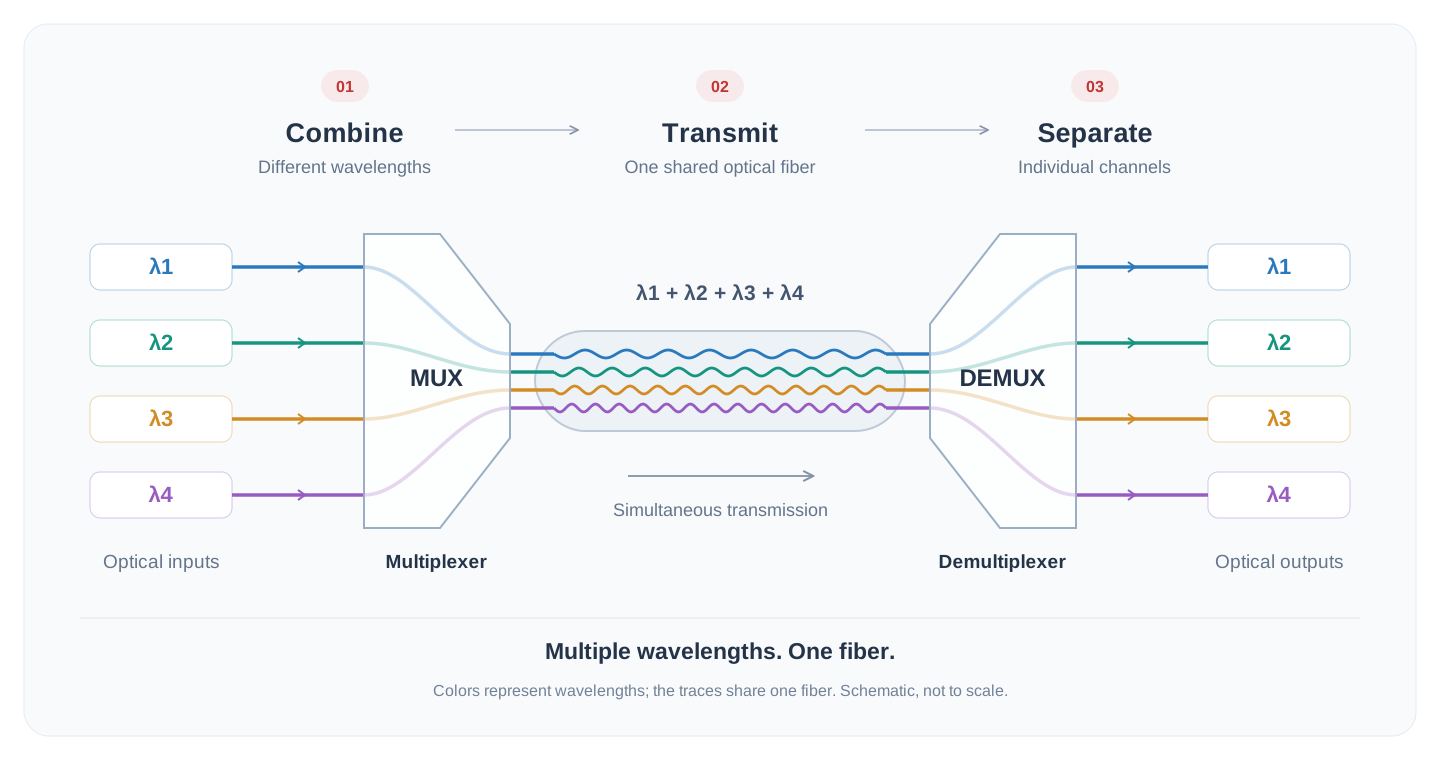
The core idea is simple: wavelength is another dimension of capacity. Just as frequency division multiplexing packs multiple radio channels into a shared spectrum, WDM packs multiple light channels into a shared fiber, except here each channel is identified by its wavelength rather than its frequency.
At a practical level, a WDM system is built from three steps:
- Combine. The MUX merges N independent channels, each at a slightly different wavelength, onto one fiber.
- Transmit. The combined signal travels the length of the fiber, with all channels moving simultaneously.
- Split. The DEMUX at the far end separates the combined signal back into the original N channels.
Because the same principle works in both directions, WDM also enables bidirectional communication over a single fiber, a capability sometimes called wavelength-division duplexing. One set of wavelengths can carry traffic eastbound while another set carries traffic westbound on the very same strand.
What Is WDM Used For?
WDM is used to dramatically increase the capacity of optical fiber links, and it is deployed wherever a network needs to move large volumes of data over existing infrastructure, including telecom backbones, metro networks, and data center interconnects.
In the early days, WDM was seen as a specialized, expensive technology reserved for national backbone networks. That has changed. Today, cost-effective WDM systems are used across the full span of a network, from the longest intercontinental routes down to short connections inside a data center campus. Any organization that needs high-capacity, low-latency connectivity and wants to avoid the cost of laying new fiber is a candidate for WDM.
Common Applications of WDM
WDM appears in a wide range of roles:
- Telecom core and metro networks. Carriers use WDM to scale the backbones that connect cities and countries, carrying tens or hundreds of wavelengths on a single fiber pair.
- Data center interconnect (DCI). Cloud providers and enterprises link data centers together over WDM to replicate data, balance workloads, and support disaster recovery.
- Cable and multi-service operators. WDM lets service providers deliver residential broadband, enterprise connectivity, and backhaul over shared fiber.
- 5G and mobile backhaul. As 5G drives large increases in cell-site traffic, WDM aggregates and transports that load efficiently.
- AI and high-performance computing. AI clusters and GPU fabrics generate enormous east-west traffic, and WDM helps scale the optical transport systems that connect them.
In all of these cases, the value is the same: WDM turns a single physical fiber into many virtual fibers, multiplying capacity without multiplying infrastructure.
Types of WDM: CWDM and DWDM
WDM comes in two main forms, coarse wavelength division multiplexing (CWDM) and dense wavelength division multiplexing (DWDM), which differ in how tightly they pack wavelengths, how many channels they support, how far they can reach, and how much they cost.
The distinction comes down to channel spacing. CWDM spreads wavelengths far apart, which makes it simpler and cheaper but limits the number of channels. DWDM packs wavelengths close together, which supports far more channels and longer reach but requires more precise and expensive components.
CWDM (Coarse Wavelength Division Multiplexing)
CWDM uses 20 nm channel spacing, with nominal central wavelengths from 1271 nm to 1611 nm in the ITU-T G.694.2 grid. This generous spacing allows it to use inexpensive, uncooled lasers, which keeps both the transceivers and the overall system affordable. In practice, CWDM supports up to 18 channels on a single fiber.
The trade-off is reach and flexibility. Because CWDM wavelengths span such a broad range, a standard erbium-doped fiber amplifier cannot amplify the full CWDM wavelength range. Only channels within the amplifier’s operating band can be amplified. As a result, CWDM is best suited to shorter-distance links, generally up to roughly 80 kilometers, in metro and access applications where spectral efficiency is not the primary concern.
DWDM (Dense Wavelength Division Multiplexing)
DWDM squeezes channels much closer together, typically at 100 GHz or 50 GHz spacing (roughly 0.8 nm or 0.4 nm), concentrated in the C-band between about 1530 nm and 1565 nm. These channel plans are defined by international standards such as ITU-T G.694.1. Because the channels sit inside a narrow band that fiber amplifiers can boost efficiently, DWDM signals can be amplified optically and travel much longer distances, often hundreds or thousands of kilometers with amplification.
This density and reach come at a cost. DWDM requires precision, temperature-stabilized lasers and tighter optical filtering, which makes the equipment more expensive and more complex to operate. In exchange, a single fiber pair can carry 40, 80, 96, or even more channels, which is why DWDM is the technology of choice for long-haul and high-capacity DWDM in optical networking.
CWDM vs DWDM at a Glance
| Feature | CWDM | DWDM |
|---|---|---|
| Wavelength range | 1271–1611 nm | ~1530–1565 nm (C-band) |
| Channel spacing | 20 nm | 0.8 nm / 0.4 nm (100/50 GHz) |
| Max channels | Up to 18 | 40, 80, 96, or more |
| Laser type | Uncooled (lower cost) | Cooled, precision (higher cost) |
| Amplification | Standard EDFA cannot cover the full CWDM range | Yes, with an EDFA matched to the operating band |
| Typical reach | Short to medium (metro/access) | Long-haul and core |
| Relative cost | Lower | Higher |
Choosing between the two is a matter of distance, capacity, and budget. For a deeper look at how to decide, see this guide to CWDM vs DWDM.
Key Benefits of WDM
WDM lets network operators multiply capacity over fiber they already own, avoiding the high cost and slow timelines of new fiber construction while leaving a clear path for future growth.
The advantages extend well beyond raw bandwidth:
- Maximizes existing fiber. Instead of trenching new cable, operators light up dormant capacity in the fiber already in the ground.
- Lower total cost. Adding or upgrading compatible optical transmission equipment can reduce the need for new fiber construction and often lower deployment costs. The savings depend on the existing infrastructure, required capacity, and link distance.
- Scalable growth. Capacity can be added channel by channel as demand rises, so investment tracks real usage.
- Technology-agnostic. WDM can carry multiple protocols and data rates, including 10G, 400G, and 800G, on the same fiber when the transceivers, channel bandwidths, wavelength plan, and link conditions are compatible.
- Future-proofing. As AI, 5G, and cloud traffic continue to surge, WDM provides a path for capacity growth, although future upgrades may require changes to equipment or the optical line design.
Together, these benefits are why WDM has become the default approach for scaling modern optical infrastructure.
Core Components of a WDM System
A basic WDM link needs compatible optical transmitters and receivers, together with multiplexing and demultiplexing functions. Transponders, optical amplifiers, and add/drop elements are added according to the interfaces, distance, and network topology.
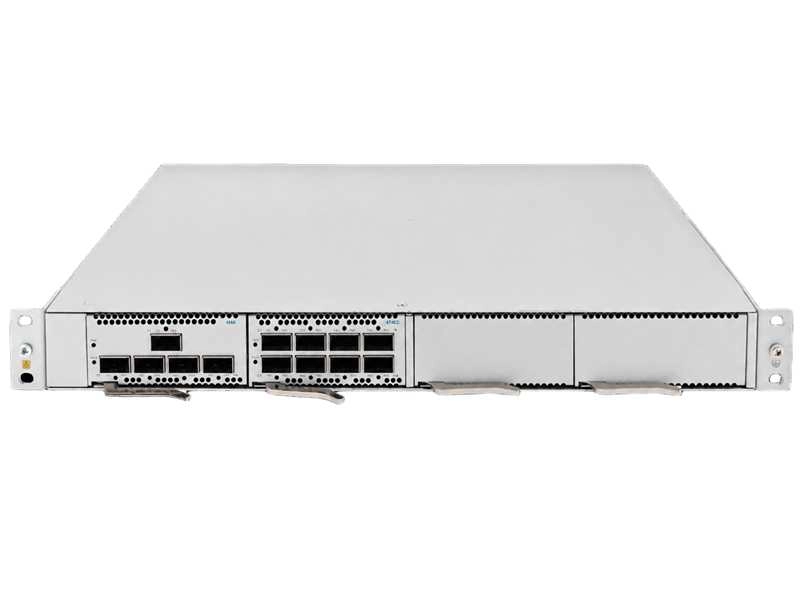
Understanding these components helps explain how WDM is deployed and managed. A simple point-to-point link does not necessarily need a separate transponder, amplifier, or OADM/ROADM.
- Multiplexer (MUX) and demultiplexer (DEMUX). The MUX combines channels onto one fiber; the DEMUX separates them at the other end. Together they define the wavelength plan of the link.
- WDM optical transceiver. A WDM transceiver transmits and receives data on the wavelengths specified for the link. Compatible pluggable transceivers can connect host equipment directly to a passive MUX/DEMUX when the interfaces and optical power budget allow.
- Transponder. When wavelength or interface conversion is needed, a transponder converts an incoming client signal onto a specific WDM wavelength, a process called wavelength mapping, and typically provides the laser and receiver for that channel.
- Optical amplifier (EDFA). Where amplification is needed, an EDFA can boost multiple WDM channels within its operating band at once, extending reach without converting signals back to electrical form. C-band and L-band systems require amplifiers designed for the corresponding band.
- OADM and ROADM. Where intermediate nodes need access to selected channels, optical add-drop multiplexers let specific wavelengths be added or dropped. A reconfigurable optical add-drop multiplexer (ROADM) can switch wavelengths remotely, enabling flexible, software-defined optical networks.
These components work together to form the optical transport systems that move traffic across metro, regional, and long-haul networks.
Frequently Asked Questions
What is the difference between WDM and FDM?
WDM and frequency division multiplexing (FDM) use the same underlying principle of dividing a shared medium into channels. The difference is the carrier. FDM is used in radio-frequency systems and separates channels by frequency, while WDM is used in optical fiber and separates channels by wavelength. Since wavelength and frequency are inversely related for light, they describe the same physical idea from different angles, but WDM is the term reserved for optical fiber.
How many channels can WDM support?
It depends on the type. CWDM typically supports up to 18 channels with 20 nm spacing. DWDM supports far more, commonly 40 channels at 100 GHz spacing or 80 channels at 50 GHz spacing, with modern systems reaching 96 channels or more on a single fiber pair.
Is WDM the same as DWDM?
No. WDM is the umbrella term for the whole family of wavelength multiplexing technologies, while DWDM is one specific, high-density form of it. CWDM is the other common form. In other words, all DWDM is WDM, but not all WDM is DWDM.