
Defining the Technology: What Is DWDM and How Does It Reshape Connectivity?
To truly understand how dense wavelength division multiplexing alters the economics of modern networking, it helps to step back and look at how a traditional optical link functions. In a standard, non-multiplexed fiber system, a single laser transmits data over a specific strand of glass using a single wavelength of light. This is fundamentally a one-to-one relationship: one physical fiber pair equals one transmission channel. If that channel fills up, the network is maxed out.
DWDM completely shatters this structural limitation. Instead of viewing a strand of fiber as a single-lane road that can only accommodate one vehicle at a time, it treats the fiber spectrum as a massive highway. By utilizing highly precise lasers, the technology carves the available optical spectrum into dozens—frequently up to 80 or 96, and in specialized modern systems, even more—distinct, tightly spaced wavelengths. Each individual wavelength, often called a “lambda,” acts as an completely independent, isolated transmission pathway.
This means that a single physical fiber pair can simultaneously transport distinct data streams from entirely different sources, using different protocols, without a single packet of data colliding or overlapping. The “dense” prefix in the name refers specifically to how closely these wavelengths are packed together. While older multiplexing systems kept wide, forgiving gaps between channels, this approach squeezes the channels together with microscopic precision. It operates primarily within the C-band 1530 nm to 1565 nm and the L-band 1565 nm to 1625 nm—the specific regions of optical glass where light experiences the absolute lowest amount of natural attenuation and degradation.
The Core Components of an Optical Multiplexing System
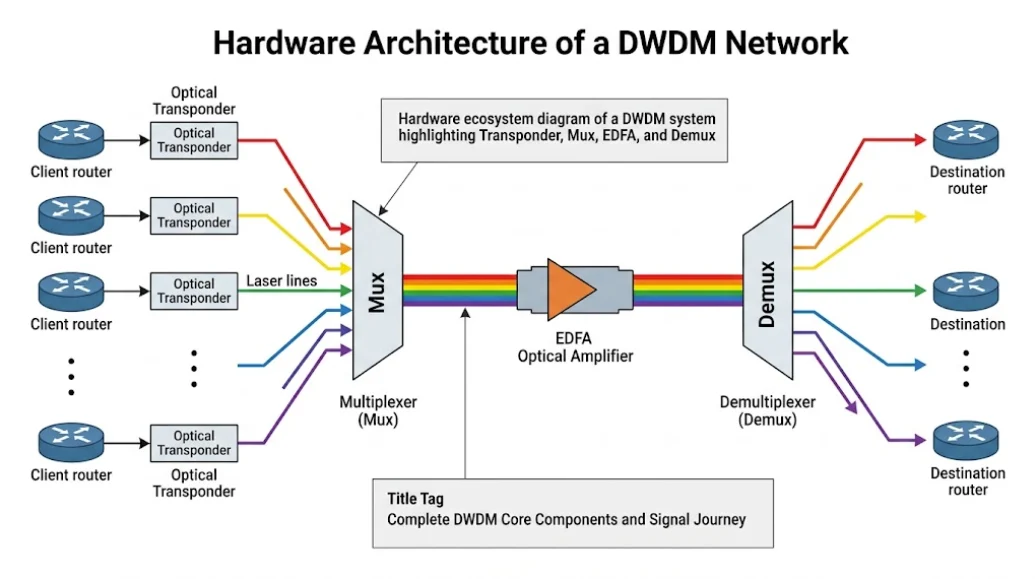
Optical Transponders
- Client‑side devices (routers, switches, storage servers) emit unstable short‑range optical signals unfit for long‑distance transmission. Transponders convert these signals into precise, ITU‑standard wavelengths. High‑performance optical transceivers here determine modulation speed and spectral efficiency.
Multiplexers (Mux) and Demultiplexers (Demux)
- Mux merges multiple individual wavelength signals from transponders into one multi‑wavelength beam for transmission over a single fiber. At the receiving end, Demux splits the combined beam back into separate wavelength streams for data recovery.
Erbium‑Doped Fiber Amplifiers (EDFA)
- Light weakens over long‑distance fiber transmission. Traditional O‑E‑O regeneration is costly, power‑hungry and high‑latency. EDFAs directly amplify all multi‑wavelength optical signals optically in one step, regardless of channel count or speed, with no data decoding needed.
Reconfigurable Optical Add‑Drop Multiplexers (ROADM)
- Early DWDM networks required manual hardware adjustments to extract specific wavelengths midway. ROADMs enable remote, software‑controlled wavelength add/drop at any network node, delivering flexible, dynamic long‑haul data routing.
Technical Comparison: Standard Fiber vs. CWDM vs. DWDM
To fully grasp where this technology fits within modern infrastructure planning, it is useful to look at how it compares to alternative fiber deployment methods, such as CWDM (Coarse Wavelength Division Multiplexing) and standard, non-multiplexed links.
| Feature | Standard Fiber Link | CWDM (Coarse WDM) | DWDM (Dense WDM) |
|---|---|---|---|
| Wavelength Spacing | None (Single Wide Channel) | Wide (Typically $20 \text{ nm}$) | Incredibly Tight ($\le 0.8 \text{ nm}$ or $0.4 \text{ nm}$) |
| Maximum Channel Count | 1 Channel per fiber strand | Typically 8 to 18 Channels max | 80 to 96+ Channels per fiber pair |
| Transmission Range | Short to Medium | Short to Regional ($\le 80 \text{ km}$) | Long-Haul to Transcontinental ($\ge 1000 \text{ km}$) |
| Native Amplification | N/A | Highly difficult / Inefficient | Excellent (Native integration with EDFAs) |
| Laser Cost Profile | Very Low | Low (Uncooled Lasers) | Higher Initial Cost (Temperature-Controlled Lasers) |
| Primary Network Layer | Local Loop / Access Layer | Metro Networks / Enterprise Campus | Core Backbone / Cloud Data Center Interconnect |
This structural breakdown highlights an important reality: there is no single “best” technology for every scenario. While standard fiber or CWDM is often perfectly adequate and highly cost-effective for short regional hops or internal corporate parks, the dense packing and native amplification capabilities of the dense alternative make it the undisputed choice for core, high-capacity, long-distance infrastructure.
Major Strategic Benefits Driving Enterprise and Carrier Adoption
Beyond the elegant physics of light manipulation, the decision to deploy high-density optical multiplexing is rooted in clear, undeniable business advantages. Network operators and cloud enterprises are managing infrastructure under tight budget constraints, making operational efficiency just as critical as raw throughput.
Massive Scalability and Future-Proofing
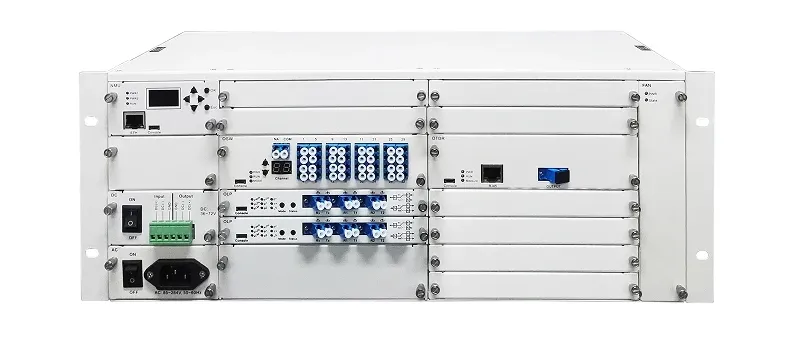
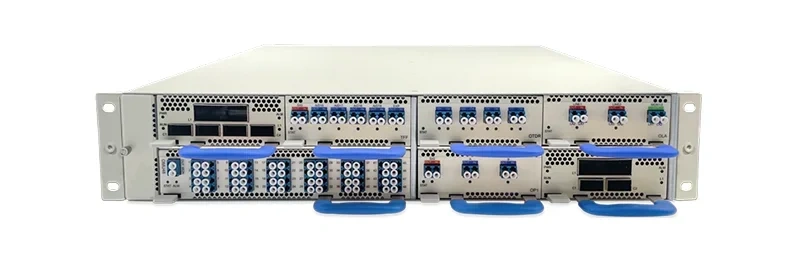
The most immediate advantage is the capacity to scale on demand. When a network operator notices that data consumption is hitting a threshold, they don’t need to coordinate with local governments to trench new streets or navigate environmental regulations to drop submarine cables. Instead, they purchase an additional card for their existing chassis and activate a new lambda on the existing fiber. The foundational infrastructure stays completely untouched; the capacity is expanded simply by utilizing a piece of the spectrum that was previously sitting dark.
Protocol and Bit-Rate Independence
At the physical layer of light transmission, the system is entirely agnostic to the type of data passing through it. A single fiber pair can simultaneously carry a 100G Ethernet stream for a cloud provider on one wavelength, a specialized Fibre Channel stream for a banking data center on an adjacent wavelength, and a legacy SDH stream for a telecom carrier on a third wavelength. The hardware doesn’t need to interpret, reformat, or translate the encapsulated packets. This absolute independence allows varied, multi-generational technologies to live together harmoniously on a single infrastructure asset.
CAPEX and OPEX Optimization
In modern infrastructure, the cost of civil engineering—the physical labor of digging trenches, securing rights-of-way, and maintaining outdoor physical plants—dwarfs the cost of optical hardware. Maximizing the data output of an existing fiber asset allows organizations to extract exponentially more value from their initial capital expenditure (CAPEX). Furthermore, by replacing power-hungry electrical regeneration sites with passive, all-optical inline amplification (EDFA), ongoing operational expenditure (OPEX) is kept down, keeping energy footprints manageable even as data throughput scales.
Real-World Applications: Where Does the Technology Live?
This technology isn’t a theoretical concept confined to research labs; it is the active, physical foundation supporting the global internet. If you are streaming high-definition video, pulling a file from a cloud storage service, or executing an international financial transaction, your data is almost certainly passing through high-density optical transport equipment at some point in its journey.
Data Center Interconnect (DCI)
The rise of massive, hyper-scale cloud computing has fundamentally rewritten the rules of data center architecture. Large providers no longer rely on solitary, giant facilities; instead, they build vast clusters of regional data centers spaced dozens of kilometers apart. These distinct facilities must continuously replicate data, balance application workloads, and share storage pools in real time, requiring massive pipelines with almost zero latency. High-density optical systems provide the necessary multi-terabit interconnects, ensuring that separate physical facilities can function seamlessly as a single cohesive virtual machine.
Long-Haul Backbone and Submarine Networks
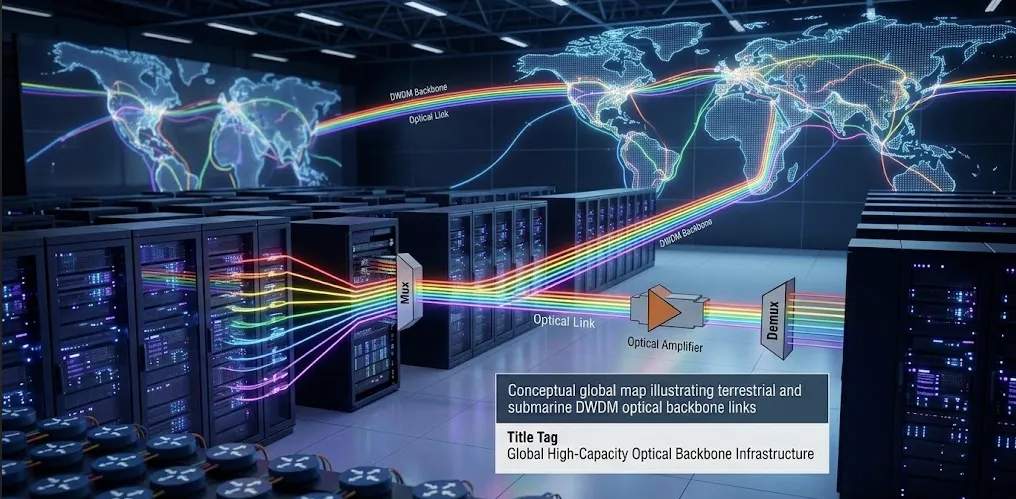
When data needs to cross a continent or an ocean, it relies on long-haul transport networks. These sprawling networks stretch for thousands of kilometers between major metropolitan nodes. Because these long-distance paths are subject to high physical attenuation over such expansive distances, the seamless integration of all-optical amplification is crucial. This technology ensures that transcontinental links can maximize their bandwidth without requiring expensive electrical regeneration sites every few dozen miles.
Metropolitan Area Networks (MANs)
Closer to home, municipal and regional infrastructures use converged Optical Transport Systems to aggregate varied traffic types across cities. These metropolitan networks serve as the primary collection point, taking high-capacity corporate leases, distributed university campus networks, and local 5G mobile backhaul traffic and consolidating them all onto a singular, unified municipal fiber ring.
The Evolution of Optical Networks: Moving Toward Terabit Capacities
As we look toward the future, the boundaries of optical networking continue to expand. The industry is rapidly moving beyond traditional fixed-grid channel allocations, where every wavelength was restricted to a static, predetermined slice of the spectrum. Newer deployments utilize flexible grids (“Flex-Grid”), which allow the network to dynamically adjust the width of a channel based on the specific volume and modulation of the data passing through it.
Furthermore, the integration of coherent optics and advanced digital signal processing (DSP) enables modern networks to push individual wavelength speeds well past old limits, moving toward 800G and even 1.2T per single lambda. According to published engineering insights from the IEEE Optical Communications research groups, the focus is shifting toward intelligent, self-optimizing optical layers. In these next-generation networks, artificial intelligence algorithms monitor real-time performance, automatically adjusting laser states, modulation formats, and path routing to counter subtle changes in physical fiber health.
Conclusion
Dense wavelength division multiplexing is much more than a clever way to boost internet speeds. It represents a fundamental architectural shift that has decoupled global network capacity from the limitations of physical cable deployment. By packing multiple, independent channels of light into a single strand of glass, DWDM protects historical infrastructure investments, optimizes ongoing operational costs, and provides the scalable foundation required to support our increasingly data-driven world. As global data demands continue to surge, this elegant technology will remain the quiet force keeping our global digital civilization connected.
FAQ
How does a DWDM system differ from a CWDM architecture regarding maximum distance?
The primary differentiator is the ability to leverage inline amplification. Because CWDM wavelengths are widely spaced across a broad spectrum (1270 nm to 1610 nm), it is nearly impossible to amplify all channels simultaneously with a single device, limiting its effective reach to roughly 80 km. Conversely, the dense alternative packs its channels tightly within the optimal C-band and L-band windows, which perfectly matches the operational profile of Erbium-Doped Fiber Amplifiers (EDFAs). This allows the combined signal to be boosted repeatedly in the optical domain, enabling it to travel thousands of kilometers without degradation.
Why are EDFAs critical for long-haul DWDM operations?
EDFAs are vital because they provide all-optical amplification, boosting dozens of closely packed wavelengths simultaneously without needing to convert the light back into electrical signals. This completely removes the electronic processing bottlenecks, high power consumption, and added latency associated with traditional O-E-O regeneration systems, making ultra-long-distance optical transport both economically viable and technically efficient.
Can existing legacy fiber cables support modern DWDM deployments without modification?
In most cases, yes. One of the primary economic benefits of this technology is its ability to run over standard, existing single-mode fiber (such as G.652 glass) that may have been installed decades ago. While the physical glass strands can remain in place, the equipment at the ends of the fiber—such as the transponders, multiplexers, and inline amplifiers—must be updated to handle the tight tolerances and precise laser frequencies required for high-density operation.