
Demystifying the OSI Model: Optical Networking’s Layer
When building out high-capacity infrastructure, engineers rely heavily on advanced optical transport systems to manage these physical realities. Because everything in this space deals directly with the raw manipulation of glass and light, the core operational mechanics are firmly grounded at the very bottom of the OSI stack.
Why DWDM is Strictly a Layer 1 (Physical Layer) Technology
Dense Wavelength Division Multiplexing, or DWDM, is a method of multiplexing multiple optical carrier signals onto a single optical fiber by using different wavelengths (colors) of laser light.
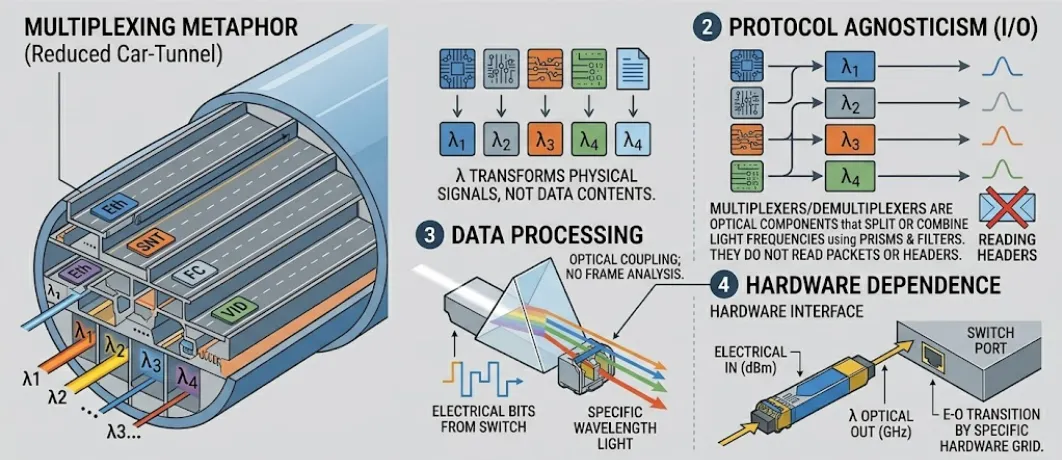
The easiest way to conceptualize this is to think of a massive highway. A single fiber strand without multiplexing is like a single-lane road that can only handle one car at a time. Implementing DWDM is the equivalent of expanding that road into an 80-lane superhighway. Each lane operates at a specific frequency, completely independent of the others.
Here is why this process is strictly a Layer 1 operation:
Protocol Agnosticism: A wavelength does not care if it is carrying Ethernet, SONET/SDH, Fibre Channel, or raw digital signals. It simply transports the physical energy from one end to another.
No Data Awareness: The multiplexers and demultiplexers used in these systems do not open packets or read headers. They are passive or active optical components that split or combine light frequencies using prisms and filters.
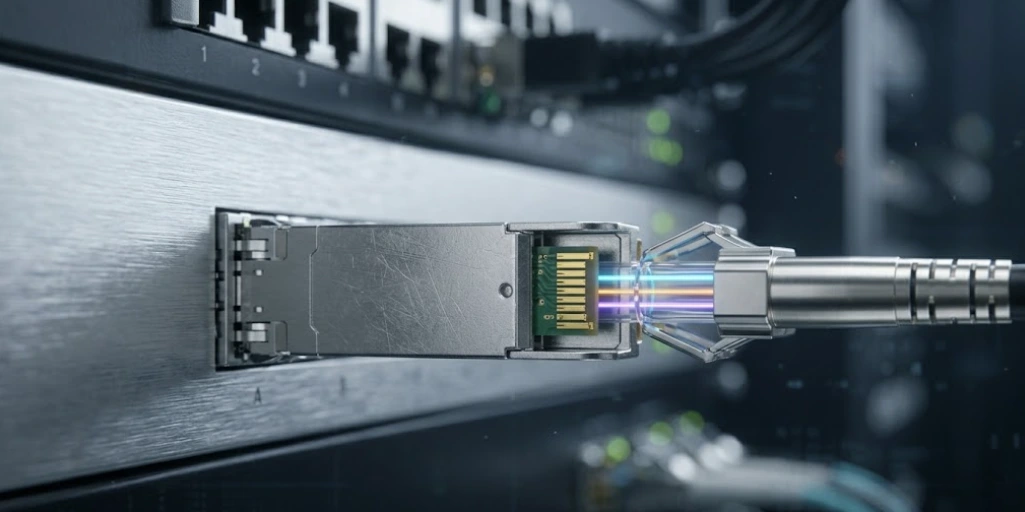
Hardware Dependence: The transition from the electrical world to the optical world happens at the physical hardware level. An optical transceiver converts the electrical bits from a switch or router into a highly precise, specific wavelength of light that matches the strict grid required by the multiplexing equipment.
Because the technology operates entirely in the domain of physics, light modulation, and frequency spacing, it fulfills every definition of a Layer 1 physical medium dependent technology.
Comparison Table: Layer 1 vs. Layer 2 in Optical Networks
To clarify how these responsibilities are split, it is helpful to contrast the physical layer elements against the data link elements that often sit directly on top of them.
| Network Attribute | Layer 1 (DWDM / Physical Layer) | Layer 2 (Data Link Layer / e.g., Ethernet, OTN) |
|---|---|---|
| Primary Unit | Photons, Wavelengths (nm), Frequencies (THz) | Frames, Packets, Bits |
| Data Awareness | Completely blind to data structures and protocols | Aware of MAC addresses, frame boundaries, and errors |
| Core Functions | Multiplexing, optical amplification, wavelength conversion | Error detection (FEC), switching, quality of service (QoS) |
| Typical Hardware | Mux/Demux, EDFA amplifiers, transponders, transceivers | Switches, Network Interface Cards (NICs), OTN processors |
| Addressing | None (Point-to-point physical channels) | Hardware addressing (MAC addresses) |
The Blurred Lines: DWDM, OTN, and Modern Transport Architecture
If the distinction is so clear, why does confusion persist? The ambiguity usually arises because modern networks rarely deploy raw physical wavelengths in total isolation anymore. Instead, they wrap them in management and framing layers.
When exploring the deeper mechanics in resources like What Is DWDM in Optical Networking? Benefits, Components, and Applications, you find that modern optical transport frequently pairs multiplexing with Optical Transport Network (OTN) protocols. Defined by the International Telecommunication Union (ITU-T G.709 standard), OTN introduces a framing structure over the wavelengths. This framing adds Forward Error Correction (FEC), performance monitoring, and fault isolation capabilities.
Because OTN wraps the data into distinct digital wrappers, it introduces elements that feel very much like Layer 2 functionality. When an engineer manages a modern transponder card, they are often interacting with software that monitors frame loss and bit error rates. This makes the system feel “data-aware.” However, it is vital to separate the transport protocol (OTN) from the underlying multiplexing technique. The protocol provides the smart wrapper, but the actual transmission medium remains individual lanes of light.
Conclusion: The Bedrock of High-Capacity Connectivity
At the end of the day, despite the sophisticated software management suites and the complex framing protocols that ride on top of modern infrastructure, DWDM remains a definitive Layer 1 powerhouse. It is the literal bedrock upon which higher network layers sit.
Without the physical magic of splitting light into dozens of distinct, non-interfering frequencies, our fiber infrastructure would have hit a hard physical capacity wall years ago. By keeping it strictly protocol-agnostic at Layer 1, network operators retain the ultimate flexibility to upgrade capacity, shift protocols, and scale out their systems without ever having to dig up the physical fiber paths buried in the ground.
FAQ
Does a DWDM system require an IP address to function?
DWDM’s core optical hardware (multiplexers, splitters, fiber) does not use IP addresses for wavelength‑based data transmission. Only its management chassis and transponders get IP addresses for remote monitoring. Administrators use SNMP or web tools to check laser status, optical power and system health separately from Layer 1 data traffic.
How does DWDM differ from CWDM at the physical layer?
The key difference is wavelength spacing. CWDM uses wide 20 nm gaps, enabling low‑cost uncooled lasers but only ~18 channels. DWDM employs narrow 0.4–0.8 nm spacing with temperature‑stabilized precision lasers, supporting 80+ channels for long‑haul, high‑density networks.
Can Layer 1 optical security prevent data breaches on a DWDM link?
Because DWDM operates entirely at the physical layer, traditional software-based security measures like firewalls cannot see it. However, because it is Layer 1, physical security threats like fiber tapping (where a bad actor physically bends the glass fiber to leak photons) are real risks. To counter this, modern systems utilize Layer 1 optical encryption, which encrypts the raw stream of bits directly at the transponder level before it turns into light. This ensures that even if someone physically taps into a specific wavelength, they only capture scrambled bits without any discernible protocol structure.