
What is an Optical Transport Network exactly? At its core, OTN is what happens when you take the operational wisdom of SDH — all those management features, performance monitoring capabilities, and protection mechanisms — and wrap them around the raw bandwidth of DWDM. It’s specified in ITU-T G.709 (often called “digital wrapper” technology), and it fundamentally changes how operators think about optical transport.
For a closer look at the equipment that makes this possible, check out this optical transport network product lineup, which covers the hardware side of modern OTN deployment.
The Layers That Make OTN Work
One of the cleverest things about OTN is its layered structure. It’s not a monolithic slab of technology; it’s a stack of functional layers, each handling a specific job.
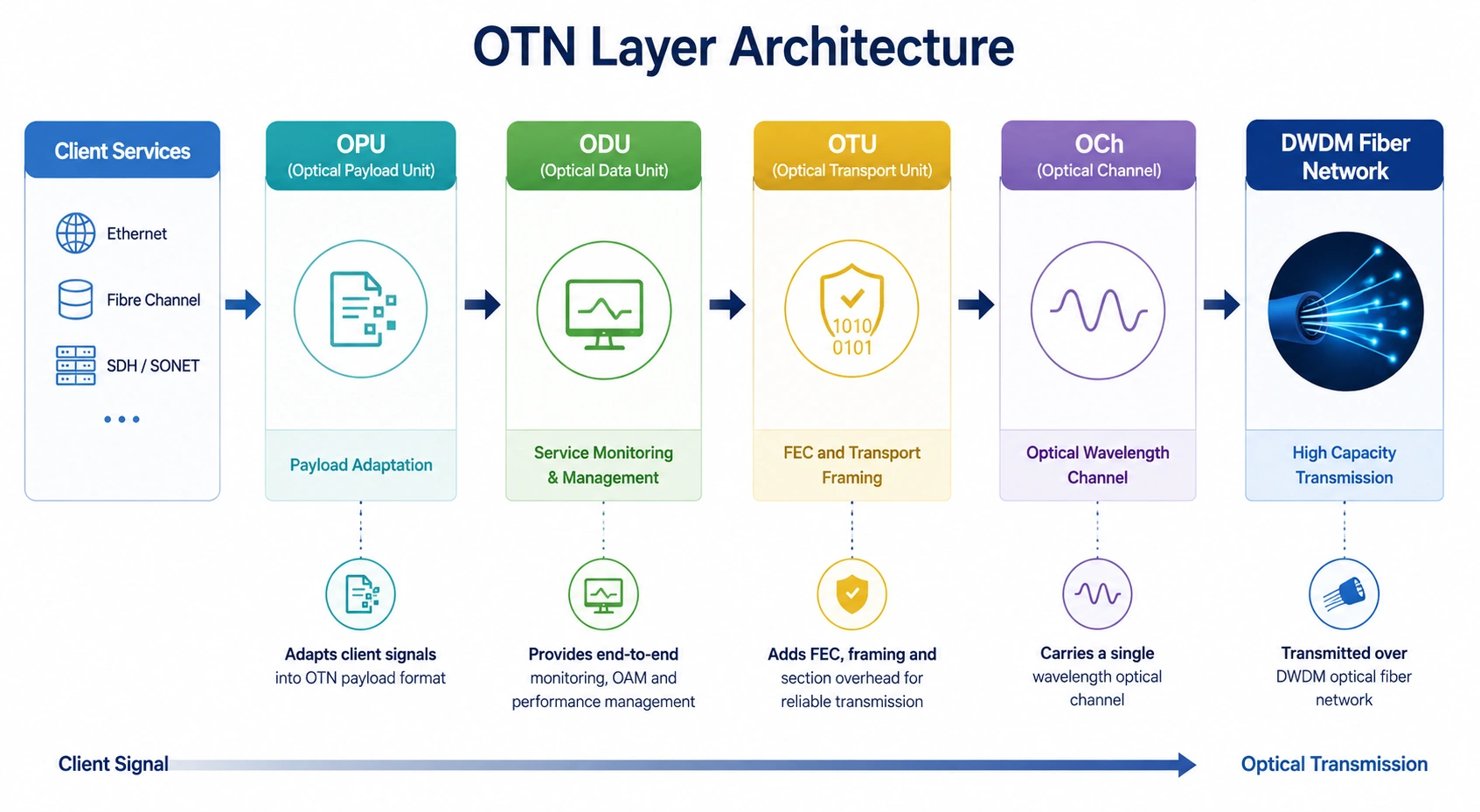
At the bottom sits the optical channel (OCh) — basically, a single wavelength of light carrying a single client signal. Above that, multiple OCh signals get combined into an optical multiplex section (OMS). And then you have the optical transmission section (OTS), which handles the actual fiber spans between amplifiers.
But the real magic happens inside the digital wrapper.
Here’s where things get interesting. OTN defines three core information structures:
- OPU (Optical Channel Payload Unit) — adapts the client signal (Ethernet, Fibre Channel, SDH, whatever) into a format suitable for OTN transport
- ODU (Optical Channel Data Unit) — adds the end-to-end path overhead; think of this as the “service layer” that enables performance monitoring across the whole network
- OTU (Optical Channel Transport Unit) — adds framing, forward error correction, and section-level overhead for transmission across a specific fiber span
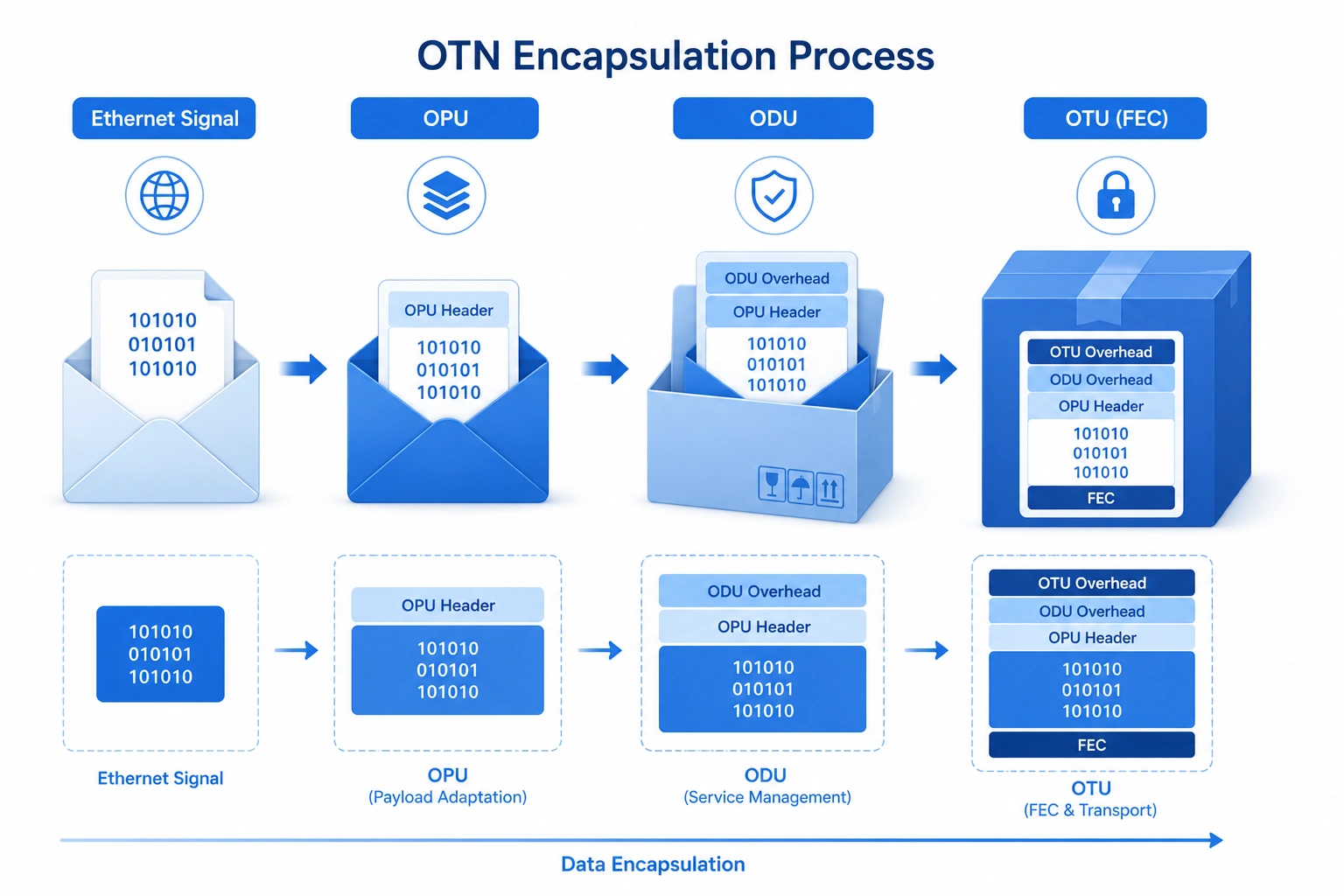
In practice, the mapping process looks like this: a customer Ethernet signal gets wrapped into an OPU. That OPU gets wrapped into an ODU with its own overhead for path-level management. Then that ODU gets wrapped into an OTU with FEC bytes tacked on at the end. The result is a bit like putting a letter into an envelope, that envelope into a padded mailer, and that mailer into a shipping box — each layer adds its own tracking and handling information.
And because the transport entity is the end-to-end networking entity, operators can monitor the health of a service from one edge of the network to the other, regardless of how many intermediate nodes it passes through.
ODU bit rates have been standardized across several levels: ODU0 at about 1.25 Gb/s, ODU1 at 2.50 Gb/s, ODU2 at 10.04 Gb/s, ODU3 at 40.32 Gb/s, and ODU4 at about 104.79 Gb/s. There’s also ODUflex, which lets operators create containers of arbitrary size for services that don’t fit neatly into the fixed hierarchy — a huge improvement over the old SDH world.
Why OTN Actually Matters (Beyond the Hype)
The elevator pitch for OTN is simple: it gives you SDH-like manageability on DWDM-like capacity.
But let’s break down what that actually means in day-to-day operations.
Forward Error Correction (FEC) is one of those features that nobody talks about until it saves a network from a fiber fault. In traditional DWDM systems, signal degradation was handled by regenerators — expensive boxes that did optical-electrical-optical conversion at regular intervals. OTN bakes FEC directly into the OTU frame, adding enough redundant information that the receiver can correct bit errors without needing full regeneration. That translates directly into longer spans and fewer regenerators.
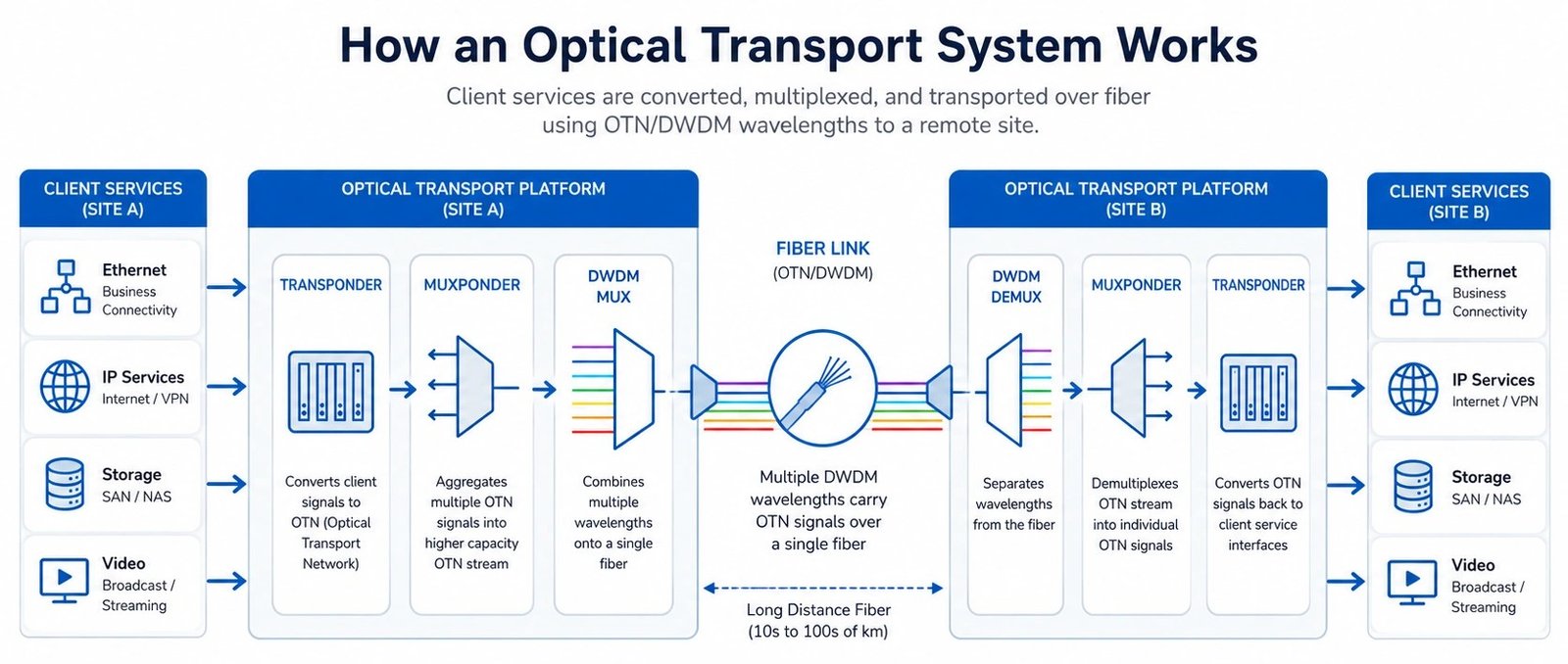
Transparency is another big one. OTN doesn’t care what’s inside the OPU payload. It can be a 10 Gigabit Ethernet stream, a Fibre Channel storage link, a legacy SDH circuit, or even another OTN signal. The digital wrapper just passes it through without modification.
And then there’s the management story. Each ODU has its own overhead channel, which means operators can run fault management, performance monitoring, and protection switching on a per-service basis. In a WDM-only world, you’d have visibility only at the physical layer — useful, but not nearly granular enough for SLA management.
For a practical example of how OTN can flexibly handle multiple traffic types on a single chassis, take a look at this multi service transport platform, which is designed specifically for hybrid network environments.
OTN and DCI: A Match Made in the Cloud
Data Center Interconnect (DCI) is arguably the fastest-growing application for OTN technology today. The reason isn’t complicated: hyperscalers and cloud providers need to move massive amounts of traffic between geographically distributed data centers, and they need to do it reliably.
In 2025 alone, the DCI platform market was valued at US$11.84 billion, and analysts project it will reach nearly US$25 billion by 2032. That’s a lot of inter-data-center links.
OTN fits this application perfectly for a few reasons. First, the bandwidth scales to match modern DCI requirements — single-wavelength rates of 800G are already in commercial deployment, and 1.6T is on the horizon. Second, the per-service management capabilities help cloud operators maintain tight SLA controls across long-haul interconnects. And third, OTN’s built-in protection switching means a fiber cut between data centers doesn’t automatically turn into a multi-minute outage.
Some manufacturers have started shipping specialized DCI platform solutions that integrate OTN switching directly into high-density DCI chassis, minimizing space and power at colocation facilities. This is a trend worth watching: as DCI links become shorter (some metro DCI connections are measured in tens of kilometers rather than hundreds), the cost-per-bit equation shifts, and OTN’s overhead needs to justify itself against simpler IP-over-DWDM approaches.
OTN vs. WDM vs. SDH: Clearing Up the Confusion
A surprising number of industry professionals still struggle to articulate the difference between these three technologies. Here’s a quick breakdown that might help.
WDM (Wavelength Division Multiplexing) is the underlying transport mechanism. It’s the layer that combines multiple wavelengths of light into a single fiber. Think of it as the highway itself — lots of lanes, but no traffic lights, no signs, and no real management beyond “make sure the lanes exist”.
SDH/SONET came first. It offered rich OAM capabilities and rigorous performance monitoring, but it was limited in bandwidth (40G per channel max) and inflexible in how it handled non-TDM traffic.
OTN sits between these two extremes. It takes the management smarts of SDH and applies them to the scalable capacity of WDM. If WDM is a multi-lane highway, OTN is the traffic control system that monitors each vehicle, reroutes around accidents, and logs every trip.
| Feature | WDM | SDH/SONET | OTN |
|---|---|---|---|
| Primary function | Transmission | Multiplexing + OAM | Transport + OAM + grooming |
| Max per-channel rate | 800G+ (DWDM) | 40G | 400G+ (800G emerging) |
| FEC capability | Limited | Basic | Standardized, high-performance |
| End-to-end monitoring | No | Yes (per VC) | Yes (per ODU) |
| Transparency to client protocols | High | Low (TDM-centric) | High (any protocol) |
The practical takeaway? If you only need raw point-to-point capacity, WDM is fine. If you’re running a legacy TDM network, SDH still works. But if you need to transport a mix of Ethernet, storage, and legacy traffic across a regional or national footprint — with proper management and protection — OTN is the answer.
The Road Ahead: 800G, 1.6T, and Beyond
The OTN story doesn’t end with today’s standards. The industry is already pushing hard into higher speeds and broader spectral efficiency.
As of 2026, long-haul 400G and metro 800G are well into commercial deployment. Long-haul 800G is in technical development, and metro 1.6T isn’t far behind. To put that in perspective: a single wavelength running at 1.6 Tb/s can carry about 1.6 million simultaneous 1 Mbps video streams. On one color of light.
The optical transport network equipment market is growing right alongside these speed increases. Dell’Oro Group estimates the market hit roughly $16 billion in 2025, with continued year-over-year growth in the 10% range as carriers and cloud providers upgrade their infrastructure.
Meanwhile, the standards bodies are keeping busy. ITU-T has been working on fine-grain ODUflex (fgODUflex) to handle sub-1G services more efficiently, as well as new FlexO interfaces designed to interoperate across multi-vendor environments. There’s even discussion of quantum-secure optical transport and AI-powered dynamic routing as OTN networks become more software-defined.
The traditional boundaries between OTN and IP layers are starting to blur as well. But that’s probably a topic for a separate article.

Conclusion
The Optical Transport Network isn’t the flashiest technology in telecom. It doesn’t have the marketing budget of 5G or the venture capital attention of AI networking startups. But it quietly underpins a huge percentage of the world’s long-haul optical infrastructure, and its importance is only growing as traffic volumes continue to double every few years.
For network planners evaluating where to invest their optical budgets, OTN deserves serious consideration — not as a replacement for DWDM or IP, but as a complementary layer that adds management, protection, and granularity to high-speed optical transport.
And as the industry pushes toward 1.6T and beyond, those management features will matter more, not less. Because raw bandwidth is impressive. But bandwidth you can actually see, measure, and protect? That’s worth paying for.
FAQ
Is OTN going to be replaced by IP-over-DWDM in the long run?
Not likely, for a simple reason: IP routers are terrible at sub-wavelength grooming. If you have a 10G service and a 100G wavelength, a pure IP-over-DWDM approach either wastes most of the wavelength or requires complex packet aggregation. OTN’s ODUflex provides a granularity that IP alone can’t match efficiently. The more realistic scenario is convergence — OTN and IP layers working together under a unified SDN controller — rather than outright replacement.
What’s the real-world latency impact of OTN wrappers?
Every OTN wrapper adds some overhead, usually around 7% more line rate than the raw client signal to accommodate FEC and management bytes. In terms of latency, the impact is measured in microseconds per node — negligible for most applications. For ultra-low-latency trading networks, operators sometimes bypass OTN entirely and use direct dark fiber, but that’s a niche use case. For 99% of enterprise and carrier traffic, OTN’s added latency is unnoticeable.
Can OTN run on existing fiber infrastructure without major upgrades?
Yes, that’s actually one of its selling points. Because OTN is designed to layer on top of DWDM, it can use existing fiber plants and optical amplifiers with relatively minor changes at the endpoints. The main investment is in OTN-capable transponders and switching gear. That said, if the existing WDM system lacks the monitoring and control capabilities that OTN expects, some hardware refresh may still be necessary. Most operators find the trade-off worthwhile given the operational improvements.