
Why Data Center Interconnect Is Getting Harder to Design
The demand for data center interconnect has changed a lot in just a few years. What used to be a straightforward bandwidth upgrade is now tied to cloud expansion, AI traffic, distributed workloads, and the general pressure to move data faster between sites. In many cases, the network is no longer the bottleneck in theory — it becomes the bottleneck in practice.
That is especially true when operators need to connect nearby facilities, metro sites, or even long-haul backbone locations under different traffic conditions. A modern DCI solution has to do more than push capacity. It needs to be compact, reliable, scalable, and easy enough to manage without requiring a full team of optical specialists.
That combination is exactly where many legacy WDM systems start to feel heavy. They can work, of course, but they often bring complexity, bulky hardware, and a steeper learning curve than many teams want today.
What Makes DCI-3200 + ZDCI(BOX)-1800 Different
The DCI-3200 + BOX/ZDCI-1800 platform is built around a simple idea: high-capacity optical transport should not be difficult to deploy or operate. Instead of forcing data center teams to adapt to old-school equipment, it is designed to fit the environment data centers already use.
Built for modern data center environments
One of the most practical strengths is the 2U+1U standard server form factor. That may sound like a small detail, but rack space is expensive, and front-to-rear airflow matters more than it seems at first glance. In real deployments, a platform that fits standard racks cleanly can save time during installation and avoid unnecessary layout compromises.
It also supports AC, DC, and high-voltage DC power options, which gives more flexibility for different facilities and operating models. For operators managing mixed environments, that kind of compatibility reduces friction pretty quickly.
Designed for Reliability
Reliability is another area where this platform stands out. It includes 1+1 redundancy for control cards, power supplies, and fans, plus hot-swappable service cards. In other words, maintenance does not automatically have to mean service interruption, which is still a big deal in DCI environments.
It also supports 1+1 optical line protection, making it a better fit for networks where uptime is not optional. For many teams, that combination feels less like an upgrade and more like a practical correction to the limitations of older systems.
Capacity That Scales Without Rebuilding the Network
High-capacity network infrastructure is no longer a luxury in DCI. Traffic keeps growing, and it tends to grow unevenly — one site expands, then another, and suddenly the original design feels too small.
6.4Tbps+ per chassis
The platform delivers 6.4Tbps+ per chassis, which is a meaningful capacity level for dense interconnect environments. More importantly, it supports multi-chassis cascade expansion, so scaling does not require starting over. That is often where the real value appears: the system can evolve with traffic demand instead of being replaced too soon.
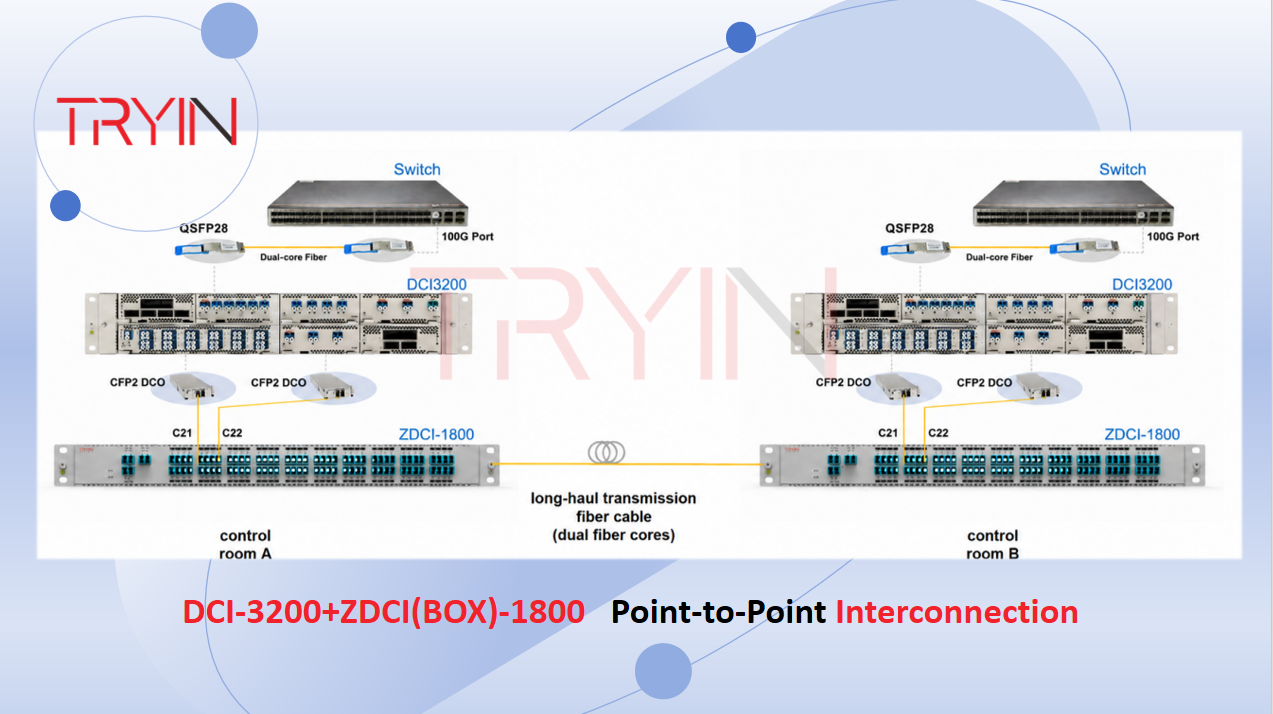
Flexible electrical and optical layering
Another useful strength is the way it handles both the electrical and optical layers.
For DCI-3200 high-speed WDM transmission platform
At the electrical layer, it supports:
- 200G muxponder cards
- 400G muxponder cards
- T10/T20 Muxponder cards
- OEO cards
At the optical layer, it includes:
- WSS
- EDFA/RFA amplification
- OTDR link monitoring
For ZDCI-1800 Intelligent Optical Automatic Processing System
1. End-to-End Scenario Coverage
From access and metro to backbone networks, plus DCI and 5G xHaul — one platform addresses all optical transport use cases.
2. Deep Technology Integration
Converges WDM, EDFA, AWG, tunable TDCM, MEMS, OPM, and OTDR into a single subsystem — eliminating the need for discrete external modules.
3. Link-Aware Self-Optimization
Dynamic dispersion and power compensation with real-time fiber link adaptation — cuts provisioning time and reduces field engineering dependency.
4. Multi-Layer Visibility
Service, link, and equipment-level monitoring with fault isolation and root-cause analysis — operational insight across the entire photonic layer.
5. Open, Carrier-Grade Architecture
Standards-based design ensures interoperability across vendor ecosystems and lowers integration overhead for diverse deployment environments.
6. OPEX Reduction
High functional density combined with unified management drives down lifecycle operational costs — purpose-built for lean network operations teams.
| Capability | DCI-3200 + ZDCI(BOX)-1800 | Typical Legacy WDM Platform |
|---|---|---|
| Form factor | 1U/2U server-style chassis | Often bulkier, less standardized |
| Capacity | 6.4Tbps+ per chassis | Varies, often lower density |
| Expansion | Multi-chassis cascade | More constrained |
| Protection | 1+1 line protection, redundant components | May require more manual planning |
| Operations | Web-based, simple GUI | Often complex and specialist-heavy |
| Best fit | 5G xHaul | Traditional optical transport use cases |
A Simpler Way to Operate Optical Transport
For many teams, operational simplicity matters just as much as raw performance. In some deployments, the network works fine on paper but becomes harder to manage once real people have to provision services, check status, or respond to alarms.
Web-based GUI lowers the learning curve
The B/S architecture Web GUI is a meaningful advantage because it reduces the need for deep optical expertise. That does not mean the system is simplistic. It means common tasks can be handled in a way that feels more familiar to DC operations teams.
Instead of making every maintenance task feel specialized, the platform presents management in a more accessible format. That can make a real difference in day-to-day use, especially when staffing is tight or multiple sites need to be monitored at once.
By fitting into current workflows more naturally, DCI-3200 + ZDCI-1800 can reduce OPEX and avoid the hidden costs that come from training, troubleshooting, and manual workarounds. That part is often underestimated until the network is already live.
One Platform for Three Common Deployment Scenarios
Different DCI projects need different transmission characteristics, and this is where the DCI-3200 + BOX/ZDCI-1800 combination becomes especially useful.
Data Center Interconnect under 100km
For short-distance DCI, 400G coherent transmission provides low-latency, high-bandwidth connectivity between nearby data centers. This is a strong fit when speed and simplicity matter more than long-reach complexity.
Metro backhaul from 100–600km
For urban and regional traffic, BOX1800 offers DWDM multiplexing with OLP protection, helping maintain reliability while traffic moves across metro routes. In this range, stable service continuity often matters just as much as capacity.
Long-haul backbone beyond 600km
For long-distance transport, QPSK modulation combined with RFA Raman amplification helps extend reach while keeping signal integrity strong. That makes the platform suitable for backbone scenarios where optical performance has to hold up over larger spans.
Real-World Deployment Examples
The platform is easier to understand when viewed through real deployment patterns. A few examples stand out:
- A metro DCI optical link deployment saved valuable rack space thanks to the 2U high-density design.
- A 3 point-to-point system deployment used 200G line-side + 20x10G client-side connectivity with dual-route 1+1 OLP protection.
- A 4-site ring topology deployment used 200G coherent transmission with built-in ring redundancy.
These examples point to the same conclusion: the system is not only about capacity. It is also about practical deployment, resilience, and manageable operations.
Why This Matters for Future DCI Builds
In next-generation data center interconnect planning, the real challenge is no longer just “how much bandwidth can be added?” It is also “how cleanly can that bandwidth be deployed, protected, and operated?”
That is where DCI-3200 + ZDCI-1800 stands out. DCI-3200 + ZDCI-1800 combines server-grade deployment simplicity with carrier-grade optical performance — a purpose-built alternative to legacy WDM complexity for modern data center interconnect.