
Data Center Interconnect — or DCI — refers to the networking infrastructure that links two or more data centers together, enabling them to share resources, replicate data, and operate as a unified system. It’s the connective tissue that makes distributed computing actually work. And in a world where organizations routinely operate across multiple facilities (sometimes spread across cities or even continents), that connectivity isn’t just nice to have. It’s fundamental.
The global DCI market has been expanding rapidly. According to Research and Markets, the sector grew from approximately $15.38 billion in 2025 to an estimated $17.54 billion in 2026, reflecting a compound annual growth rate of 14.1%. Those numbers underscore a straightforward reality: enterprises, cloud providers, and service operators are investing heavily in interconnect capacity — and they’re doing so with urgency.
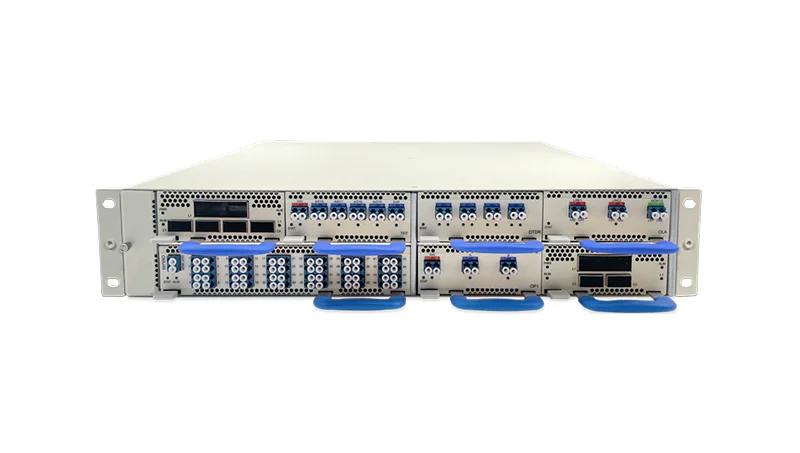
Why Data Center Interconnect Matters Now
The way data moves has changed. A few years ago, most traffic flowed north-south — users requesting data from a central server. Today, east-west traffic dominates. Data moves laterally between servers, between clusters, and between geographically separated facilities. This shift has made robust inter-data-center connectivity a necessity rather than an afterthought.
Several forces are driving this:
- AI and distributed compute — Training large models often requires GPU clusters too power-hungry for a single building. Distributing workloads across sites only works if those sites are tightly connected with low-latency, high-bandwidth links.
- Hybrid and multi-cloud architectures — Enterprises are mixing private infrastructure with public cloud services, creating traffic patterns that require seamless interconnection.
- Edge computing — Smaller data centers closer to end users mean more locations that need to stay synchronized with central facilities.
- Business continuity — Real-time replication and failover require persistent, high-capacity links between redundant sites.
The result is that DCI has become, arguably, the fastest-growing segment of network infrastructure — with some industry sources citing annual bandwidth growth exceeding 50%.
How DCI Works — Core Technology Components
At its foundation, data center interconnect relies on high-speed optical and networking technologies working in concert. Understanding the building blocks helps clarify what separates a well-designed interconnect from a cobbled-together solution.
Fiber Optic Infrastructure
Single-mode fiber remains the backbone for long-haul DCI connections. It can carry signals over 100 km or more without amplification — critical when data centers sit in different metro areas or regions. Multi-mode fiber, by contrast, handles shorter intra-campus links.
Dense Wavelength Division Multiplexing (DWDM)
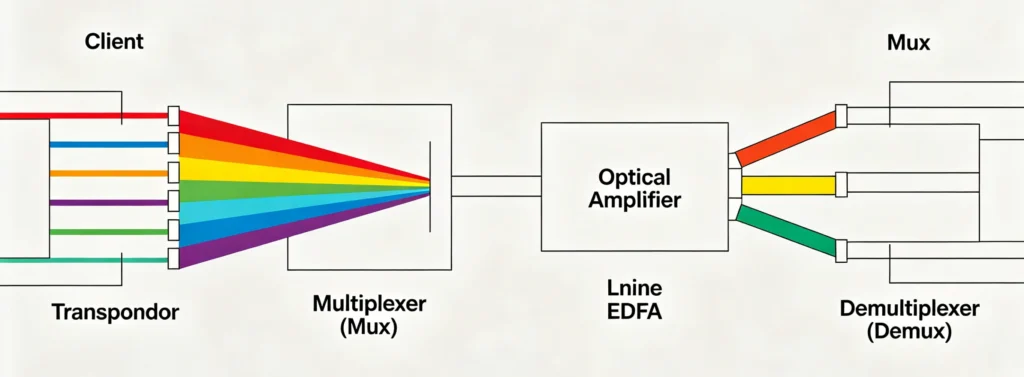
DWDM multiplies fiber capacity by transmitting multiple data streams on different wavelengths of light simultaneously. A single fiber pair can carry dozens — even hundreds — of independent channels. For high-capacity interconnects, DWDM is essentially the standard.
Optical Transport Network (OTN)
Defined by the ITU-T G.709 standard, OTN provides a digital wrapper for organizing, monitoring, and managing optical signals. OTN (Optical Transport Network) provides a digital framing and multiplexing layer that encapsulates client signals for transport over optical networks. Modern Optical Transport Systems build on this framework to deliver carrier-grade reliability.
Software-Defined Networking (SDN)
SDN separates the control plane from the data plane, enabling centralized, programmable management of interconnect resources. It allows operators to provision bandwidth, enforce policies, and respond to traffic changes dynamically — without manually reconfiguring hardware at each site.
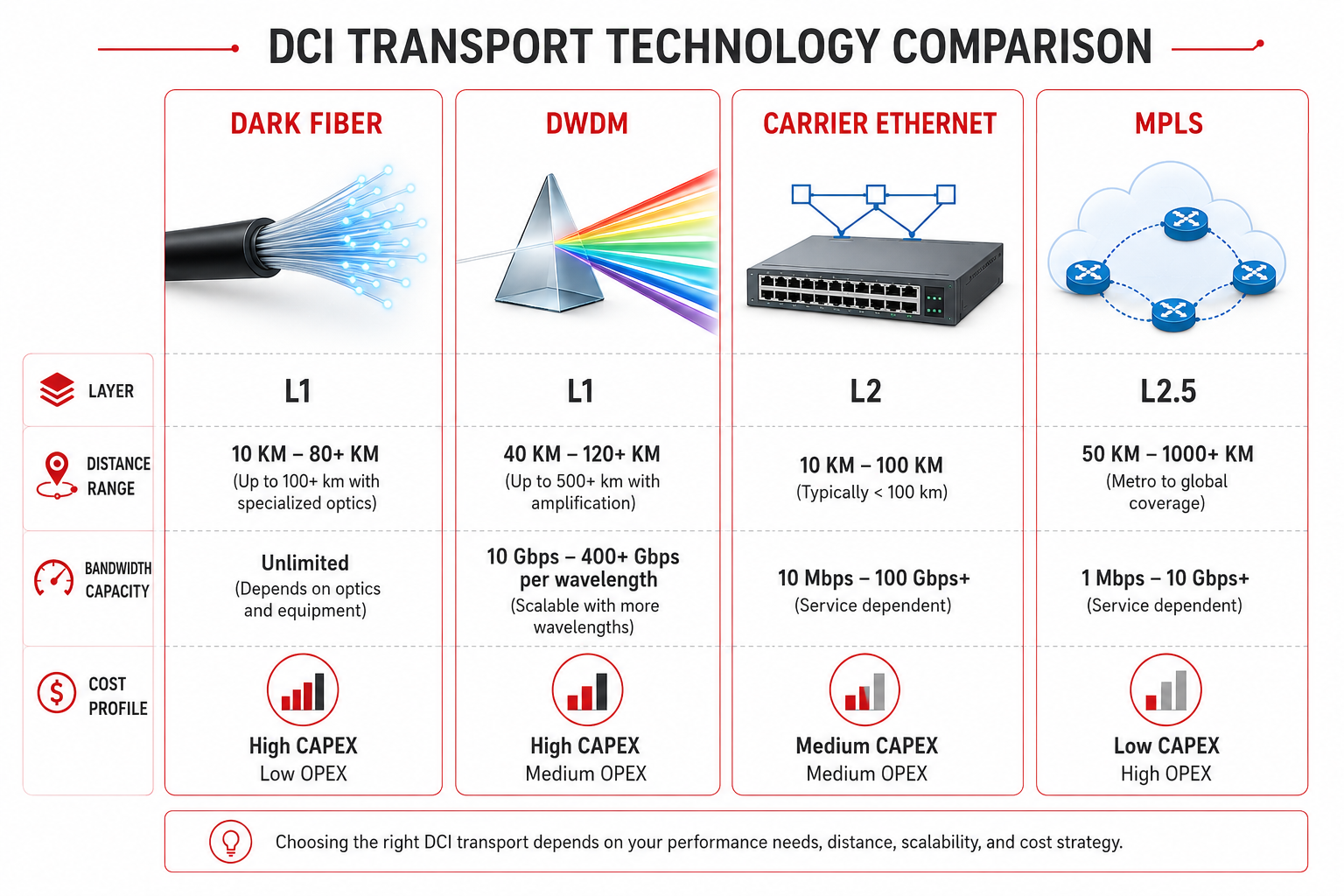
Table 1: DCI Transport Technology Comparison
| Technology | Layer | Typical Distance | Bandwidth | Cost Profile | Best For |
|---|---|---|---|---|---|
| Dark Fiber | Layer 1 | Metro to long-haul | Scalable (with equipment) | High CapEx, low OpEx | Full control, high growth |
| DWDM | Layer 1 | Metro to long-haul | Very high (Tbps) | Moderate–High | High-capacity backbone |
| Carrier Ethernet | Layer 2 | Metro | Up to 100 Gbps | Moderate | Quick deployment |
| MPLS | Layer 2.5 | Any | Variable | Ongoing OpEx | Multi-site WANs |
Common DCI Architecture Types
Not every organization needs the same topology. Architecture choices depend on scale, budget, redundancy requirements, and how many sites are involved.
- Point-to-point — A direct link between two facilities. Simple, low-latency, but limited in flexibility.
- Hub-and-spoke — A central data center connects to satellite sites. Cost-effective and easier to manage, though the hub becomes a potential single point of failure.
- Mesh / Full-mesh — Every site connects to every other site. Highly resilient but expensive and complex to manage.
- Software-defined interconnect — Uses SDN principles to abstract physical topology, enabling dynamic path selection and policy-based routing regardless of the underlying fiber layout.
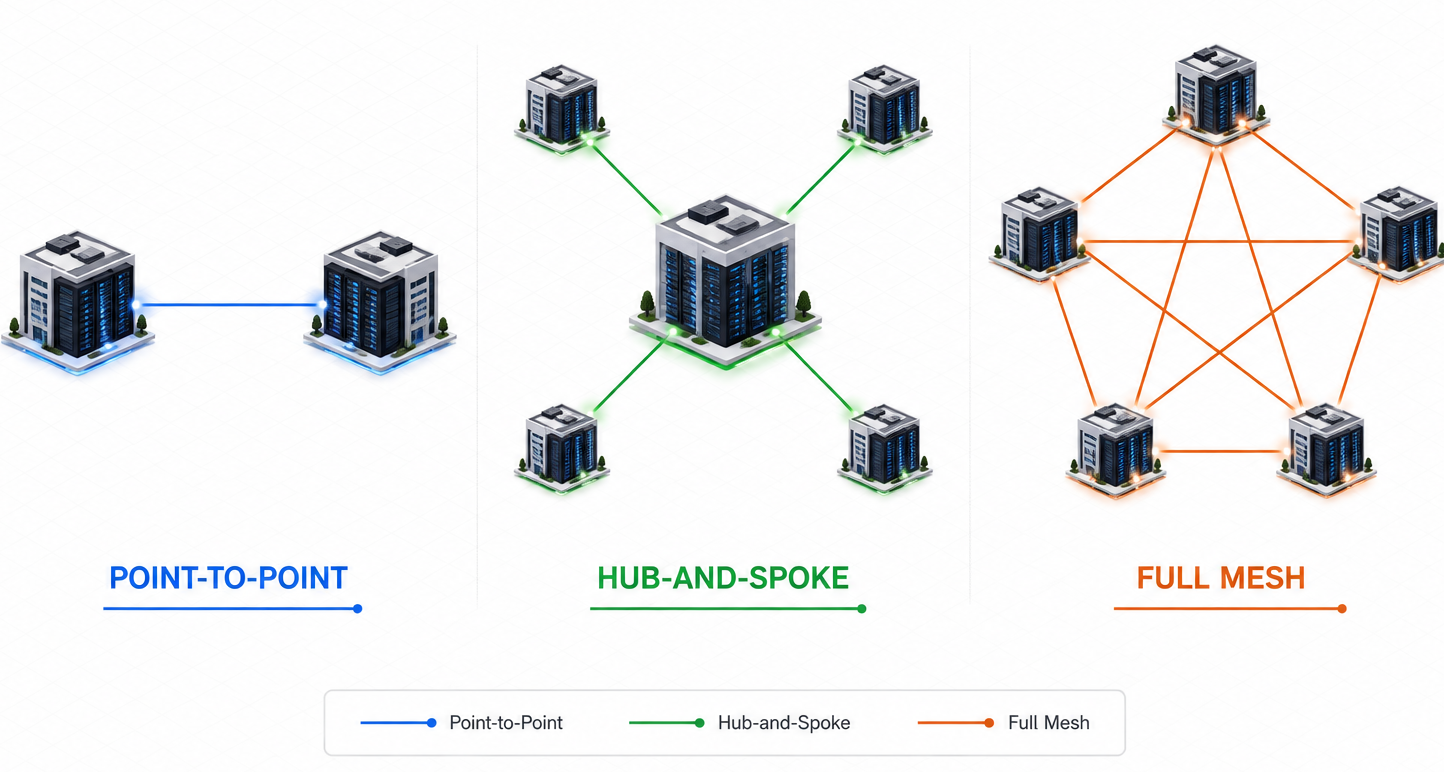
Table 2: Architecture Comparison
| Architecture | Scalability | Redundancy | Complexity | Ideal Use Case |
|---|---|---|---|---|
| Point-to-point | Low | Low | Simple | Two-site DR setups |
| Hub-and-spoke | Moderate | Moderate | Moderate | Centralized enterprise |
| Full-mesh | High | Very high | High | Mission-critical global ops |
| Software-defined | High | Configurable | Moderate | Dynamic, policy-driven networks |
Key Benefits of Data Center Interconnect
When implemented well, DCI delivers a range of operational and strategic advantages:
- Disaster recovery and business continuity — Real-time data replication across geographically diverse sites ensures services remain available even during site-level failures.
- Dynamic workload balancing — Traffic can be shifted between facilities based on current load, preventing bottlenecks and improving resource utilization.
- Reduced latency for distributed users — Connecting multiple sites closer to user populations decreases response times.
- Stronger security posture — Modern interconnect solutions support encryption in transit, helping meet compliance mandates.
- Live migration and workload mobility — Applications and virtual machines can move between data centers with minimal disruption.
Challenges in DCI Deployment
For all its benefits, deploying data center interconnect infrastructure isn’t trivial. Several pain points consistently surface:
Provisioning complexity — Setting up DCI involves coordinating routing protocols, optical systems, encryption, and monitoring across multiple sites and (often) multiple vendors. Without deep networking expertise, the learning curve is steep.
Cost — Fiber, optical equipment, and ongoing operational expenses add up quickly. Over-provisioning wastes capital; under-provisioning creates performance headaches down the line.
Multi-vendor management — Many organizations rely on equipment from several manufacturers. Interoperability issues, inconsistent management interfaces, and finger-pointing between vendors are common frustrations.
Security across third-party links — Data traversing shared or leased infrastructure faces interception risk. Layered encryption and physical-path diversity become essential.
Scaling uncertainty — Forecasting bandwidth growth three to five years out is notoriously difficult. Building a network that can grow without requiring forklift upgrades demands careful planning.
These challenges are precisely why the industry has been moving toward automation-first approaches. A Zero-touch DCI Platform can dramatically reduce provisioning time, minimize human error, and make scaling less painful.
The Role of Automation and Zero-Touch Provisioning
Manual provisioning of inter-data-center links simply doesn’t scale in environments with dozens of sites and rapidly shifting capacity demands. This is where automation — and specifically zero-touch provisioning (ZTP) — becomes transformative.
ZTP allows new network equipment to be deployed and configured automatically, without on-site engineering intervention. Combined with centralized orchestration platforms, it enables operators to bring new capacity online in hours instead of weeks.
The benefits compound: fewer truck rolls, faster time-to-revenue, reduced configuration drift, and lower operational risk. For organizations managing complex multi-site optical networks, a purpose-built DCI Platform with integrated automation capabilities represents a meaningful operational advantage.
DCI Use Cases Across Industries
Data center interconnect isn’t limited to hyperscale cloud providers. It serves a broad range of verticals:
- Financial services — Low-latency trading, regulatory compliance, and geographic redundancy for transaction data.
- Healthcare — HIPAA-compliant replication of patient records and imaging data between hospital systems and backup facilities.
- Cloud and SaaS — Hyperscale providers connecting massive campuses to meet elastic demand from millions of users.
- AI/ML — Distributed training jobs that spread computation across GPU clusters in different physical locations, connected via high-bandwidth optical links.
Choosing the Right DCI Solution
Selecting an interconnect strategy involves weighing multiple variables simultaneously. There’s no universal answer — the right choice depends on operational context.
Table 3: Decision Criteria for DCI Solutions
| Factor | Questions to Ask |
|---|---|
| Distance | Are sites in the same metro area, or separated by hundreds of kilometers? |
| Bandwidth | What capacity is needed today — and what’s the projected growth over 3–5 years? |
| Latency | Do applications (trading, replication) require sub-millisecond response? |
| Budget | Is CapEx or OpEx the primary constraint? |
| Management | Does the team have optical networking expertise, or is managed/automated preferred? |
| Redundancy | What’s the acceptable recovery time if a link fails? |
Conclusion
Data center interconnect sits at the intersection of nearly every major IT trend: cloud, AI, edge computing, and digital resilience. As bandwidth demands continue to compound and organizations distribute workloads across more locations, the infrastructure connecting those sites becomes increasingly strategic.
The trajectory is clear — toward higher-capacity optics, greater automation, and simpler operational models. Organizations that invest in scalable, automation-ready interconnect platforms today position themselves to absorb tomorrow’s traffic growth without disruptive overhauls.
Frequently Asked Questions
What distinguishes DCI from a standard WAN or MPLS connection?
While WAN and MPLS services provide general-purpose site connectivity, DCI is purpose-built for high-capacity, low-latency data center workloads. DCI solutions typically operate at Layer 1 or Layer 2 with optical transport, delivering dedicated bandwidth without the shared contention that characterizes traditional carrier services. The performance envelope — often 100G, 400G, or beyond per wavelength — far exceeds what conventional enterprise WAN circuits provide.
Can DCI infrastructure support real-time synchronous replication for disaster recovery?
Yes, provided the physical distance between sites falls within acceptable latency thresholds. Synchronous replication typically requires round-trip latency below 5–10 milliseconds, which limits effective distance to roughly 50–100 km depending on the fiber path. For longer distances, asynchronous replication with near-zero RPO (Recovery Point Objective) is the standard approach, leveraging the high sustained throughput that optical interconnect platforms provide.
How are next-generation Ethernet standards influencing DCI capacity planning?
The ratification of 800G Ethernet specifications by the IEEE — and ongoing work toward 1.6T — is reshaping how operators think about per-wavelength capacity and port density. These higher-speed interfaces reduce the number of parallel links needed to meet bandwidth targets, simplifying cabling and lowering power consumption per bit. For DCI planners, this translates to infrastructure that can grow without proportional increases in physical complexity.