
The best WDM system for a data center is the one that matches four variables: required capacity, transmission distance, fiber infrastructure, and growth plans. For short links under 80 km with moderate capacity needs, a passive CWDM system delivers the lowest cost and simplest operation. For high-capacity data center interconnect (DCI) at 100G to 800G, metro distances, or any link that may need optical amplification, a DWDM system is the better choice because it supports far more channels, longer reach, and a cleaner upgrade path.
The sections below explain how the technology works, how CWDM and DWDM differ in practice, and which evaluation factors should drive your final decision.
What Is a WDM System and Why Do Data Centers Need One?
A WDM system is an optical transmission solution that carries multiple independent data streams over a single fiber pair by assigning each stream its own wavelength of light. It allows a data center to multiply the capacity of existing fiber without adding physical cables.
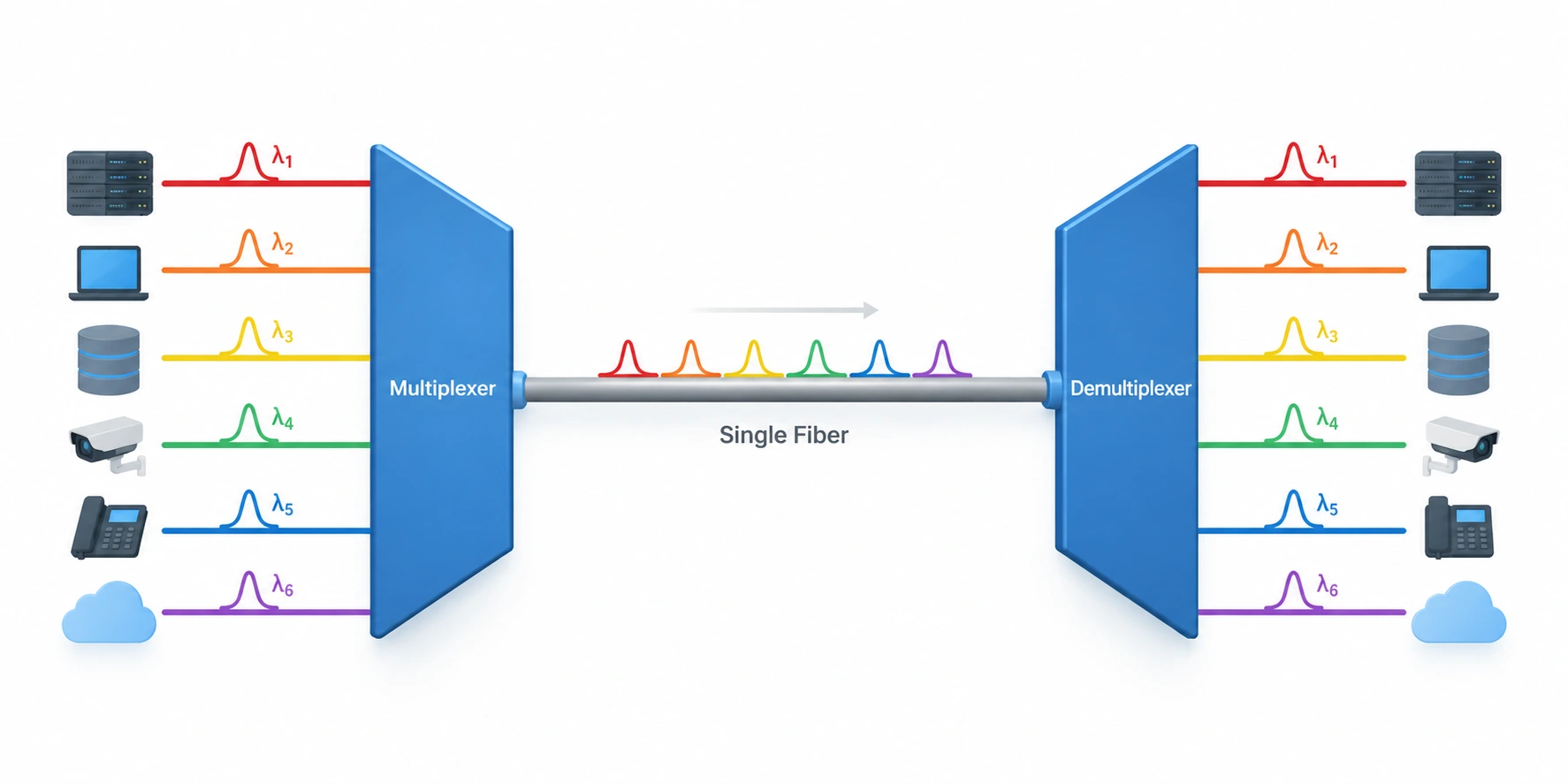
In practice, a WDM system consists of three main elements: wavelength-specific optical transceivers that transmit and receive on assigned wavelengths, multiplexer and demultiplexer units that combine and separate those wavelengths at each end of the link, and the fiber itself. Each wavelength acts as an independent lane, so a single fiber pair can simultaneously carry storage traffic, server replication, and client services without any of them interfering with the others. This is the same principle that underpins modern optical transport systems deployed in carrier networks, and it is well documented as the foundation of high-capacity optical communication .
For data centers, the value is direct. Fiber runs between data halls, between a primary site and a disaster recovery site, or across a metro DCI link are usually limited in number. A WDM system turns each of those scarce fiber pairs into a multi-lane highway, deferring or eliminating new construction.
CWDM or DWDM: Which WDM Technology Fits Your Data Center?
Choose CWDM when your links are short, your channel count is low, and cost is the primary constraint. Choose DWDM when you need high per-channel speeds (100G and above), more than about ten channels, distances beyond 80 km, or room to scale over the next five years.
The two technologies differ in how tightly they pack wavelengths. CWDM uses 20 nm channel spacing defined by the ITU-T G.694.2 standard, supporting up to 18 channels between 1271 nm and 1611 nm. DWDM uses much tighter frequency-based spacing, typically 100 GHz (about 0.8 nm) or 50 GHz, which packs 40 to 96+ channels into the C-band alone.
| Aspect | CWDM | DWDM |
| Channel spacing | 20 nm | 0.8 nm (100 GHz) or 0.4 nm (50 GHz) |
| Typical channel count | Up to 18 | 40 to 96+ |
| Wavelength range | 1271–1611 nm | C-band 1530–1565 nm, extendable to L-band |
| Max reach without amplification | ~80 km | ~80 km or more (depending on optical budget, modulation format, and fiber type) |
| Optical amplification (EDFA) | Not supported | Supported, enabling thousands of km |
| Practical per-channel rate | Up to 10G/25G | 100G, 400G and higher |
| Relative cost | Lower | Higher |
| Operational complexity | Very low, mostly passive | Low (passive) to moderate (amplified) |
When CWDM Is the Better Fit
CWDM shines in short-reach, cost-sensitive deployments. Typical data center scenarios include connecting data halls within the same campus, linking a primary facility to a nearby disaster recovery site, or aggregating a handful of 10G or 25G services over a single fiber pair. Because CWDM uses uncooled lasers and passive mux/demux units, it consumes almost no power, requires no optical-layer management, and can often be deployed in a single maintenance window.
The main caution is capacity ceiling. CWDM tops out at 18 channels, cannot be amplified, and its practical per-channel rate is limited. If your traffic forecast shows a realistic path to needing more than about 14 wavelengths (accounting for headroom) or speeds above 25G, model the DWDM alternative before committing.
When DWDM Is the Better Fit
DWDM is the standard for high-capacity DCI. Cloud and large enterprise operators connecting data centers across a metro area routinely need dozens of 100G or 400G wavelengths, and DWDM on dark fiber has become the dominant architecture for this. It is also typically required once a link exceeds roughly 80 km, because erbium-doped fiber amplifiers (EDFAs) can boost C-band signals without electrical regeneration, and DWDM is the technology that supports such amplification. Notably, pluggable coherent optics have narrowed the price gap between the two technologies at moderate channel counts, so DWDM is increasingly justified even for links that were traditionally CWDM territory.
What Key Factors Should You Evaluate in a WDM System?
Beyond the CWDM versus DWDM decision, five factors determine whether a specific WDM system will serve your data center well: capacity requirements, transmission distance, fiber compatibility, scalability, and total cost of ownership.
Capacity and Channel Requirements
Start with an honest traffic audit. Count the services you need to transport today, their rates, and projected demand over three to five years. A practical rule is to provision sufficient spare channels—often cited as 20 to 30 percent more than currently required—so that adding a new service does not force a redesign. If the audit shows eight or fewer channels at 10G, CWDM is usually sufficient. Ten or more channels, or any channel at 100G and above, points to DWDM.
Transmission Distance and Amplification
Distance determines architecture. Passive systems, which have no powered components in the optical path, are limited by the transceiver’s optical budget, typically to spans under 80 km. Beyond that, you need an active DWDM system with EDFAs and, for longer spans, dispersion management. Deciding between a passive and active deployment changes the budget as much as the CWDM versus DWDM choice itself, so settle the distance question early.
Fiber Infrastructure Compatibility
Verify your fiber plant before selecting wavelengths. CWDM spreads channels across a wide spectrum that includes regions affected by water absorption, so older fiber without the low-water-peak characteristic (ITU-T G.652.C/D) can render several CWDM channels unusable. DWDM concentrates in the C-band, which lies outside the water-peak absorption region, so it is generally less affected by fiber vintage than CWDM. Also confirm that your chosen optical transceiver module exists in the form factor your switches support, and that your end-to-end insertion loss budget closes with margin.
Scalability and Future Growth
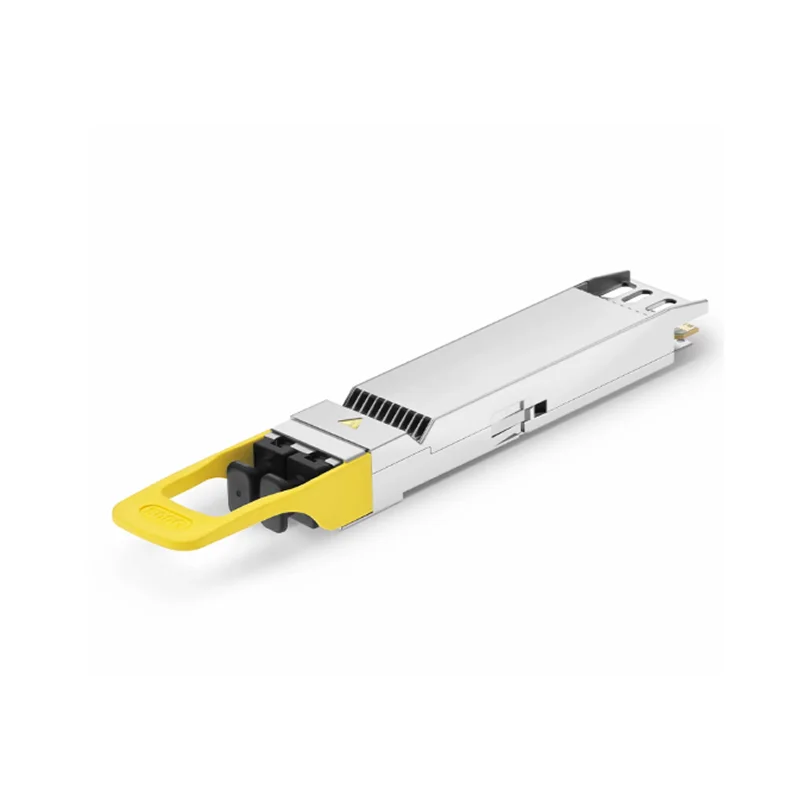
The cheapest system to buy today is not always the cheapest to own. If you anticipate AI-driven traffic growth, a modular DWDM platform that accepts additional line cards and amplifiers protects your investment. A well-planned system also leaves a migration path toward higher speeds: as 400G and 800G coherent optics become standard for DCI, choosing a platform certified for an 800G optical transceiver module today avoids a forced mid-life replacement. Existing CWDM users can also consider hybrid designs that overlay DWDM channels inside spare CWDM passbands, adding capacity without disturbing running services.
Budget and Total Cost of Ownership
Compare systems on lifecycle cost, not sticker price. CWDM has lower capital cost per channel and significantly lower operating overhead than amplified DWDM. DWDM carries higher upfront and power costs, but its per-gigabit cost can be lower at high capacity, especially where dark fiber is leased by the strand. Weigh capital expenditure, power and cooling, maintenance skill requirements, and the cost of a future migration in a single total-cost-of-ownership model.
How Do You Match a WDM System to Your Data Center Scenario?
Match the system to the link role: passive CWDM for intra-campus and short DCI, DWDM for metro-scale DCI at 100G (passive if the loss budget allows, amplified otherwise), and active DWDM with amplification for regional or high-density requirements.
A simple mapping keeps the decision grounded:
- Intra-data center and same-campus links (under 10 km): passive CWDM, or point-to-point DWDM optics where 100G lanes are already needed.
- Short DCI between nearby facilities (10–40 km): CWDM for 10G/25G services; DWDM when channel counts or speeds will grow.
- Metro DCI (40–120 km): DWDM, passive if the loss budget allows, amplified otherwise.
- Regional or multi-site backbone (beyond 120 km): active DWDM with EDFAs, dispersion compensation, and optical-layer monitoring.
A five-step selection process puts it all together:
- Audit current services and forecast traffic three to five years out.
- Measure or confirm the actual distance and fiber attenuation on every candidate route.
- Verify fiber type, connector condition, and available wavelength windows.
- Choose the technology and architecture (passive or active) with at least 20 percent channel headroom.
- Compare finalists on total cost of ownership, including power, spares, and migration risk.
FAQs
Can CWDM and DWDM run on the same fiber?
Yes. Hybrid designs overlay DWDM channels inside the passband of specific CWDM channels, typically around 1531 nm and 1551 nm. This allows an existing CWDM deployment to gain additional channels without replacing running hardware, although the overlaid channels require careful wavelength and power planning and may be amplified only if they fall within the EDFA C-band.
Why can’t CWDM channels be amplified with EDFAs?
EDFAs provide gain primarily in the C-band, approximately 1530 to 1565 nm, with L-band variants extending the gain window to about 1625 nm. CWDM channels are spread across 1270 to 1610 nm, so most of them fall outside the EDFA’s C-band gain window, which is why a single EDFA cannot amplify all CWDM channels at once.
This is the primary practical reason CWDM is typically deployed in unamplified spans, although cost, per-channel rate, and channel-planning considerations also drive that design choice.
Do WDM systems require special switches or routers?
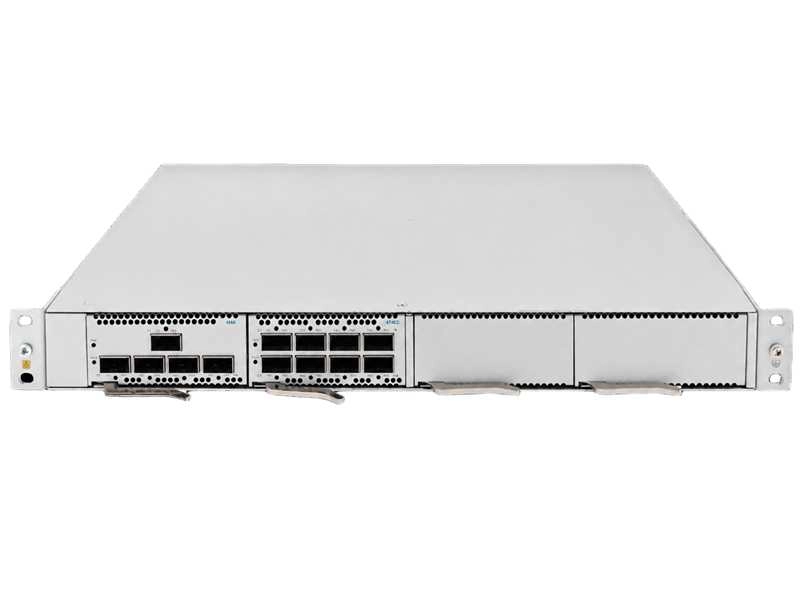
Usually not. Passive WDM deployments use wavelength-specific pluggable transceivers, which plug into standard SFP, SFP+, or QSFP ports on ordinary data center switches. Only active DWDM platforms with transponders or coherent optics introduce dedicated transport chassis alongside your existing equipment.