
Mobile backhaul, fiber broadband, enterprise private lines and AI-driven data center traffic are all growing on the same fiber plant. For a telecom provider, that turns the transport layer into a long-term commitment: the optical transport equipment chosen today has to carry traffic mixes that do not exist yet, on routes that are expensive to re-engineer, under service level agreements that leave little room for downtime.
The features that matter most are per-wavelength capacity with a credible path to 400G and 800G, coherent reach backed by adequate FEC and OSNR margin, standards-based OTN grooming that carries mixed client services on one fiber, flexible ROADM add-drop, protection that restores service in under 50 ms, open management interfaces with real telemetry, and power and space efficiency measured over the full lifecycle rather than at purchase.
Each of those features trades against the others, so the following sections explain what to check and why it changes the economics of a network.
Capacity and Per-Wavelength Rate
Start with capacity, because it is the hardest variable to change later. Evaluate the maximum rate per wavelength and the total capacity per fiber, then size both against a five-year traffic forecast rather than the current year.
A platform that tops out at a low per-wavelength rate forces expansion by adding channels, which consumes spectrum, amplifiers and rack space long before the fiber is full.
Single-Wavelength Rate: 100G, 400G, and 800G
Per-wavelength rate is the biggest lever on cost per bit, because higher rates cut the number of line cards, wavelengths and amplifier slots needed for the same throughput.
| Rate per wavelength | Typical positioning | What to check |
|---|---|---|
| 100G | Mature regional and long-haul layers | Whether it can be mixed with higher rates on the same line system |
| 400G | Mainstream metro core and DCI builds | Modulation options and achievable reach on existing fiber |
| 800G | New backbone and high-density DCI | Watts per bit, faceplate form factor, and module availability |
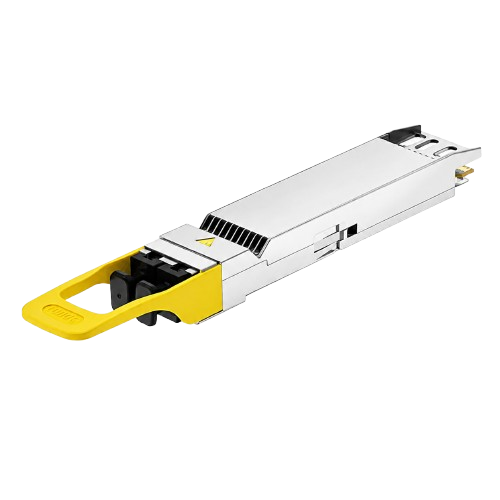
For new builds, a platform that accepts an 800G Optical Transceiver Module in the same chassis as lower-rate line cards gives the widest upgrade range. It allows 400G where the fiber supports it and 800G on routes where traffic concentrates, without replacing the chassis or line cards.
Per-Fiber Capacity and Spectral Efficiency
Per-fiber capacity is the product of channel count and per-channel rate. Conventional C-band systems support approximately 80 to 96 channels at 50 GHz spacing, and C plus L band expansion roughly doubles the usable spectrum, though L-band amplification adds noise and cost considerations. Baud rate and modulation format then decide how much capacity fits into each channel. Ask vendors for capacity figures on representative routes rather than maximum theoretical values, because real spans are limited by amplifier spacing, fiber type and aging.
Reach, Coherent Optics, and FEC Performance
Match the coherent optics class to actual span distances, and verify forward error correction gain and OSNR margin (see the FEC Gain and OSNR Margin section) instead of relying on the headline reach number in a datasheet. A platform that carries a route without electrical regeneration removes an entire class of equipment from that site.
Coherent Detection and Modulation
Coherent receivers recover amplitude, phase and polarization, and digital signal processing compensates for chromatic dispersion and polarization mode dispersion electrically. That removes most physical dispersion compensation modules and simplifies link design. The trade-off is between modulation order and distance: higher-order modulation carries more bits per symbol but tolerates less noise, so per-wavelength modulation selection lets each route be tuned for capacity or reach independently.
FEC Gain and OSNR Margin
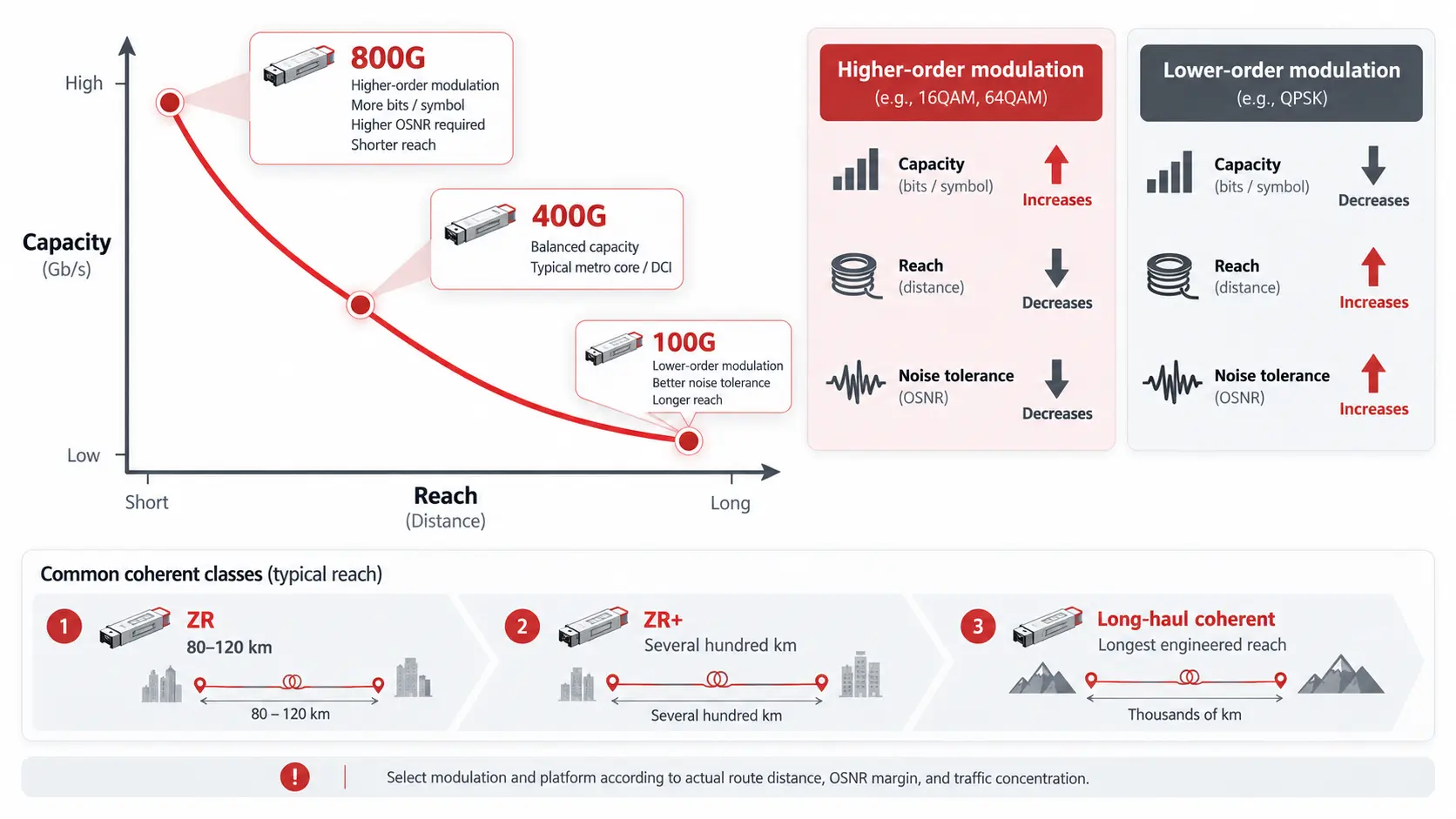
Forward error correction determines how much noise a link tolerates before errors appear. Soft-decision FEC provides several decibels more coding gain than hard-decision schemes, which extends reach or frees margin for aging fiber.
| Coherent class | Typical application | Reach envelope |
|---|---|---|
| ZR-class pluggables | Point-to-point metro and DCI | Roughly 80 to 120 km amplified |
| ZR+ multi-rate | Regional, mixed-rate networks | Several hundred kilometers |
| Embedded long-haul transponders | Backbone and submarine-adjacent spans | Engineered per link, longest reaches |
Because pluggable coherent optics are standardized for interoperability, the Optical Transport Systems a provider buys should state which implementation agreements its line cards and modules conform to. The Optical Internetworking Forum develops and publishes these Implementation Agreements, including 400ZR, 800ZR and 800ZR+, which is the practical reference for checking that modules from different sources interoperate on the same line system.
OTN Framing, Grooming, and Multi-Service Support
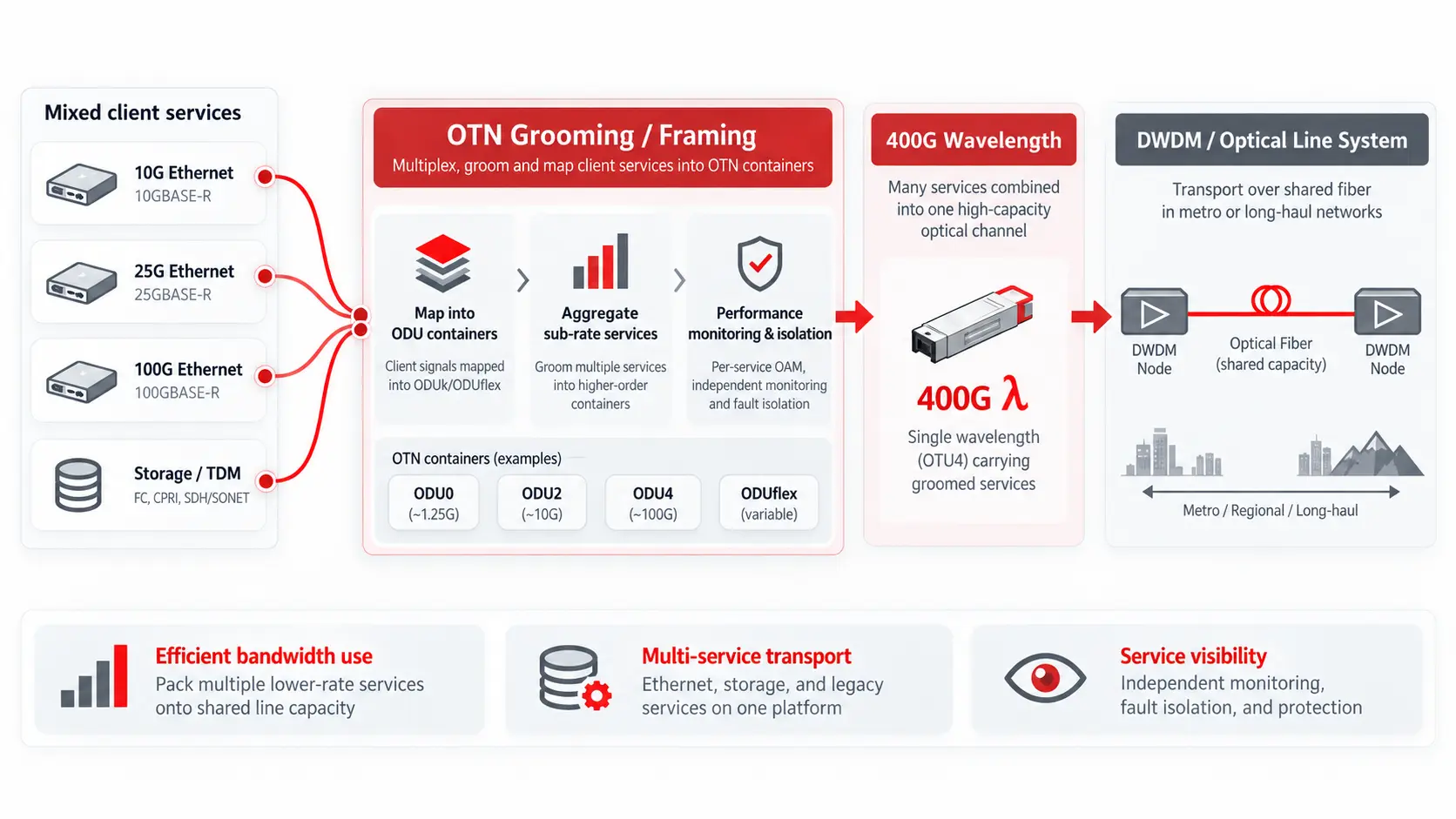
Standards-based OTN framing is what allows one platform to carry Ethernet, storage, and legacy TDM traffic on the same wavelength while keeping performance monitoring, fault isolation and protection independent for each service.
Without it, every client type needs its own transport layer and the network becomes a set of parallel overlays.
ODUk Containers and Sub-Wavelength Grooming
OTN wraps client signals into digital containers. The frame structure, container hierarchy and overhead bytes are defined in ITU-T G.709, the reference to check when a vendor claims OTN compliance. Support for containers from ODU0 through ODU4 and ODUCn, plus flexible-rate containers, determines how efficiently sub-rate clients are packed into a wavelength. Efficient grooming is what lets a 10G enterprise circuit be packed into a high-capacity wavelength alongside other clients without wasting spectrum.
Client Interface Mix
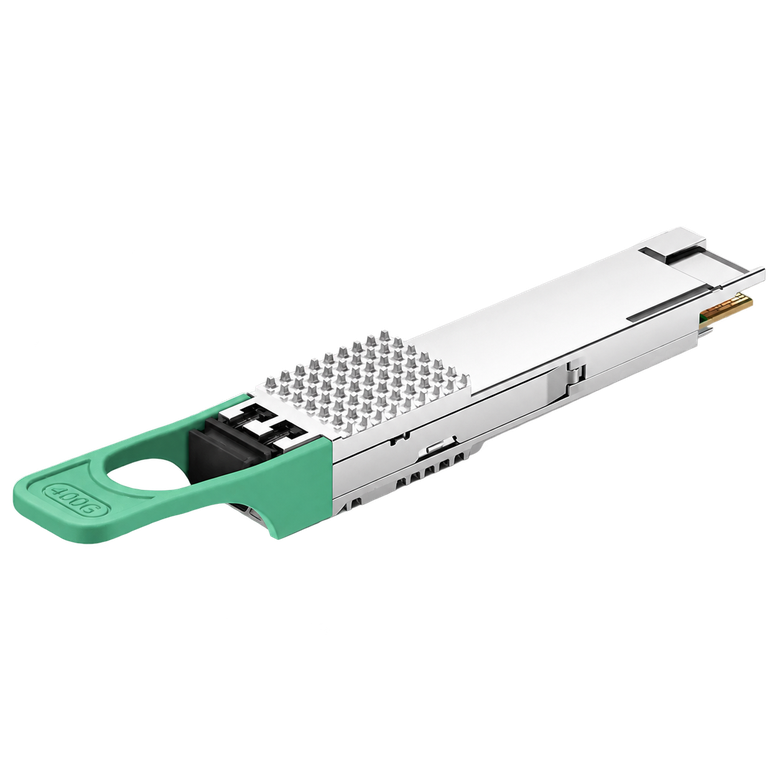
Check the range of client interfaces and whether sub-rate services groom onto shared line capacity. Hard pipe isolation matters for wholesale and enterprise circuits, where customers expect deterministic latency and strict separation from other traffic. A platform supporting a 400G Optical Transceiver Module alongside lower-rate client optics gives one fabric for access, aggregation and core roles.
ROADM Flexibility and Wavelength-Level Agility
Look for colorless, directionless and, where justified, contentionless add-drop, with enough degrees to cover the fiber directions at each site. Reconfigurable optical add-drop multiplexers with colorless, directionless and contentionless architectures let any wavelength reach any port in any direction. Colorless removes the fixed wavelength assignment per port, directionless removes the fixed direction, and contentionless removes internal blocking when multiple identical wavelengths need to be added or dropped simultaneously. Degrees indicate how many fiber directions a node can serve. Under-specified nodes become bottlenecks the first time traffic shifts, while wavelengths that merely transit a site should pass through at negligible incremental cost.
Protection, Resilience, and Availability
Require protection switching below 50 ms at both the optical and electrical layers, plus redundant power, control and cooling at equipment level. This is the feature that keeps a fiber cut invisible to customers.
Transport layer protection restores service far faster than higher-layer reconvergence, which is why it underpins carrier-grade availability commitments.
Protection Schemes and Switching Time
| Scheme | Layer | Typical behavior |
| Optical line 1+1 protection | Optical | Dual transmit, selective receive, fast switchover |
| ODUk subnetwork connection protection | Electrical | Per-service protection independent of route |
| Optical multiplex section protection | Optical | Protects the whole multiplexed band |
| Shared ring protection | Optical or electrical | Efficient protection for ring topologies |
Ask vendors for measured switchover times under load rather than specification-sheet minimums, and confirm how protection interacts with restoration when a second failure hits the protected path.
Equipment-Level Redundancy and Layer-1 Encryption
Dual power feeds, redundant control and switching cards, and hot-swappable fan trays remove single points of failure inside the chassis. For regulated or high-value traffic, Layer-1 encryption with managed key rotation protects data in flight with negligible added latency, which matters where compliance rather than throughput sets the requirement.
Automation, Telemetry, and Open Interfaces
Open, model-driven interfaces and streaming telemetry are now selection criteria, not extras. They determine how much of the operating expense is automated and how quickly faults are located.
Manual, per-site provisioning does not scale once a network carries thousands of wavelengths and services.
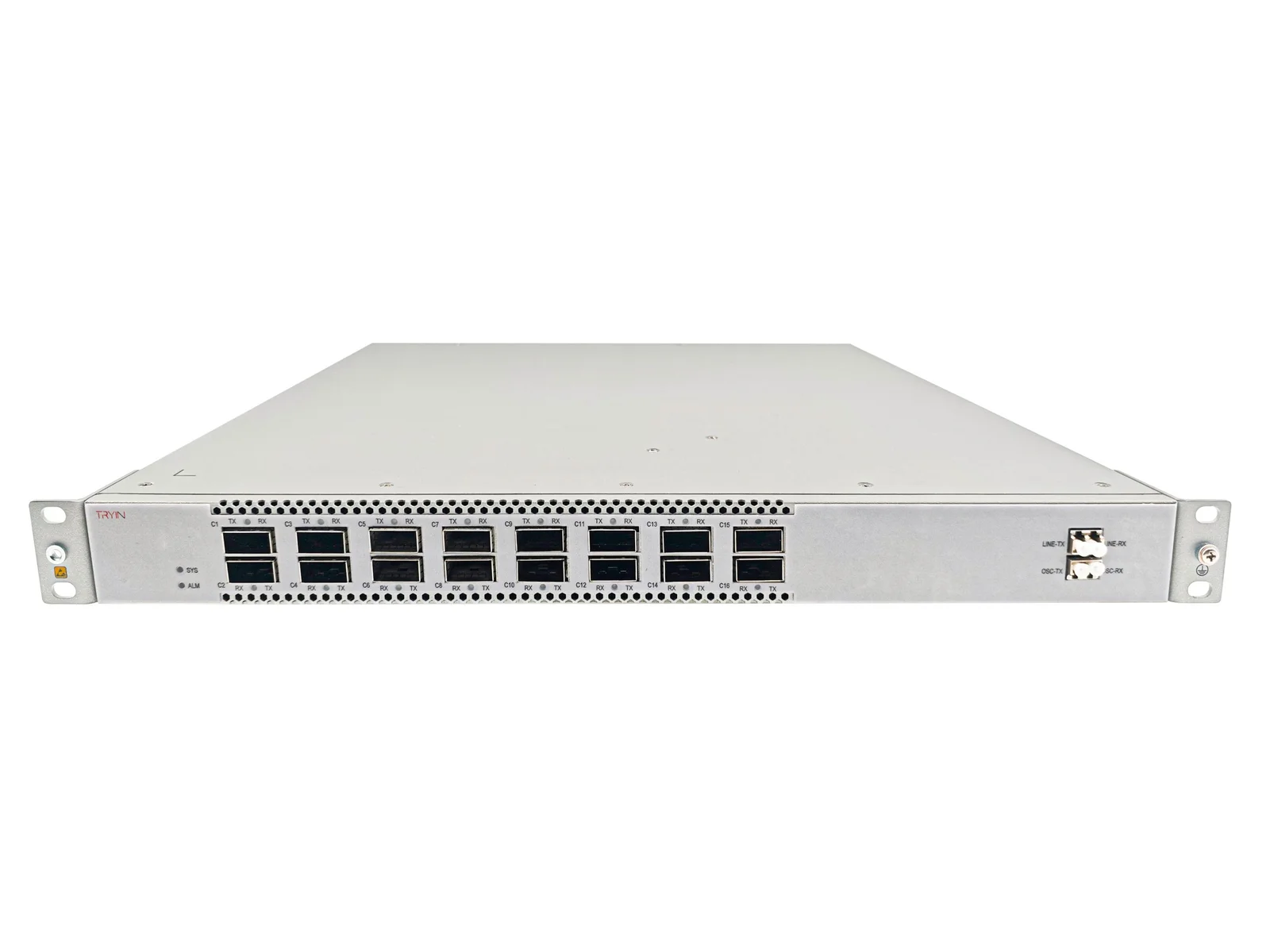
Three capabilities are worth testing during evaluation. First, model-driven management using NETCONF and YANG, so configuration and state are exposed consistently and can be driven by a controller. Second, streaming telemetry that reports optical power, OSNR and pre-FEC bit error rate per wavelength and per service, with historical degradation trends, rather than a static topology view. Third, zero-touch provisioning, where a service is computed and activated end to end without manual configuration at intermediate sites. Platforms built around this operating model, such as the Zero-Touch DCI Network Series, show how far provisioning time can be compressed when the management layer is designed for automation from the start.
Power, Space, and Total Cost of Ownership
Evaluate watts per bit, port density per rack unit, and the full licensing model over the expected equipment life. Purchase price is usually the smallest component of what a transport platform costs to own.
Power and cooling are recurring costs that scale with every wavelength added, while space is a hard constraint in central offices and colocation sites.
The evaluation should cover at least the following:
- Watts per bit at typical, not idle, utilization, including line cards and optics
- Number of high-rate ports per rack unit, and whether higher-rate modules fit existing faceplates
- Software licensing structure, including capacity step-ups, controller features, encryption and analytics
- Spares strategy, hardware refresh cadence, and end-of-support commitments
- Measured efficiency of the management layer in reducing truck rolls and provisioning time
A platform that costs more upfront but halves watts per bit and avoids a mid-life chassis replacement usually wins on lifecycle cost. The right comparison is total cost per bit delivered over the deployment period, not the invoice.
FAQ
Is optical transport equipment the same as DWDM equipment?
DWDM is the multiplexing technique that puts many wavelengths on one fiber, while optical transport equipment is the wider category of platforms that generate, multiplex, amplify, switch, monitor and protect those wavelengths. A transport platform includes DWDM functions plus OTN framing, protection switching and management, which a pure multiplexing layer does not provide.
Can optical transport equipment be deployed incrementally?
Yes, and incremental deployment is usually the safer path. Modular chassis with pay-as-you-grow licensing let a provider install a shelf with a small set of line cards and add capacity as traffic appears. The constraint to check is whether the first configuration scales within the same chassis and software release, or whether growth forces a platform migration.
How long should telecom providers plan the equipment lifecycle for?
Transport platforms are typically planned over seven to ten years, with traffic forecasts covering at least five. Because fiber plant work and site preparation dominate deployment cost, the goal is a platform whose line system survives several generations of line cards and optics, so upgrades happen in the equipment rather than in the ground.