
There’s a quiet shift happening in how data centers talk to each other. For years, the conversation around infrastructure has centered on compute power, storage capacity, and cooling efficiency. But increasingly, the real bottleneck isn’t inside the data center at all — it’s the link between them. And more and more, that link is built on Dense Wavelength Division Multiplexing, or DWDM.
The premise is straightforward enough: instead of running separate fibers for each connection, DWDM multiplexes multiple optical signals onto a single fiber pair by assigning each to a different wavelength of light. In practice, that means a single fiber can carry dozens — sometimes hundreds — of discrete data channels simultaneously. For organizations connecting multiple data centers, this isn’t just a technical nicety. It’s becoming a strategic necessity.
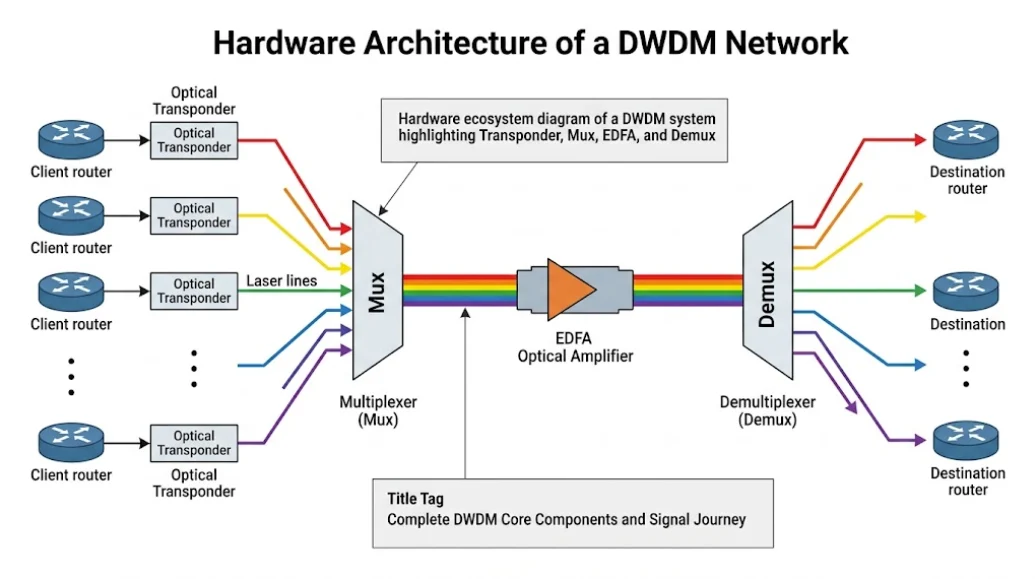
The architecture begins with client routers feeding traffic into optical transponders, which convert electrical signals to specific wavelengths. These wavelengths are combined by a multiplexer (Mux) onto a single fiber pair. Optical amplifiers (EDFAs) boost the signal along the route, and at the destination, a demultiplexer (Demux) separates the wavelengths back into individual channels for client routers.
Why Traditional Approaches Are Running Out of Road
The old way of doing data center interconnect was simple, if inelegant. When one facility needed more bandwidth to another, you added another link. Maybe another transponder. Maybe another fiber pair if you could get one. That approach worked well enough when traffic grew predictably, but the dynamics have changed.
AI workloads are a primary culprit. Training large models requires continuous movement of datasets, checkpoints, and intermediate results across facilities. Inference systems depend on consistent access to distributed data stores. And resilience strategies demand real-time replication across locations. When interconnect capacity is constrained, training timelines stretch, application performance becomes unpredictable, and operational risk increases.
The problem is compounded by geography. Expanding from a single facility to multiple campuses or metro sites means the network between those sites increasingly determines overall performance. Power grid limitations in some regions are pushing cloud providers to spread AI data centers across buildings roughly 100 kilometers apart, tapping into different electricity grids to run power-hungry GPU clusters. Traditional link-by-link expansion simply doesn’t scale in that environment.
What DWDM Changes
DWDM transforms the equation by allowing multiple high-capacity optical channels to operate over a single fiber pair. Each channel can carry 100GbE, 400GbE, 800GbE, OTU4, or high-speed Fibre Channel for storage replication. Instead of continually installing new fiber or rebuilding infrastructure, organizations can increase capacity by adding wavelengths or upgrading per-channel speeds.
The shift toward IP over DWDM — where routers and switches integrate directly into Optical Transport Networks using pluggable transceiver modules — has made this even more practical. This eliminates the need for intermediary transponders and grey interfaces, simplifying architectures and reducing both capital and operational expenses. With advanced pluggables like 400G ZR/ZR+ or 100G ZR digital coherent optics, IP over DWDM delivers robust performance across diverse applications.
The economics are compelling. Some estimates suggest converged IP-over-DWDM architectures can reduce single-bit costs by over 40 percent compared to traditional multi-layer approaches. And for organizations building AI at scale, that efficiency matters.
The Architecture in Practice
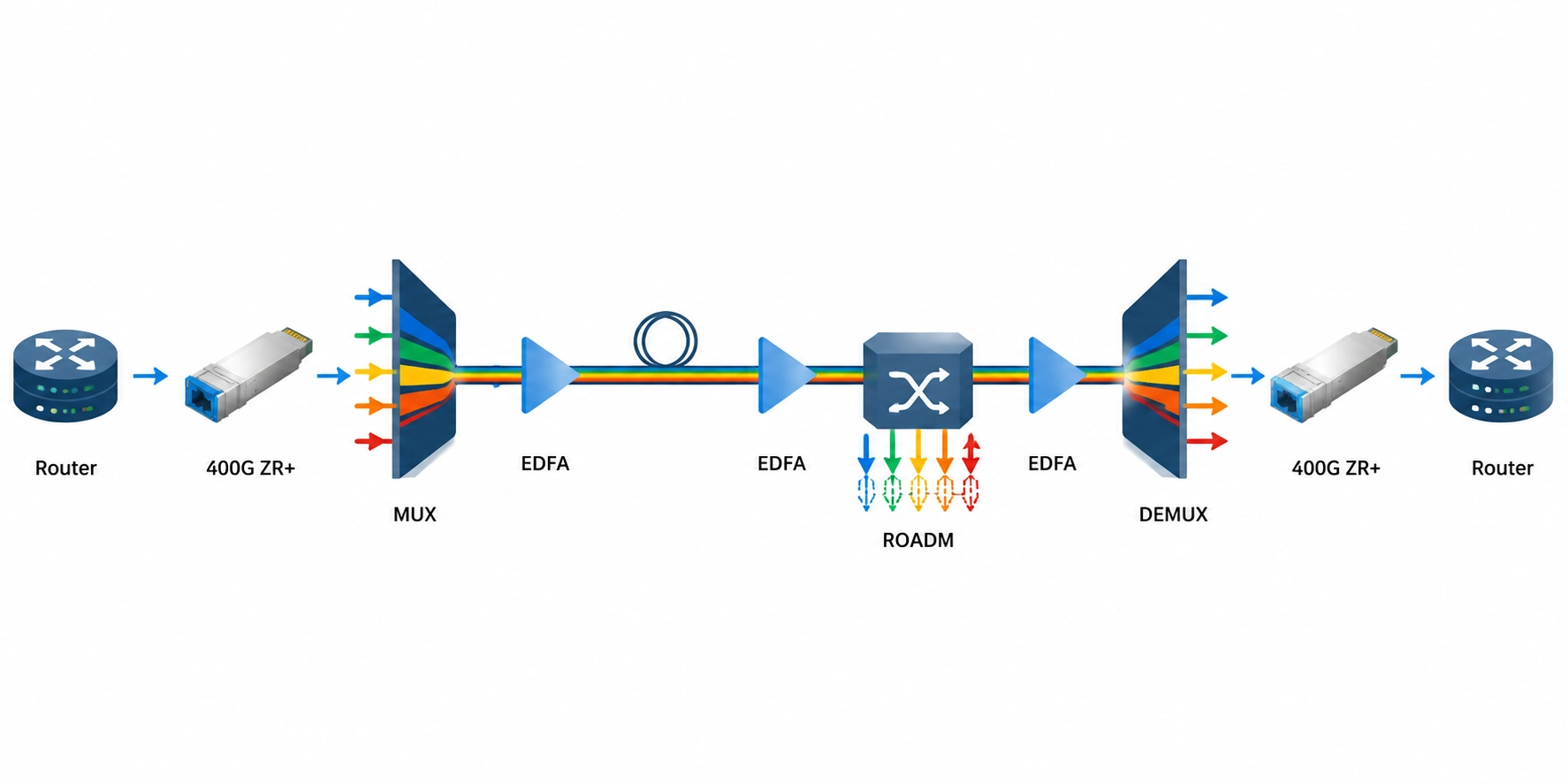
So what does a DWDM-based data center interconnect actually look like in practice? The architecture varies by distance and scale, but a few patterns have emerged.
For metro DCI — typically distances under 80 kilometers — unified IP over DWDM solutions are becoming common. These pair high-speed coherent optical transceivers with passive DWDM multiplexer/demultiplexer units, allowing operators to build time- and cost-efficient networks without external amplification or chromatic dispersion compensation.
For longer-haul deployments, optical line systems with amplifiers become necessary. The disaggregated WDM model — where transponders and optical line systems are sold independently — has gained significant traction, accounting for nearly 40 percent of total optical transport market revenue during the first nine months of 2025. This approach promotes open interfaces, eliminates vendor lock-in, and aligns with a pay-as-you-grow model.
Here’s a quick comparison of the main DCI architecture models:
| Architecture | Key Components | Best For | Primary Advantage | Primary Trade-off |
|---|---|---|---|---|
| Traditional (Separate IP + Optical) | Independent routers, transponders, DWDM systems | Legacy environments, multi-vendor networks | Mature, well-understood | Higher cost, more equipment, complex ops |
| IP over DWDM (IPoDWDM) | Router/switch with pluggable coherent optics | Metro DCI, greenfield deployments | Simplified, lower CapEx/OpEx | Requires newer router support |
| Disaggregated WDM | Separate transponder units + optical line systems | Cloud providers, scalable deployments | Open interfaces, vendor flexibility | Integration responsibility falls on operator |
| Unified DWDM Solution | Integrated transceivers + passive mux/demux | Short- to mid-reach DCI | Turnkey, minimal footprint | Less flexible for future upgrades |
Where the Market Is Headed
The numbers tell a clear story. The global data center interconnect market was valued at $15.38 billion in 2025 and is projected to reach $29.85 billion by 2030, growing at a compound annual rate of 14.2 percent. According to Research and Markets, this growth is being fueled by surging inter-cloud connectivity demand, increasing security requirements, and the proliferation of distributed workloads.
Within that broader market, DWDM-specific spending is accelerating. Spending on DWDM long-haul equipment for data center interconnect is expected to grow at a compounded annual rate of 15 percent over the forecast period. And the IPoDWDM segment is growing even faster — Dell’Oro Group projects the IPoDWDM market will grow at an average annual rate of 16 percent, reaching $4.4 billion by 2030.
The driver behind much of this growth is AI. Industry analysts expect that AI workloads will place the biggest demand on data center interconnect bandwidth in the next two to three years. Cloud providers are already interconnecting their AI GPU data centers with massive amounts of bandwidth, using data center switches and ZR+ optics. The shift toward scale-across DCI — expanding AI data centers across multiple buildings — is expected to change market dynamics and drive a sharp increase in 800 ZR+ optical module shipments in 2026.
The standards that enable all of this interoperability are equally important. The ITU-T G.709 standard defines the Optical Transport Network (OTN) framework, specifying the Optical Transport Unit and digital wrapper technology that allows transparent transport of client signals. This standard provides the foundation that allows optical networks to carry traffic reliably across long distances — the kind of behind-the-scenes specification that makes modern DCI possible in the first place.
Real-World Applications
DWDM-based data center interconnect is showing up across a range of scenarios.
Multi-building campuses are perhaps the most common use case. GPU clusters, storage systems, and data pipelines are increasingly distributed across facilities within a campus environment. DWDM allows these to operate as a unified compute fabric rather than separate silos.
Metro expansion follows a similar pattern. When AI growth exceeds the capacity of a single data center, coordination across metro locations becomes necessary. DWDM provides the bandwidth to make that coordination practical.
Cloud provider backbone networks represent the largest scale deployments. Hyperscalers are building new in-house transponder technology for long-haul routes to boost security, reliability, and automation across their global networks.
Enterprise disaster recovery is another significant application. DWDM-based DCI provides Terabit-scale bandwidth between data centers, supporting business continuity, real-time backup, and hyperscale networking.
Storage replication also benefits from the predictable performance DWDM delivers. For organizations running synchronous replication across metro distances, the consistent latency and guaranteed bandwidth are non-negotiable.
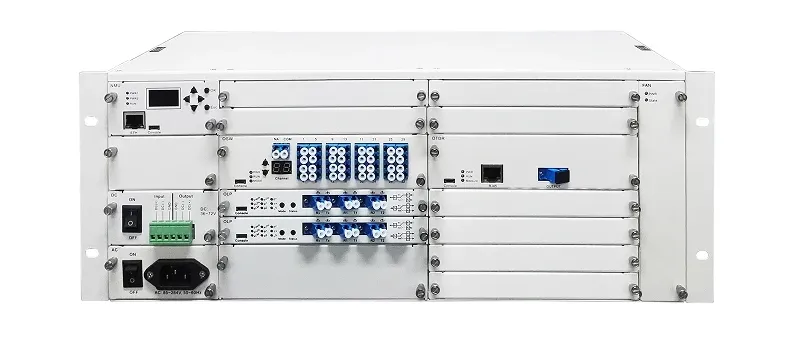
For organizations looking to implement these architectures, Optical Transport Systems provide the foundational hardware that makes high-capacity DCI possible.
The Challenges Worth Considering
It would be misleading to suggest DWDM is a silver bullet. There are real challenges that come with the territory.
Cost remains a significant barrier for many organizations. High upfront capital costs, supply chain concentration, and technical complexity make DWDM deployment challenging — particularly for enterprises that lack the optical networking expertise needed to manage advanced platforms.
Security is a persistent concern. DCI links carry sensitive data across physical environments that aren’t always easily monitored. Physical layer encryption has become increasingly important, and some vendors are now offering quantum-safe Layer 1 encryption to protect against future threats. Novel approaches combining encryption with channel conditions are also emerging.
Latency is critical for AI workloads. These generate massive, deterministic traffic flows that can overwhelm legacy packet-switched architectures, introducing jitter and congestion. Open, standards-based DWDM and OTN backbones are increasingly designed to provide the predictable, jitter-free transport required for parallel compute synchronization and real-time inference.
Operational complexity shouldn’t be underestimated either. Managing optical networks requires specialized skills that aren’t always readily available. Modern optical systems with telemetry and monitoring capabilities help address this, but the learning curve remains.
Looking Forward
DWDM for data center interconnect has moved from a niche technology to a foundational element of modern infrastructure strategy. The combination of AI-driven bandwidth demand, the shift toward scale-across architectures, and the maturation of coherent pluggable optics has created an environment where DWDM is no longer optional for organizations connecting multiple facilities at scale.
The technology continues to evolve. 800G ZR/ZR+ coherent pluggables are beginning large-scale rollouts. Work is already underway on 1.6T solutions. And the trend toward disaggregated, open architectures shows no signs of slowing.
For network operators and infrastructure planners, the question is increasingly not whether to adopt DWDM for data center interconnect, but how quickly and at what scale. The bandwidth demands aren’t going to decrease. The only question is whether the interconnect can keep up.
If you want to know more about Data Center Interconnect, please read What is Data Center Interconnect (DCI)?
FAQ
What’s the difference between DWDM and CWDM for data center interconnect?
DWDM uses tightly spaced wavelengths, allowing many more channels on a single fiber — typically 40 to 80 or more — making it ideal for high-capacity, long-haul DCI. CWDM uses wider wavelength spacing (typically 20 nm versus 0.8 nm or less for DWDM), which limits the number of channels but reduces cost because it can use uncooled lasers. CWDM is generally suitable for shorter distances and lower capacity requirements, while DWDM dominates in high-capacity, long-haul data center interconnect. DWDM also supports optical amplification, enabling transmission over thousands of kilometers — something CWDM cannot do.
How does DWDM handle encryption for secure data center interconnect?
DWDM-based DCI can implement encryption at multiple layers. Physical layer encryption protects data in transit without adding significant latency. Some systems now offer quantum-safe Layer 1 encryption designed to resist attacks from future quantum computers. More advanced approaches include channel-dependent encryption schemes that combine encryption with real-time channel conditions for enhanced security. The use of dedicated dark fiber also provides inherent isolation from public internet threats.
Is DWDM-based DCI only relevant for hyperscale cloud providers?
Not at all. While hyperscalers were early adopters and remain the largest users, DWDM-based data center interconnect is increasingly deployed by colocation providers, enterprises with multiple facilities, regional carriers, and organizations running AI workloads at any scale. The emergence of disaggregated WDM models and IP-over-DWDM architectures has made the technology more accessible to organizations that don’t have the scale — or the budget — of a hyperscaler. Even mid-sized enterprises with two or three data centers can benefit from the capacity and operational control DWDM provides.