
Data center interconnect, or DCI, is one of those terms that gets thrown around a lot in networking circles, but it’s worth actually understanding what’s happening under the hood. At its simplest, DCI is the technology that links two or more data centers together, allowing them to share data, compute resources, and storage capacity as if they were one unified environment. But that simple definition barely scratches the surface of what makes DCI both fascinating and increasingly essential.
Think of it this way: a single data center might be a powerful engine, but multiple data centers connected by DCI form something closer to a complete powertrain. Without that interconnection, each facility operates in isolation, unable to share workloads, provide geographic redundancy, or distribute traffic during peak demand. The global data center interconnect market was valued at approximately USD 15.60 billion in 2025 and is projected to reach USD 37.40 billion by 2032, growing at a CAGR of 13.3%. That kind of growth doesn’t happen by accident — it reflects a fundamental shift in how infrastructure is being built and operated.

What Makes DCI Different from Regular Networking
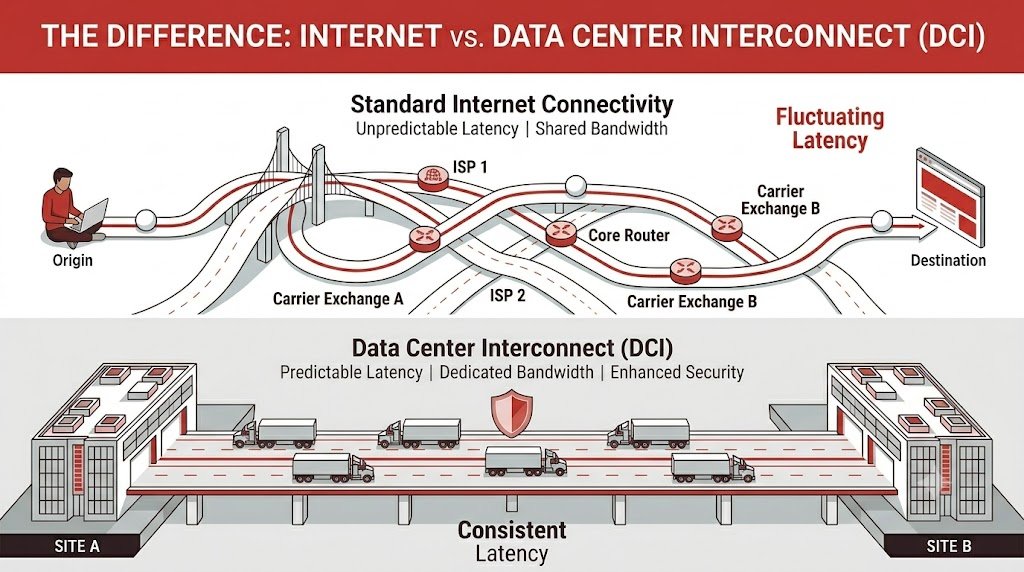
One of the first things to understand about data center interconnect is that it’s not the same as standard internet connectivity. With a typical internet connection, traffic routes through multiple carriers and exchange points, with routing decisions made dynamically based on prevailing conditions. That works fine for browsing the web or streaming video, but it introduces latency variability and performance unpredictability that make it unsuitable for tightly coupled applications.
DCI, by contrast, uses dedicated circuits that provide predictable latency, better security, and guaranteed bandwidth. These aren’t connections that share capacity with other users or route through unpredictable public infrastructure. They’re private, purpose-built links that perform more like a local network than a wide area connection. This matters because database replication needs consistent low latency to maintain synchronization. Application traffic between sites requires predictable bandwidth to deliver a good user experience.
The Architecture Behind the Scenes
So how does data center interconnect actually work? The answer depends largely on distance and scale, but most DCI deployments rely on optical transport technologies. Dense Wavelength Division Multiplexing (DWDM) is the workhorse here — it allows multiple data streams to travel simultaneously over a single fiber pair by assigning each stream to a different wavelength of light.
The optical line system supporting this transmission needs to be flexible, modular, and integrated. In practice, this means DCI architectures typically fall into a few categories:
- Point‑to‑point – a direct fiber link between two facilities.
- Hub‑and‑spoke – connects multiple sites to a central location, which works well when you have one primary facility and several secondary ones.
- Full mesh – provides direct connections between every facility, offering the best performance but at significantly higher cost.
- Hybrid – combines the above forms, balancing performance requirements against budget constraints.
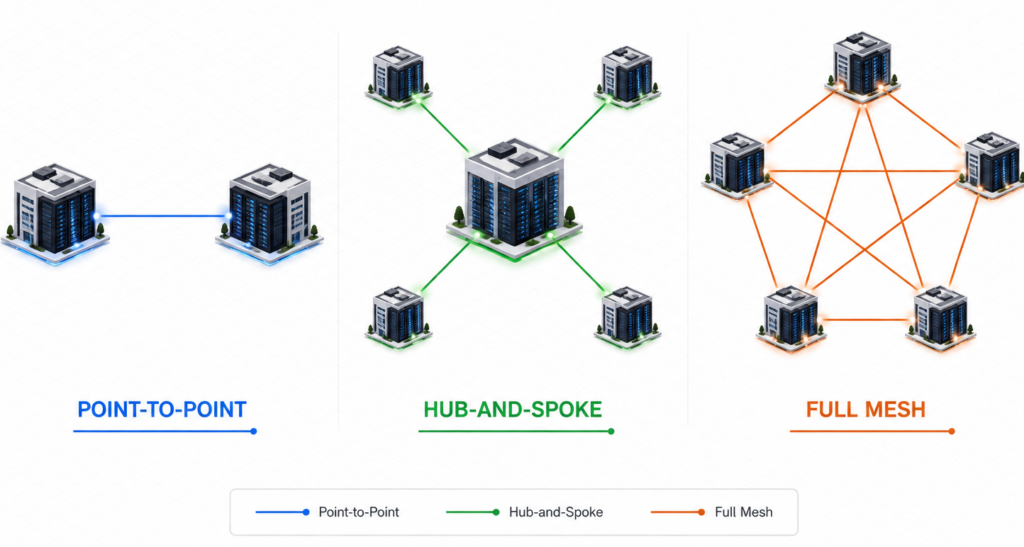
To help compare these options at a glance, here’s a quick breakdown:
| Topology Type | Connection Pattern | Best For | Key Advantage | Key Drawback |
|---|---|---|---|---|
| Point‑to‑point | Direct link between two DCs | Active‑backup DR, simple dual‑site apps | Lowest latency, simplest design | Single point of failure, no path redundancy |
| Hub‑and‑spoke | All branches connect to a central hub | Regional headquarters + remote sites, cloud aggregation | Centralized management, easy scaling | Hub congestion risk, bandwidth bottleneck |
| Full mesh | Every node connects to every other | High‑availability distributed workloads (e.g., AI clusters) | Maximum redundancy, automatic failover | Very high fiber and equipment cost |
| Hybrid | Combination of mesh and hub‑and‑spoke | Large enterprises or carrier multi‑layer networks | Balances cost and performance | Complex design and maintenance |
For organizations looking to implement these architectures, Optical Transport Systems provide the foundational hardware that makes high‑capacity DCI possible.
Standards That Make It All Work
None of this would be possible without common standards that ensure different vendors’ equipment can interoperate. The ITU‑T G.709 standard defines the Optical Transport Network (OTN) interface signals, covering everything from the OTN hierarchy to the functionality of overhead bits. This standard, sometimes called the digital wrapper technology, provides the framework that allows optical networks to carry traffic reliably across long distances. It’s the kind of behind‑the‑scenes specification that most people never think about, but without it, the entire concept of data center interconnect would be far more fragmented and difficult to implement.
Why DCI Matters More Than Ever
The accelerating demand for DCI isn’t theoretical — it’s being driven by concrete trends in how applications are built and deployed. AI workloads are perhaps the most visible driver. Training a large AI model requires thousands of GPUs to continuously exchange results and updates with each other in near real‑time. This creates massive east‑west traffic between servers, and when those servers are distributed across multiple data centers, the interconnect becomes absolutely critical.
But it’s not just AI. Hyperscale cloud providers, colocation facilities, and enterprises are all spreading compute across multiple sites. According to Research and Markets, the DCI market is expected to grow from $17.54 billion in 2026 to $29.85 billion in 2030 at a compound annual growth rate of 14.2%. The growth is being fueled by several factors: the surge in inter‑cloud connectivity demand, increasing data security requirements, the growth of distributed workloads, and the rising adoption of SDN‑based networking.
The Technology Evolution
The rapid growth of cloud services, AI computing, and high-capacity data center interconnect (DCI) networks has accelerated the adoption of coherent optical transmission technologies. As network bandwidth continues to increase, coherent optical modules have become a key solution for enabling high-speed, long-distance data transmission with excellent spectral efficiency and network flexibility. Among these solutions, 800G CFP2-DCO coherent optical modules provide a reliable option for building scalable transport networks while supporting advanced digital signal processing (DSP) and high-performance coherent transmission.
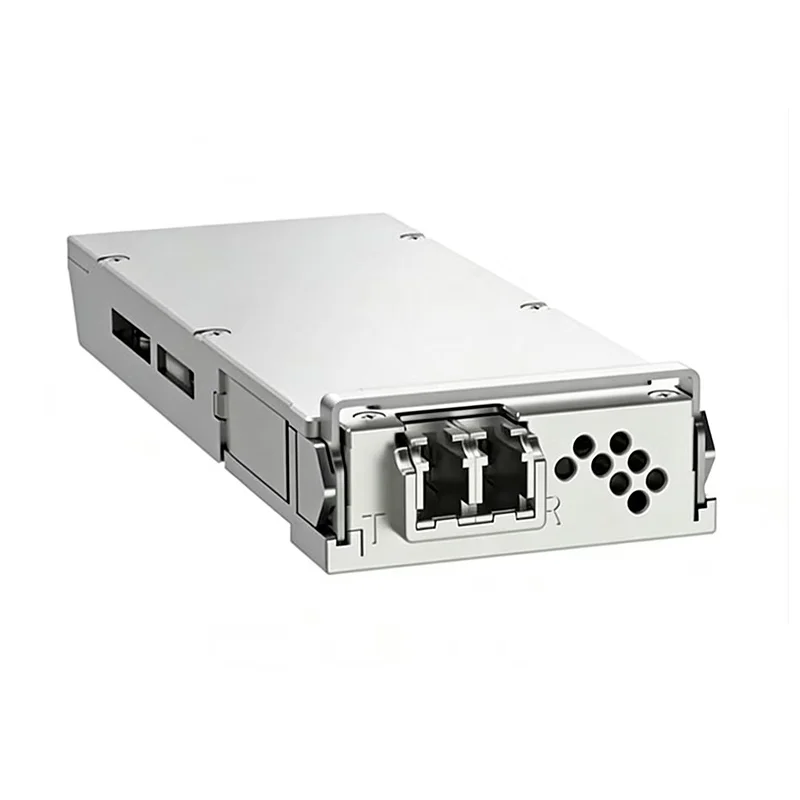
This shift toward IP‑over‑DWDM architectures, where routers and switches are equipped with coherent optical interfaces, eliminates the need for separate optical transponders in many cases. The result is simpler architectures, reduced power consumption, and lower operating costs. For network operators, this represents a significant departure from traditional approaches that required multiple layers of equipment.
The Challenges That Come with the Territory
For all its benefits, data center interconnect isn’t without challenges. Security is a persistent concern — DCI links carry sensitive data across often‑unmonitored physical environments, creating risks of eavesdropping, data leakage, and tampering. Robust encryption at the physical layer has become increasingly important, with new schemes emerging that combine encryption with channel conditions to protect against unauthorized access.
Latency is another critical factor. AI workloads generate massive, deterministic traffic flows that can overwhelm legacy packet‑switched architectures, introducing jitter and congestion. Network managers are pushing speeds beyond 100G, with 400G becoming a clear requirement and work already underway at 600G and 800G.
Cost also remains a significant barrier for many organizations. High upfront capital costs, supply chain concentration, and technical complexity make DCI deployment challenging, particularly for enterprises that lack the optical networking expertise needed to manage advanced platforms.
Conclusion
The future of data center interconnect is closely tied to the future of computing itself. As workloads become more distributed and data volumes continue to grow exponentially, the ability to move information quickly and reliably between facilities will only become more critical.
Several trends are worth watching. DCI‑as‑a‑Service is emerging as a fast‑growing model, particularly attractive to enterprises and regional carriers that want bandwidth on demand without large infrastructure investments. Software‑defined networking is enhancing flexibility and scalability. And the integration of DCI with SD‑WAN is redefining how organizations design metro, regional, and cross‑border connectivity.
For anyone responsible for infrastructure strategy, understanding how data center interconnect works is no longer optional. It’s becoming as fundamental as understanding how servers and storage work. The question isn’t whether you’ll need to connect multiple data centers — it’s how you’ll do it effectively.
If you want to know more about Data Center Interconnect, please read What is Data Center Interconnect (DCI)?
FAQ
What’s the difference between DCI and a standard WAN connection?
A standard WAN connection typically routes traffic over shared infrastructure with variable performance, while DCI uses dedicated circuits that provide predictable latency, guaranteed bandwidth, and inherent security isolation. DCI is designed to be more resilient to network disruptions and can support higher data transfer rates compared to traditional WAN connections.
How does DCI handle data security across long distances?
DCI networks implement security through multiple layers. Physical layer encryption protects data in transit, and the use of dedicated private circuits provides inherent isolation from public internet threats. More advanced approaches include quantum‑secured transmission architectures and chaotic encryption schemes embedded with intrusion detection.
Is DCI only for hyperscale cloud providers?
Not at all. While hyperscalers were early adopters, DCI is now used by colocation providers, enterprises with multiple facilities, regional carriers, and even mid‑sized organizations that need geographic diversity for disaster recovery or workload distribution. The emergence of DCI‑as‑a‑Service has made it more accessible to organizations that don’t want to make large capital investments in infrastructure.