
In enterprise and data center networks, Optical Transceiver Speed is rarely just a number printed on a datasheet. In practice, it is the result of how the module, host platform, fiber plant, and cooling design work together. That is why two modules with the same nominal data rate can behave quite differently once they are deployed at scale.
For procurement teams and network engineers, the key question is not simply “how fast is this module?” but rather “what will hold that speed in production?” That distinction matters more as networks move from 100G to 400G and now into 800G, where signal integrity and thermal margins get tighter fast.
What Optical Transceiver Speed Really Means
Line rate vs. usable throughput
A module’s advertised speed is usually its line rate, not the exact payload bandwidth available to applications. Encoding, framing, error correction, and protocol overhead all take a small but real slice out of the theoretical number. In other words, a 400G module supports 400G signaling, but the end-to-end throughput seen by workloads may be slightly lower.
This is one reason B2B buyers should compare not only the spec label but also the traffic model behind the deployment. For latency-sensitive or bandwidth-heavy environments, that difference can influence switch port planning and oversubscription decisions.
Lane structure matters
Modern optics rely on multiple lanes rather than one ultra-fast channel. A 400G module may use 4 lanes at 100G, while some 800G designs use 8 lanes at 100G or other high-density lane arrangements. The aggregate speed is what matters operationally, but lane architecture affects signal quality, power, and cooling requirements.
The Main Factors That Determine Speed
Modulation format
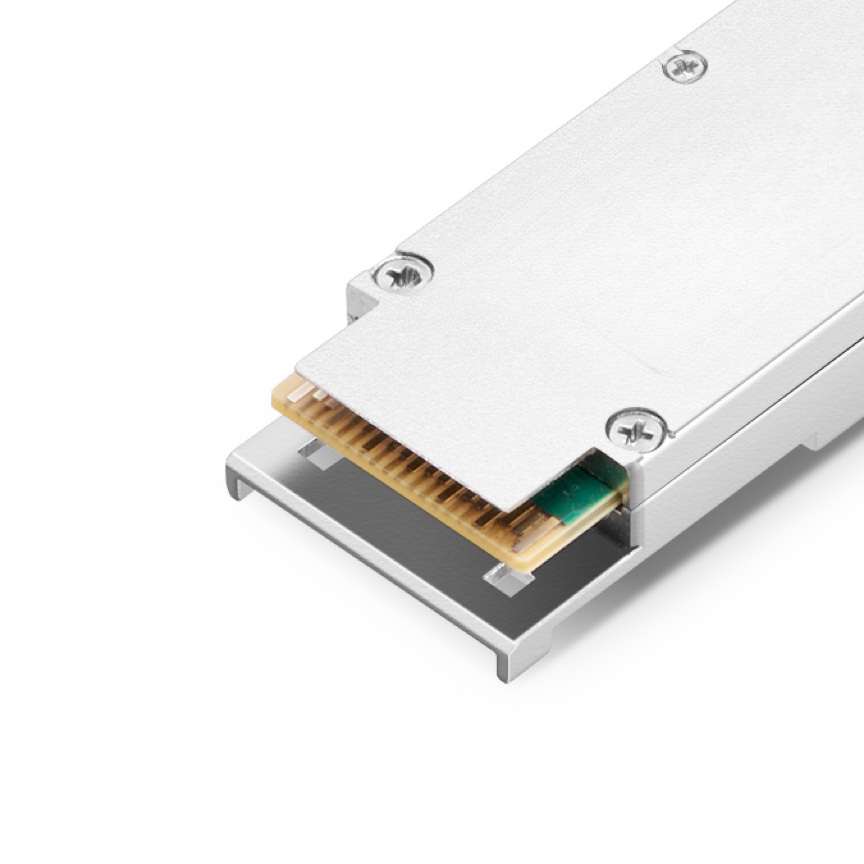
The modulation method is one of the biggest technical drivers behind Optical Transceiver Speed. Older designs often used NRZ signaling, which is simpler but less efficient at very high rates. Newer modules commonly use PAM4, which carries more bits per symbol and allows higher speeds on the same physical medium.
That said, PAM4 is more demanding. It has narrower noise margins, which means the system must manage distortion, jitter, and crosstalk far more carefully. In real deployments, that usually translates into stricter component selection and more conservative validation.
DSP and signal conditioning
At higher speeds, the digital signal processing engine becomes a major part of performance. DSP helps correct impairments, balance channels, and keep the signal usable over the target reach. On the host side, equalization and electrical channel quality also play a role.
A useful way to think about it: the module may be rated for a certain speed, but the port, PCB layout, and electrical trace quality determine whether that speed is actually sustainable. This is especially true in dense switch environments where small signal losses accumulate quickly.
Optical engine quality
The laser, driver, receiver, and associated optics all contribute to stable high-speed transmission. In volume deployments, consistency matters as much as peak performance. Even small variations in component quality can affect error rates, link stability, and maintenance overhead.
Fiber type and reach
Fiber choice is another practical limit. Short-reach multimode fiber and longer-reach single-mode fiber are not interchangeable in terms of performance expectations. Dispersion and attenuation become more important as speed increases and distance grows.
| Fiber Type | Typical Use | Speed Impact | Deployment Note |
|---|---|---|---|
| MMF | Short-reach inside racks or rows | More limited at long distances | Works well for compact links |
| SMF | Campus, data center, and long-reach links | Better for higher-speed, longer-distance runs | Often preferred for scalable backbone design |
For teams planning a refresh, reach is often underestimated. A module may support the target data rate, but if the fiber plant is not suitable, the operational result can be disappointing.
Thermal design and power consumption
Higher-speed optics generally consume more power and produce more heat. That is not a side issue; it is part of the performance envelope. Once a rack is densely populated, airflow and thermal headroom can become the difference between stable operation and error-prone links.
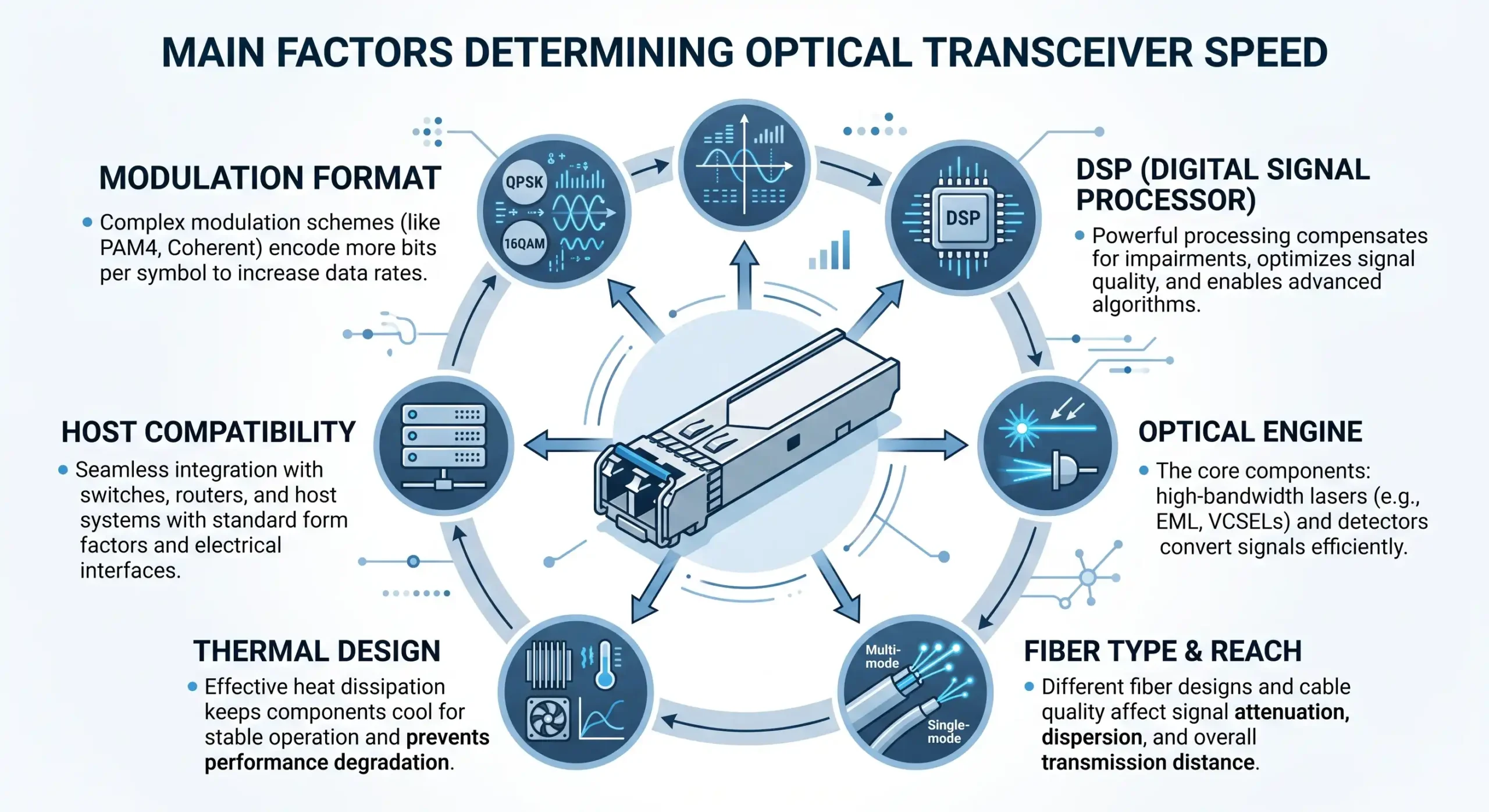
This is one reason 400G and 800G rollouts require more discipline around rack layout, airflow direction, and temperature monitoring. In many cases, thermal limitations show up before the optical spec itself does.
Why Compatibility Often Limits Speed
Host platform support
A module cannot outrun the port it plugs into. Switches and routers define the usable speed ceiling, and firmware validation can be just as important as the physical interface. A transceiver may fit the cage, yet still fail to operate as intended if the host platform does not fully support it.
This is where buyers often run into hidden risk: a module is technically compatible in form factor, but not fully compatible in system behavior.
Form factor and density trade-offs
Different form factors exist for a reason. SFP, QSFP, QSFP-DD, and OSFP each balance density, power, and thermal management differently. As speed rises, packaging becomes part of the engineering challenge.
For readers exploring current high-density options, the next generation of Optical Transceiver Speed is closely tied to form factor evolution and thermal design, not just signaling rate. That is why platforms built around 800G Optical Module deployments place so much emphasis on host validation and cooling.
What Changes from 100G to 800G?
The move from 100G to 800G is not just a straight multiplication of bandwidth. It usually reflects a broader architectural shift: more east-west traffic, higher rack density, AI and ML workloads, and a need to reduce port count while increasing bandwidth per rack unit.
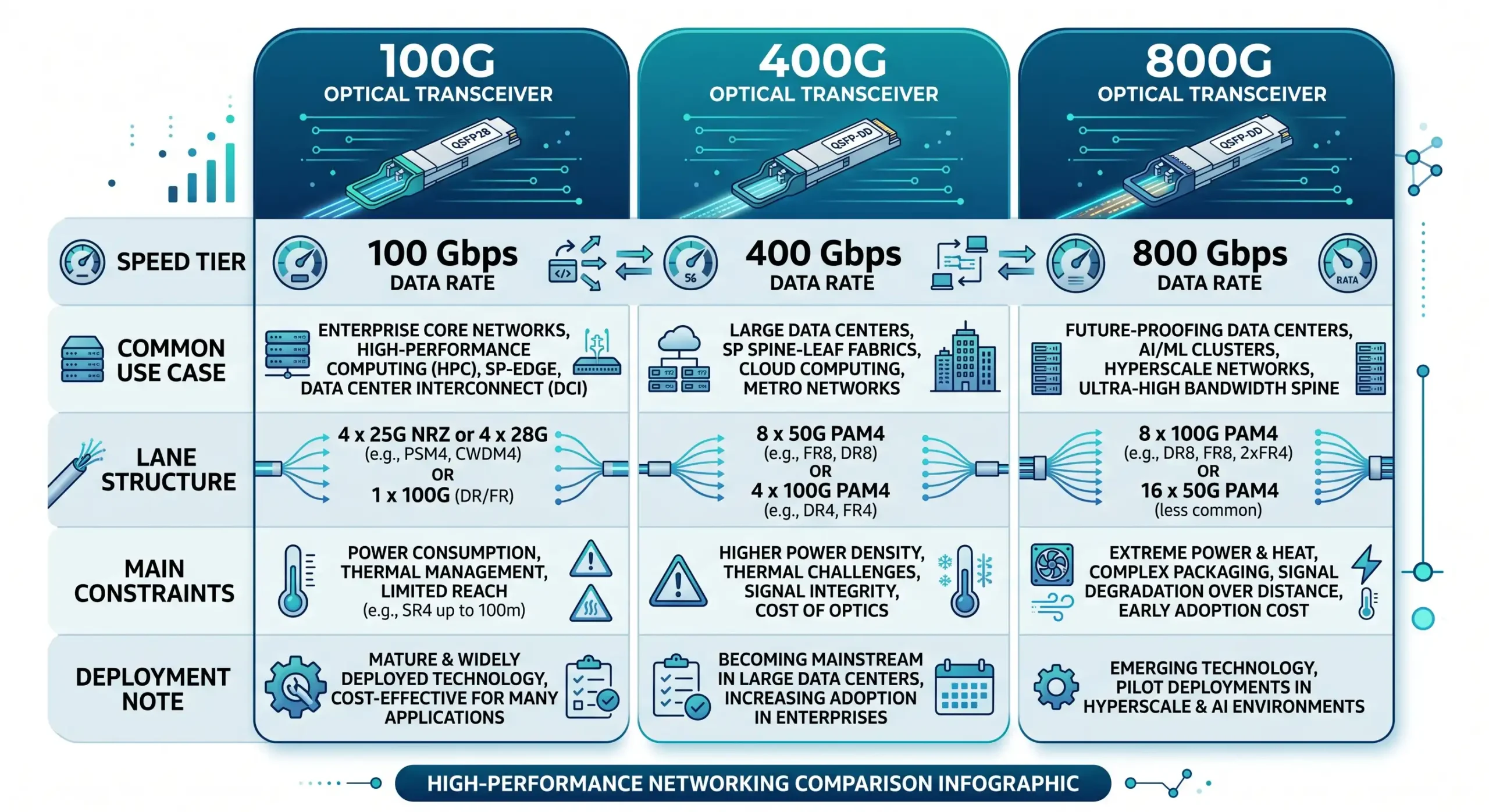
| Speed Tier | Typical Use Case | Main Constraint | Deployment Note |
|---|---|---|---|
| 800G | High-density AI/cloud fabrics | Power, cooling, and host support | Best for newer platform refreshes |
| 400G | Data center spine-leaf, AI backbones | Thermal and signal integrity | Requires careful validation |
| 100G | Enterprise uplinks, aggregation | Lower density pressure | Mature and cost-effective |
At 800G, everything becomes more sensitive: signal quality, connector integrity, thermal design, and firmware alignment. In practice, that means the upgrade path must be planned as a system project, not a simple module purchase.
How B2B Buyers Should Evaluate Optical Transceiver Speed
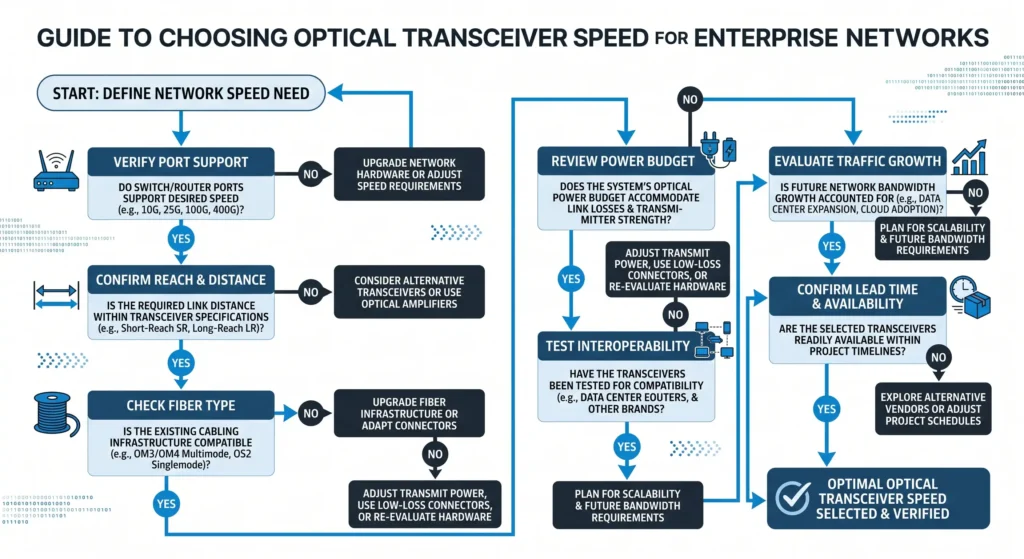
A practical procurement checklist usually includes:
- Port speed support on the actual switch or router
- Required reach and fiber type
- Power budget and rack cooling margin
- Vendor coding and interoperability validation
- Traffic growth over the next 12 to 36 months
- Lead time and supply consistency
A common mistake is to buy for the highest possible number rather than the best business fit. In many environments, 100G or 400G remains the more rational choice if the current traffic profile does not justify 800G yet.
Common Mistakes That Reduce Performance
- Assuming all modules with the same speed will perform identically
- Ignoring airflow and thermal derating
- Using the wrong fiber type for the planned reach
- Skipping interoperability testing in mixed-vendor environments
- Choosing a higher speed before confirming the host platform can support it
For B2B teams, these mistakes often cost more than the module itself because they create troubleshooting time, downtime risk, and delayed rollouts.
Conclusion
Optical Transceiver Speed is determined by far more than the headline data rate. Modulation, DSP, optical component quality, fiber reach, thermal design, and platform compatibility all shape what can actually be delivered in production.
For enterprise and data center buyers, the best decision is usually the one that fits the full network environment, not just the fastest spec on paper. In high-speed deployments, that practical view is often the difference between a smooth rollout and an expensive rework.
FAQ
Can two optical modules with the same speed deliver different real-world stability?
Yes. Signal conditioning, thermal design, component quality, and host compatibility can make one module noticeably more reliable than another, even at the same nominal rate.
Is it always worth moving to a higher-speed transceiver?
Not always. If traffic growth is moderate or the existing fiber plant is not ready, a slower but more mature speed tier may deliver a better cost-to-performance ratio.
What should procurement teams verify before standardizing on 800G?
They should confirm port support, cooling capacity, firmware validation, reach requirements, and interoperability across the intended network platform.