
Industries that operate pipelines, power cables, bridges, and railway networks need continuous, real-time visibility into assets that stretch for kilometers, often through environments where conventional electronic sensors fail. Electromagnetic interference, high voltage, corrosion, and explosive atmospheres all degrade or rule out traditional measurement devices. Fiber optic sensing technology answers this challenge by turning the optical fiber itself into a measuring instrument, which is why adoption keeps expanding across energy, transportation, and civil infrastructure.
Fiber optic sensors are classified in three ways. By structure, they are either intrinsic, where the fiber itself is the sensing element, or extrinsic, where the fiber only carries light to an external sensing element. By measurement principle, they include intensity-based, interferometric, fiber Bragg grating, and polarization-based types. By spatial layout, they are divided into point, quasi-distributed, and distributed sensors, with distributed acoustic sensing (DAS), distributed temperature sensing (DTS), and distributed vibration sensing (DVS) being the most widely deployed distributed technologies.
The sections below break down each classification, explain how the major sensor types work, and show where each one delivers the most value.
Intrinsic and Extrinsic Fiber Optic Sensors
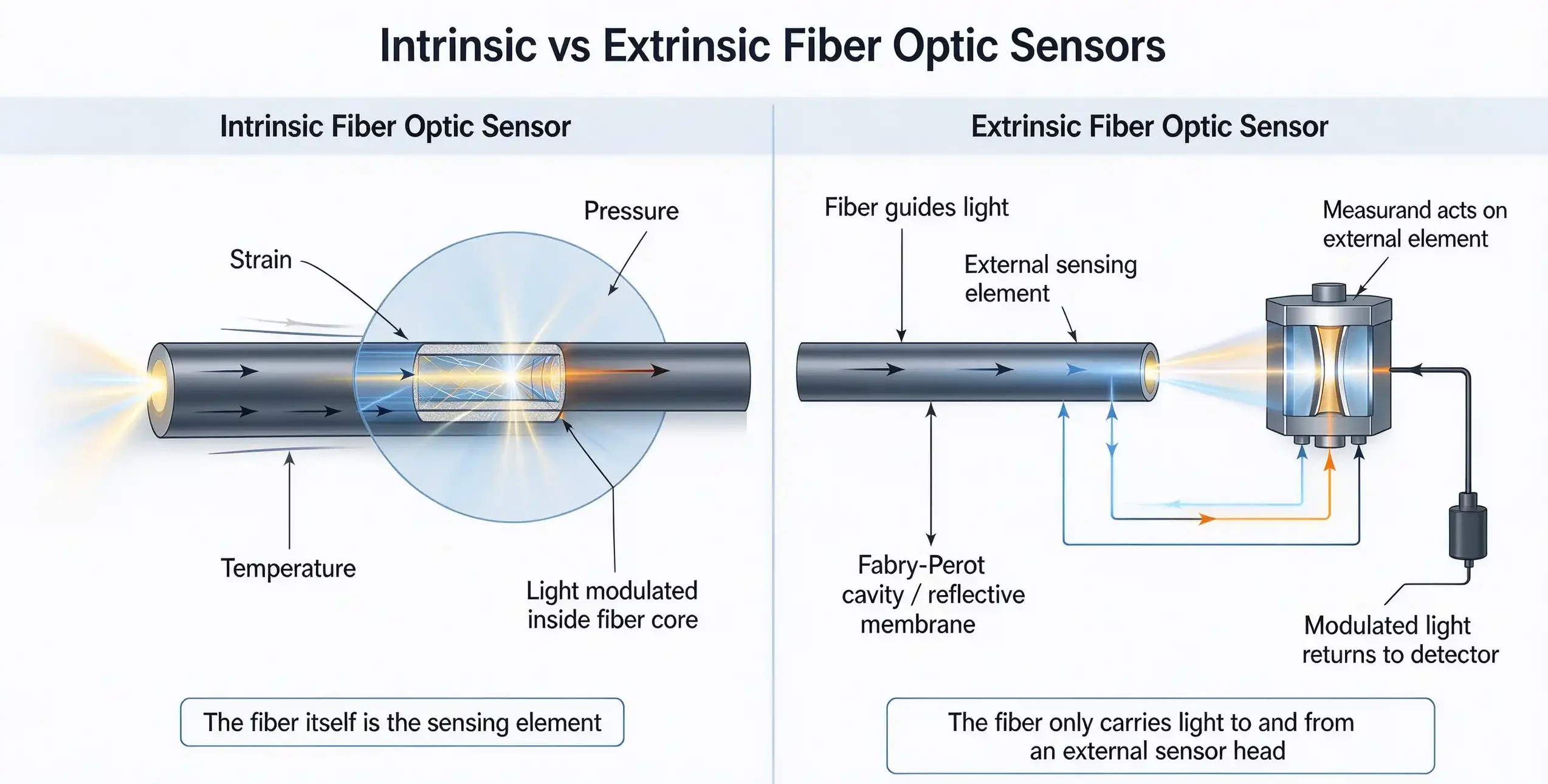
Structurally, every fiber optic sensor falls into one of two classes: intrinsic sensors, in which the optical fiber itself acts as the transducer and the measurand modulates light inside the fiber core, or extrinsic sensors, in which the fiber merely guides light to and from a separate sensing element located outside the fiber.
This division, described in the Wikipedia overview of fiber-optic sensors, is the most fundamental classification in the field because it determines whether the sensing function is embedded in the fiber itself or engineered as a separate optical head. Both classes underpin modern optical fiber sensing and monitoring systems used across energy and transport networks.
Intrinsic Fiber Optic Sensors
In an intrinsic sensor, external strain, temperature, or pressure changes the refractive index or geometry of the fiber core, which modulates the intensity, phase, wavelength, or polarization of the light traveling through it. Fiber Bragg gratings, interferometric sensors, and distributed scattering-based sensors are the best-known examples. Because the measurement happens inside the fiber, a single strand can host many sensing points or act as a continuous sensor over tens of kilometers.
Extrinsic Fiber Optic Sensors
In an extrinsic sensor, the fiber ends at an external optical element such as a Fabry-Perot cavity, a reflective membrane, or a chemically sensitive tip. The measurand acts on that element, and the fiber carries the modulated light back to the detector. This decoupled design makes the sensing head easy to engineer for extreme temperatures, high pressures, or chemically aggressive media, and it allows the sensitive tip to be replaced without touching the fiber link.
Types by Measurement Principle
By measurement principle, fiber optic sensors fall into four main types: intensity-based sensors that detect changes in received light power, interferometric sensors that convert measurands into optical phase shifts, fiber Bragg grating sensors that encode strain and temperature as wavelength shifts, and polarization-based sensors that read changes in the polarization state of light.
The four principles differ in accuracy, reach, and cost, as summarized below.
| Principle | Light property modulated | Typical measurands |
| Intensity-based | Amplitude | Presence, displacement, liquid level |
| Interferometric | Phase | Pressure, strain, acoustic waves |
| Fiber Bragg grating | Wavelength | Strain, temperature |
| Polarization-based | Polarization state | Electric current, magnetic field |
Intensity-Based Sensors
Intensity modulation is the simplest and lowest-cost principle: the measurand bends, blocks, absorbs, or reflects light, and the detector reads the resulting change in received power. These sensors are rugged and fast, but because raw intensity drifts with source aging and connector loss, they are mainly used for detection tasks such as presence checking and level sensing rather than precision metrology.
Interferometric Sensors
Interferometric sensors split light into two paths and measure the phase difference between them, using designs such as Mach-Zehnder, Michelson, and Fabry-Perot configurations. Because optical phase is extremely sensitive to path length, these sensors achieve the highest resolution of any type and are favored for pressure, acoustic, and micro-strain measurement.
Fiber Bragg Grating Sensors
A fiber Bragg grating (FBG) is a periodic modulation of the refractive index written into the fiber core, which reflects one specific wavelength, the Bragg wavelength, while transmitting all others. When strain or temperature changes, the reflected wavelength shifts, giving an absolute, multiplexable measurement. Many gratings at different wavelengths can be chained along a single fiber, which is why FBGs dominate structural health monitoring.
Polarization-Based Sensors
Polarization-based sensors exploit the Faraday effect, in which a magnetic field rotates the polarization of light in the fiber. Wrapping the fiber around a current-carrying conductor turns the sensor into an electric current meter, providing non-contact, high-voltage-resistant measurement for power grids.
Point, Quasi-Distributed, and Distributed Fiber Optic Sensors
By spatial layout, fiber optic sensors are divided into point sensors that measure one specific location, quasi-distributed sensors that multiplex many discrete sensing points along a single fiber, and distributed sensors that use the entire fiber as a continuous sensing element.
| Layout | Sensing points | Typical use |
| Point | One | Transformer winding temperature, probe-type pressure sensing |
| Quasi-distributed | Many discrete points | FBG arrays on bridges and wind turbines |
| Distributed | Continuous along the fiber | Pipelines, power cables, tunnels, perimeters |
The choice is largely driven by point count. For a handful of critical locations, point sensors are the most economical. When dozens of discrete points must be tracked, a quasi-distributed FBG chain on one fiber avoids running many cables. When the asset itself is long and continuous, a distributed sensor wins, because the interrogator analyzes the light backscattered from every section of the fiber and uses the round-trip travel time to pinpoint where each event occurred, effectively replacing thousands of individual transducers.
Distributed Acoustic, Temperature, and Vibration Sensing
Within the distributed category, three technologies dominate practical deployments: DAS turns the fiber into thousands of virtual microphones using Rayleigh backscatter, DTS delivers continuous temperature profiles using Raman scattering, and DVS detects vibration signatures along the fiber for security and integrity monitoring.
Distributed Acoustic Sensing (DAS)
Distributed acoustic sensing works by launching short laser pulses into the fiber and analyzing the Rayleigh backscatter they generate. Any acoustic or seismic disturbance near the fiber changes the backscatter signature at that location, so the system reports both the event and its exact position. A 30 km pipeline monitored at one-meter resolution behaves as if it were covered by roughly 30,000 microphones, making DAS the standard tool for detecting third-party interference, illegal tapping, and leaks.

Distributed Temperature Sensing (DTS)
Distributed temperature sensing relies on Raman scattering, whose anti-Stokes to Stokes intensity ratio depends strongly on temperature. The interrogator converts this ratio into a temperature reading at each point along the fiber, producing a full thermal profile over many kilometers. Typical applications include hotspot detection in power cables, fire detection in road and rail tunnels, and temperature profiling in oil and gas wells.
Distributed Vibration Sensing (DVS)
Distributed vibration sensing is closely related to DAS but focuses on sustained vibration signatures rather than discrete acoustic events. By classifying the vibration pattern along the fiber, a DVS system can distinguish digging, walking, climbing, and vehicle movement, which makes it a popular choice for perimeter and border intrusion detection around airports, substations, and storage sites.
Common Applications of Fiber Optic Sensors
Fiber optic sensors are deployed wherever long assets must be monitored continuously in electrically noisy, flammable, or hard-to-access environments, with oil and gas pipelines, electric power networks, civil infrastructure, transportation, and perimeter security being the leading use cases.
| Industry | Typical applications |
| Oil and gas | Pipeline leak detection, third-party interference alarms, downhole monitoring |
| Electric power | Cable hotspot detection, transformer winding temperature, grid current sensing |
| Civil infrastructure | Bridge, dam, and tunnel structural health monitoring |
| Transportation | Railway track condition and traffic flow monitoring |
| Security | Perimeter, border, and critical site intrusion detection |
Two characteristics explain this breadth. First, optical fibers carry no electricity to the sensing point, so they are intrinsically safe in explosive atmospheres and immune to electromagnetic interference near high-voltage equipment. Second, a single installed cable can serve as both the transport medium and the sensor. The Fiber Optic Sensing Association, the industry body for distributed sensing, notes that these advantages are driving fiber-based monitoring onto pipelines, borders, and aging infrastructure at a growing pace. When selecting a system, engineers typically start from the measurand, the number of sensing points, and the environmental envelope, then decide between multiplexed point sensors and a distributed architecture.
FAQs
What are the three main types of fiber optics?
The three main types of optical fiber are single-mode fiber, which has a core of roughly 9 microns and carries one light mode over long distances; multimode fiber, with 50 or 62.5 micron cores used for shorter, high-capacity links; and plastic optical fiber, a low-cost, flexible alternative for short-range use. Sensing systems choose among them based on reach and resolution requirements.
How far can a distributed fiber optic sensor measure?
Most commercial distributed sensing systems cover 30 to 100 km of fiber from a single interrogator, depending on the scattering mechanism and whether optical amplification is used. Spatial resolution typically reaches one meter or better, so even very long assets receive effectively continuous coverage.
Do fiber optic sensors require power at the sensing point?
No. In both intrinsic and distributed designs, the fiber is completely passive: the light source, detector, and processing electronics all sit in the interrogator at one or both ends of the fiber. This is what makes the technology intrinsically safe for explosive environments and practical for buried or submerged installations.