
Fiber optic cables form the physical backbone of the connected world, carrying enterprise cloud traffic, financial transactions, and mobile backhaul between continents, cities, and data centers. As operators push fiber deeper into metro rings, access networks, and campus environments, the volume of buried and aerial cable plant keeps expanding, and so do the hazards that threaten it. A single unnoticed cable cut can silence thousands of connections at once, which is why watching over the fiber plant has become a strategic concern rather than a technical afterthought.
Fiber optic monitoring is the continuous, automated assessment of fiber cable health using dedicated optical test instruments and management software. By injecting light pulses into a fiber and analyzing the signals that scatter back, the system detects breaks, bending, splice degradation, connector contamination, and even unauthorized tapping, pinpoints the exact location of each fault, and raises an alarm in real time, often before customers ever notice a service impact.
The sections below explain why the technology matters, how it works, what a complete system contains, and where it delivers the most value.
Why Fiber Optic Monitoring Matters
Fiber optic monitoring matters because fiber, despite its enormous capacity, is a fragile physical medium that is constantly exposed to construction digging, rodents, weather, and handling errors, while the business cost of undetected faults keeps climbing.
Glass fiber is thin, and although its cable jackets are engineered for harsh environments, the medium itself cannot tolerate sharp bends, crushing pressure, or moisture ingress. The most common cause of outage is not equipment failure but accidental excavation, commonly known as backhoe fade. Rodents, ice loading on aerial spans, and careless patching in cabinets add to the risk. This fragility, together with the high cost of building new routes, is one of the well-known downsides of fiber infrastructure, and it is precisely the reason monitoring exists: the medium cannot be made indestructible, but its condition can be watched continuously.
The economics are equally compelling. A single cable can carry fiber-optic communication traffic worth far more than the cable itself, so every hour of downtime means lost revenue, SLA penalties, and customer churn. Without monitoring, operators learn about a fault only when services fail, and technicians may spend hours hunting for a break whose location is unknown. With monitoring, the same fault is located within minutes and the right crew is dispatched to the right spot. This is the shift from reactive firefighting to proactive assurance that defines modern Optical Fiber Sensing and Monitoring practice.
How Fiber Optic Monitoring Works
Fiber optic monitoring works by launching calibrated light pulses into a fiber and analyzing the light that is reflected or scattered back, using the time of flight of each returning signal to calculate exactly where an event sits along the cable.
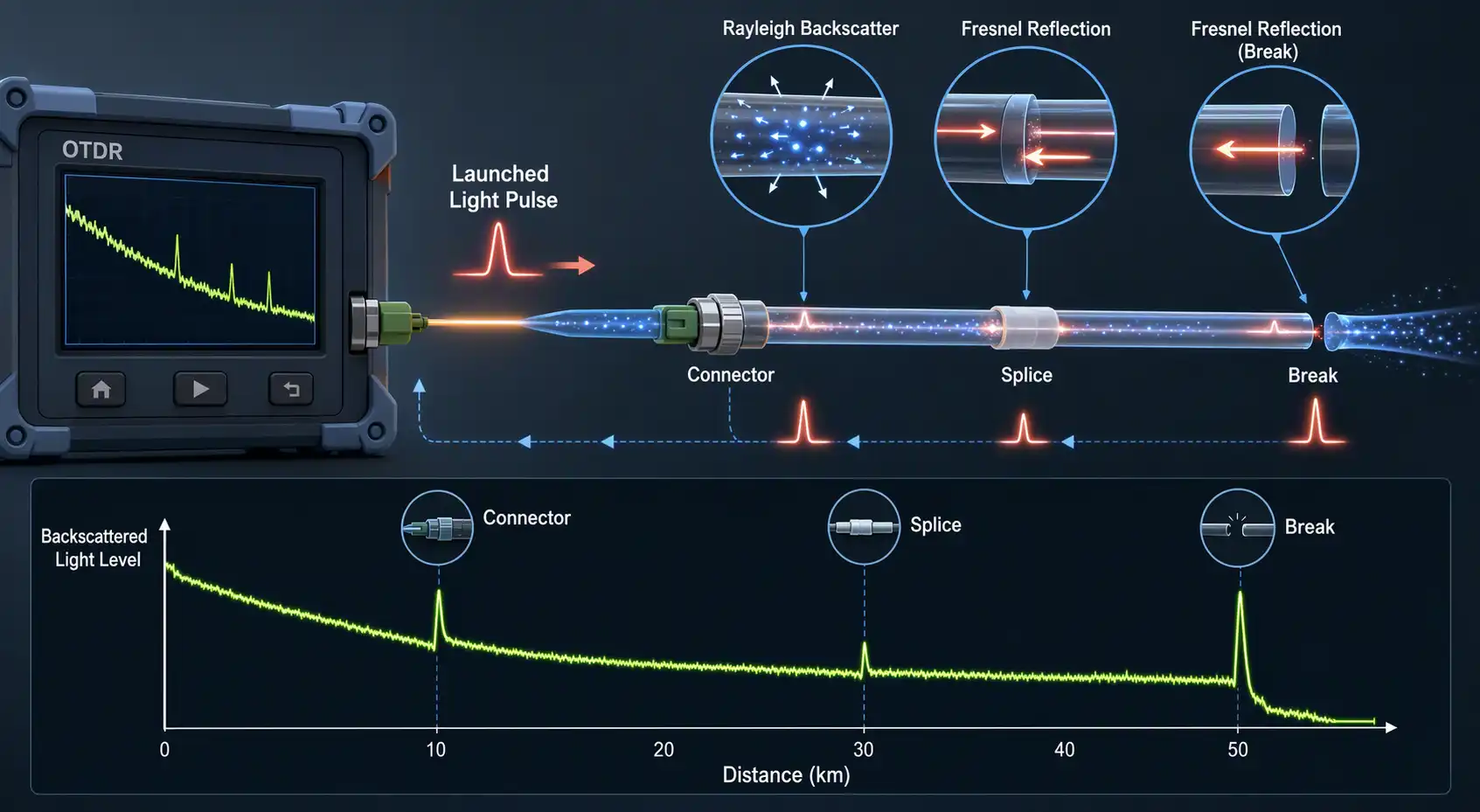
The core instrument is the optical time domain reflectometer, commonly known as an OTDR. Described simply, an OTDR behaves like an optical radar: it fires a short, high-power pulse into the fiber under test and listens for the tiny fraction of light that comes back. Two physical phenomena make this possible. Rayleigh backscatter returns a faint, continuous signal from every point along the glass, revealing the gradual attenuation of the fiber. Fresnel reflections occur at boundaries where the glass meets air, such as connectors, splices, and breaks, producing sharp peaks in the trace. Because the speed of light in fiber is known, the time taken for each return signal converts directly into distance, so the instrument can state not only what happened but where, typically with meter-level accuracy.
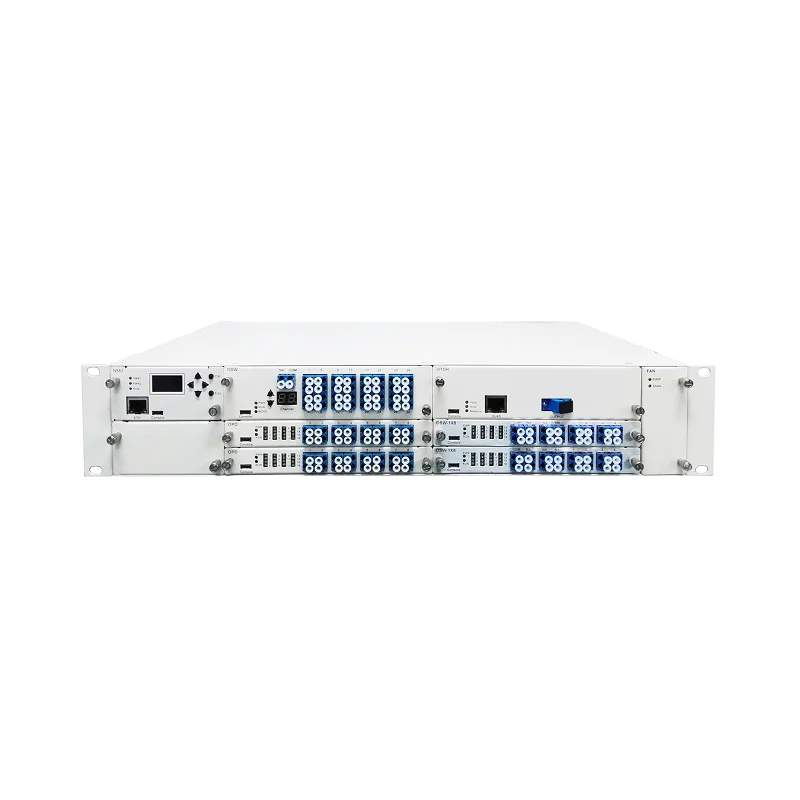
An automated monitoring deployment pairs the OTDR with scheduling software so the same fibers are scanned around the clock without a technician on site. Each new trace is compared against a stored reference captured when the fiber was healthy. Any deviation beyond a configured threshold, a new loss step, a shifting reflection, or a shortened fiber end, triggers an alarm. A purpose-built OTDR Solution designed for continuous, unattended operation is therefore the foundation of any serious monitoring architecture.
Testing Dark Fiber vs. Lit Fiber
Monitoring must handle two very different fiber states. Dark fiber carries no live traffic, so test pulses can be injected at any standard wavelength, such as 1310 nm or 1550 nm, without interference. Lit fiber, by contrast, is actively carrying customer data, so the test signal must move out of band. In-service monitoring systems use dedicated wavelengths, typically 1625 nm or 1650 nm, which sit outside the transmission window and pass through filtering optics that keep the test pulse away from live receivers and amplifiers. Monitoring selected dark fibers in a cable is also practical, because damage usually affects all fibers in the bundle, so a few monitored strands act as sentinels for the whole cable.
Core Components of a Fiber Monitoring System
A complete fiber optic monitoring system combines remote test hardware deployed at network nodes with a central management platform, allowing thousands of fibers to be tested automatically from a single location.
The most common architecture is the remote fiber test system, which distributes test units across the network and concentrates analysis and administration centrally.
| Component | Function |
| OTDR test head (remote test unit) | Performs automated optical measurements and reports results over the IP network |
| Optical switch (1xN) | Extends a single OTDR across many fibers, so one test head covers a whole cable rack |
| Central management software (EMS) | Stores reference traces, schedules tests, compares results, manages user access |
| Alarm and notification module | Pushes alerts by email, SMS, or SNMP traps to operations teams and ticketing systems |
| Mapping and reporting layer | Correlates optical distance with route geography so alarms translate into a street address |
The test units are typically installed at exchange sites, points of presence, or data center meet-me rooms. Because the EMS retains every historical trace, operators can also perform trend analysis, watching attenuation increase at an aging splice month over month, long before it threatens service.
Key Benefits of Fiber Optic Monitoring
The main benefits of fiber optic monitoring are dramatically faster fault localization, lower operating costs, proactive maintenance driven by degradation trends, and the ability to meet strict service level agreements.
The single most measurable gain is the reduction in mean time to repair. Traditional fault finding can take hours, with several technicians patrolling a route before the break is found, while a monitoring system narrows the search to a few meters in minutes. Faster localization means fewer truck rolls, shorter outages, and SLA credits avoided. Proactive maintenance adds a second layer of value: gradual events such as increasing splice loss or developing macrobends announce themselves in the trace data well before service is affected, allowing repairs to be scheduled during maintenance windows instead of emergency callouts. Optical monitoring also strengthens security, because the signature of an attempted fiber tap, typically a subtle bend or an inserted splitter, shows up as an unexpected optical event that the system flags immediately.
Common Applications of Fiber Optic Monitoring
Fiber optic monitoring is deployed wherever large volumes of fiber carry mission-critical or revenue-generating traffic, spanning telecom transport, access networks, data centers, and utility infrastructure.
Telecom Long-Haul and Metro Networks
Long-haul routes stretch hundreds of kilometers through remote terrain, where a break is expensive to locate manually. Monitoring covers both lit backbone links and dark fiber along the same routes, giving wholesale providers verifiable evidence of fiber health for lease contracts.
FTTH and Access Networks
Fiber to the home deployments extend the monitored boundary to the subscriber, since fiber now physically runs to the house in FTTH builds. Monitoring across passive optical network splitters helps operators isolate whether a fault sits in the feeder, distribution, or drop segment, which is essential when one outage affects a whole neighborhood.
Data Centers and DCI
Data center interconnect links carry concentrated, high-value traffic between campuses, so even brief interruptions are costly. Continuous monitoring of these dark fiber or DWDM routes protects availability and speeds restoration when carrier-side maintenance damages a leased span.
Utilities and Smart Grids
Power companies increasingly rely on their own fiber for grid automation and protective relaying.Monitoring detects both physical damage and unauthorized interference along right-of-way routes, keeping critical control channels available.
How to Choose a Fiber Optic Monitoring Solution
Choosing the right monitoring solution comes down to matching system capability to network size, fiber state, and operational model, so evaluation should focus on coverage, accuracy, integration, and scalability.
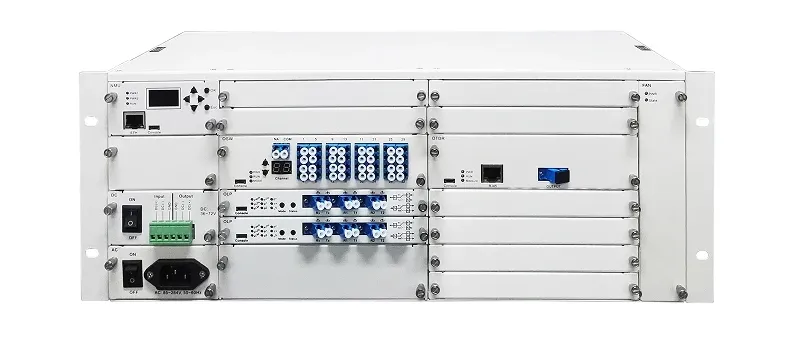
A practical checklist for selecting an Optical Fiber Monitoring System includes:
- Support for both dark fiber and in-service lit fiber testing, including out-of-band wavelengths
- Fault localization accuracy at meter level, confirmed against known route data
- Alarm integration with existing operations systems through SNMP, email, and SMS
- Scalability from a handful of fiber routes to network-wide coverage
- Reference trace storage and trend reporting for proactive maintenance
- Role-based access control for teams divided by region or customer
- Mapping correlation so that optical distance converts to real-world coordinates
Weighing these criteria against network growth plans helps teams avoid both underpowered systems that miss faults and oversized platforms that complicate daily operations.
Frequently Asked Questions
Is fiber optic the same as WiFi?
No. Fiber is a wired transmission medium that carries data as light through glass, while WiFi is a wireless radio technology that connects devices to a local network over the air. The two often work together, since WiFi access points typically ride on fiber backhaul, but fiber optic monitoring concerns the physical fiber layer, not the wireless link.
Why would I need fiber optics for my business?
Businesses choose fiber when copper or wireless links cannot keep pace with demand for bandwidth, low latency, and symmetric upload and download speeds. Dedicated fiber connections support cloud workloads, storage replication, and voice and video services with far greater headroom and reliability, which is why fiber underpins most modern enterprise connectivity.
Is fiber optic monitoring only for large telecom operators?
No. Although national carriers pioneered the technology, modern systems scale from a compact unit watching a handful of campus or DCI fibers to network-wide deployments with thousands of test points. Enterprises operating their own fiber routes, colocation providers, utilities, and managed service providers increasingly adopt monitoring, because the cost of a single undetected break applies at any scale.