
Every video call, cloud backup, and AI training job ultimately rides on fiber. Between the routers and switches that generate traffic and the thin strands of glass that carry it, there is a dedicated layer of hardware responsible for converting, combining, amplifying, and routing light across cities, countries, and continents. For network planners, understanding this equipment layer is the starting point for building capacity that scales.
Optical transport equipment is the family of hardware devices that moves data over optical fiber by converting electrical signals into light, multiplexing many wavelengths onto a single fiber, amplifying signals across long distances, and switching or routing them at network nodes. It includes optical transceivers, WDM multiplexers, optical amplifiers, ROADMs, and OTN switches, and it forms the physical backbone of telecom networks, metro networks, and data center interconnects.
The sections below explain what this equipment does, how it works, the main types you will encounter, the technologies behind them, and the factors that matter when choosing a system.
What Is Optical Transport Equipment?
Optical transport equipment refers to any device that transmits, multiplexes, amplifies, switches, or manages signals in the optical domain of a fiber network. Rather than performing packet processing like a router, it provides the high-capacity pipes and wavelength-level control that carry client traffic such as Ethernet, Fibre Channel, and legacy SDH/SONET between sites.
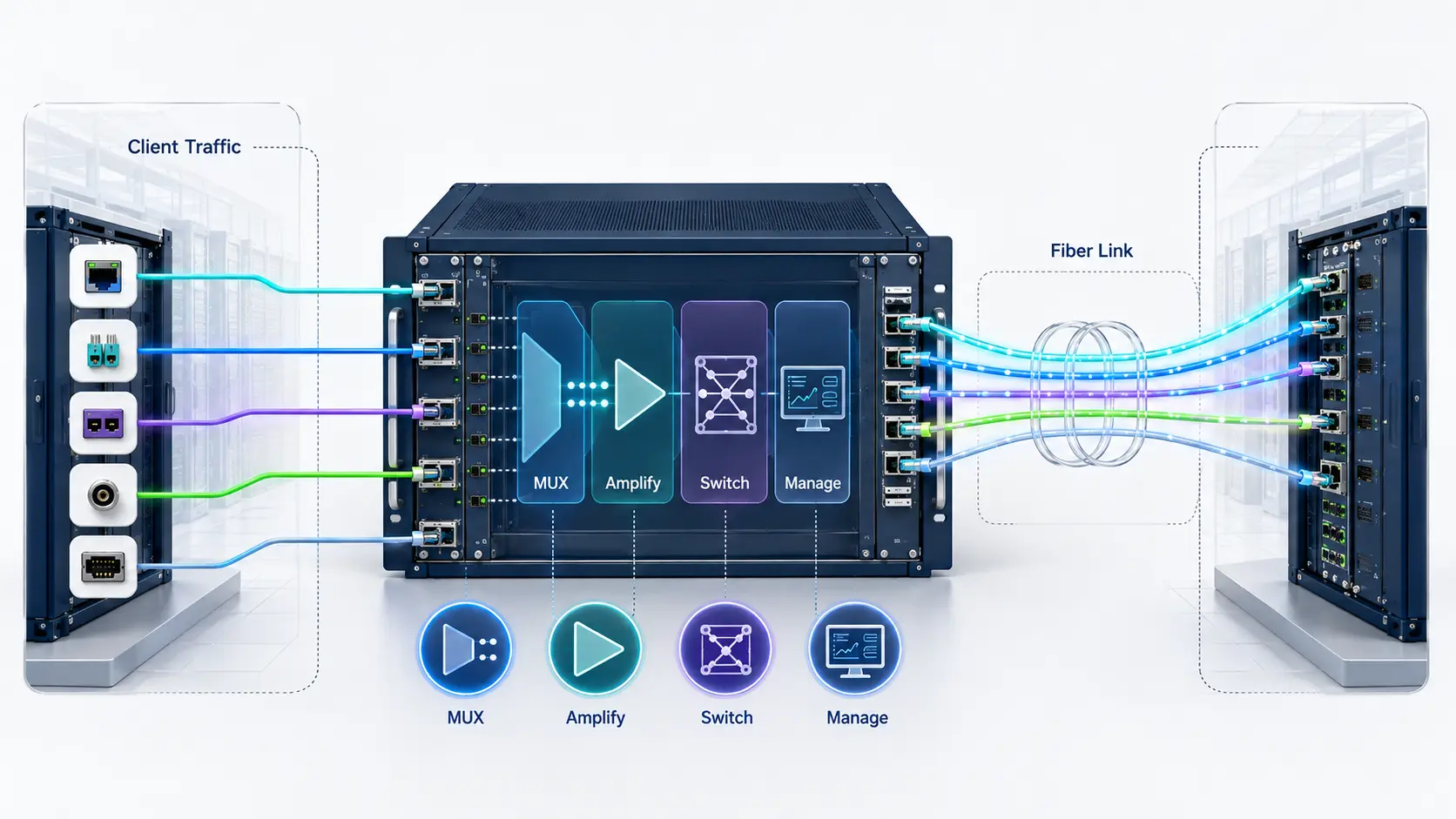
In practice, the term covers a broad portfolio. A compact Optical Transport Systems platform in a metro site, a long-haul amplifier station in the desert, and a pluggable module inside a data center switch all belong to the same equipment category. What unites them is their role: they move data as light over fiber with minimal loss, maximal distance, and predictable performance.
It helps to distinguish equipment from architecture. The Optical Transport Network, standardized by the ITU-T around the G.709 digital wrapper, defines how signals are framed, monitored, and protected. Optical transport equipment is the physical implementation of that architecture. A network is built from equipment; the standard tells the equipment how to behave so that devices from different layers and generations interoperate.
This separation of duties matters in real deployments. Routers and switches handle logical connectivity at the electrical layer, while transport hardware carries the resulting traffic over distances that range from a few kilometers between data halls to thousands of kilometers across a national backbone.
How Does Optical Transport Equipment Work?
Optical transport equipment works by converting client electrical signals into modulated light, combining multiple wavelengths onto shared fiber, boosting the signal where attenuation weakens it, and reversing the process at the far end. At intermediate nodes, wavelengths can be added, dropped, or rerouted without disturbing the rest of the traffic.
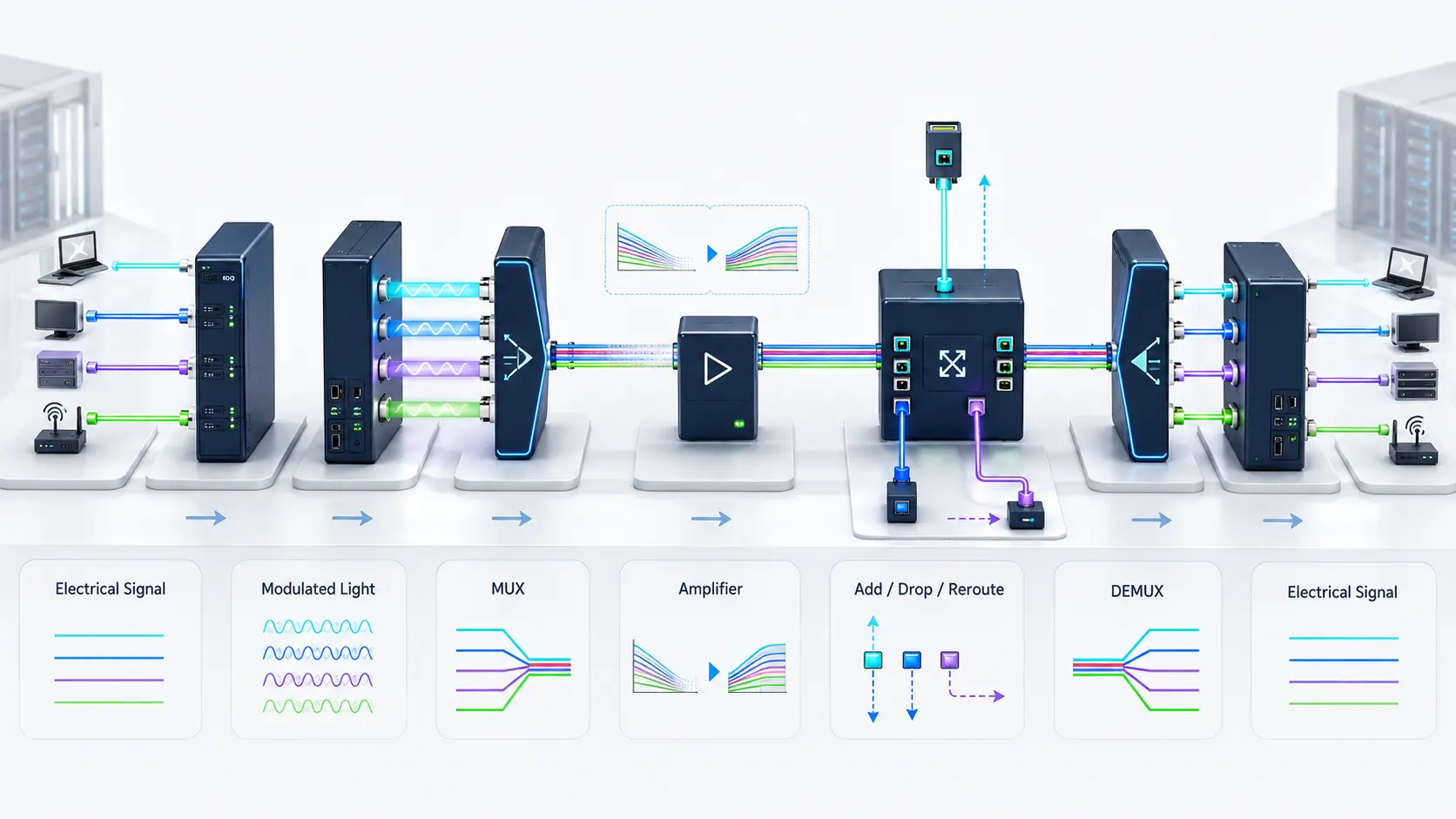
A single transmission follows a predictable path through the equipment chain:
- Electrical to optical conversion. A transceiver modulates a laser so that the client signal, for example 400GbE from a switch, is encoded onto a specific wavelength of light.
- Multiplexing. A multiplexer combines dozens of individual wavelengths into one composite optical signal carried on a single fiber pair.
- Transmission and amplification. As light attenuates over distance, optical amplifiers restore signal power roughly every 80 to 100 kilometers without converting it back to electricity.
- Add, drop, and switching. At network nodes, ROADMs selectively drop local wavelengths, add new ones, or pass express traffic through in the optical domain, while OTN switches groom and reroute services at the electrical layer.
- Demultiplexing and detection. At the destination, a demultiplexer separates the wavelengths and a photodetector converts each one back into an electrical signal for the client equipment.
The value of this chain is not just raw speed. Because amplification and express routing keep signals in the optical domain for most of the journey, the equipment delivers terabits of capacity per fiber with low, stable latency and high reliability.
Core Types of Optical Transport Equipment
The main types of optical transport equipment are optical transceivers and transponders, WDM multiplexers and demultiplexers, optical amplifiers, ROADMs and optical switches, and OTN switches and muxponders. Each solves one problem in the signal path, and complete networks combine all of them.
Optical Transceivers and Transponders
Transceivers are the interface between the electrical and optical domains, converting signals in both directions at each end of a link. They are the most numerous devices in any transport deployment, and their capabilities have evolved rapidly. Transponders extend this role by converting a client signal into a standardized line signal, including wavelength conversion and regeneration, while muxponders combine several lower-rate client signals into one high-capacity wavelength.
WDM Multiplexers and Demultiplexers
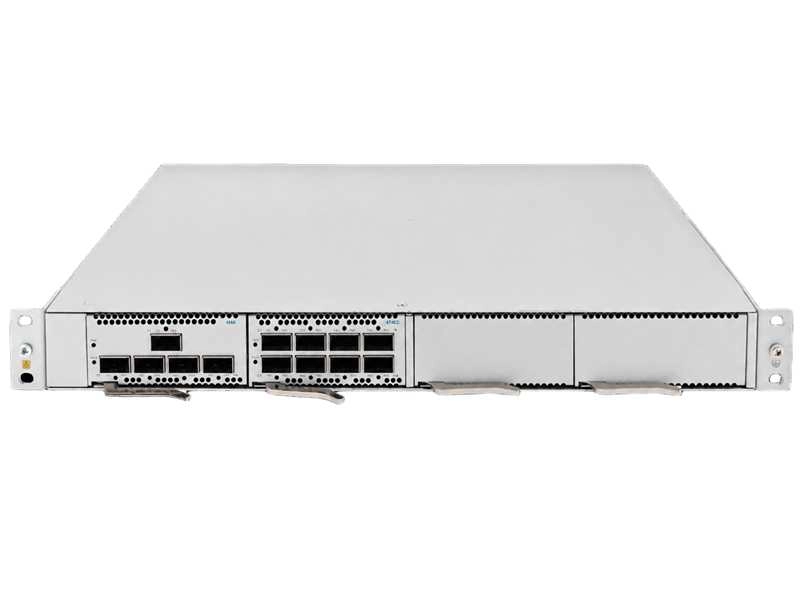
Wavelength division multiplexing is what turns one fiber into many virtual fibers. Multiplexers merge separate wavelengths onto a shared fiber at the transmitting end, and demultiplexers separate them again at the receiving end. Coarse WDM offers a low-cost option for short metro links, while dense WDM packs 40, 80, or more channels into the C-band for high-capacity transport, the same principle a compact DCI WDM system applies to data center interconnect.
Optical Amplifiers
Erbium-doped fiber amplifiers, or EDFAs, boost all wavelengths in a fiber simultaneously, extending reach without electrical regeneration. Raman amplification supplements EDFAs on long spans by providing distributed gain through the transmission fiber itself. Together they make unrepeatered spans of well over 100 kilometers and multi-thousand-kilometer amplified chains practical.
ROADMs and Optical Switches
Reconfigurable optical add/drop multiplexers let operators add, drop, or redirect individual wavelengths at a node through software rather than manual patching, keeping express traffic in the optical domain. Optical circuit switches extend this flexibility by physically routing light between ports, which is increasingly used inside data centers to balance AI training traffic.
OTN Switches and Muxponders
OTN switches provide electrical-layer switching of framed signals, enabling sub-wavelength grooming, protection switching, and performance monitoring. This is the layer where a 10G private line and a 100G Ethernet service can share a single wavelength without interfering with each other.
| Equipment Type | Primary Function | Typical Application |
| Optical transceiver | Electrical to optical conversion at link ends | Client connections in routers, switches, transport platforms |
| Transponder or muxponder | Wavelength conversion, multiplexing of client signals | Long-haul and regional line sides |
| WDM mux and demux | Combining and separating wavelengths | Fiber capacity multiplication |
| Optical amplifier | Restoring signal power over distance | Long-haul and metro spans |
| ROADM | Software-controlled wavelength add/drop and routing | Mesh and ring network nodes |
| OTN switch | Electrical-layer grooming and switching | Service aggregation and protection |
Key Technologies Behind Optical Transport Equipment
Three technologies define what modern optical transport equipment can do: DWDM multiplexing multiplies fiber capacity, OTN framing adds management and error correction, and coherent optics push single-wavelength speeds to 400G and beyond. Understanding these three makes every product datasheet easier to read.
DWDM Wavelength Multiplexing
Dense wavelength division multiplexing assigns each service its own wavelength within the C-band spectrum, typically with 50 or 100 GHz spacing. Because each wavelength acts as an independent channel, capacity scales by lighting new wavelengths instead of laying new fiber. This is why operators can upgrade a link from 40 channels to 96 channels on existing fiber, an economic advantage that shapes every transport purchasing decision.
OTN Framing and Forward Error Correction
The ITU-T G.709 standard defines a digital wrapper that encapsulates any client signal into a common frame with overhead for management and forward error correction. FEC adds redundant information at the transmitter so the receiver can correct bit errors caused by noise, which directly extends transmission reach and reduces the number of regeneration sites a network needs. Built-in performance monitoring also lets operators isolate faults between providers and verify service levels end to end.
Coherent Optics
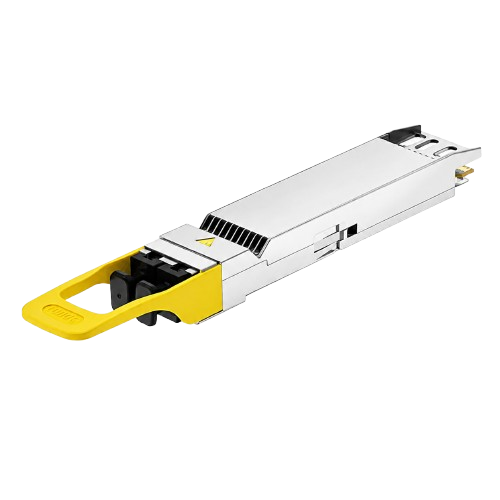
Coherent transmission modulates the amplitude, phase, and polarization of light to pack multiple bits per symbol, and powerful DSP chips at the receiver compensate for dispersion and nonlinearity accumulated over the fiber. This is the technology behind single-wavelength 400G and 800G line rates. At the module level, coherent pluggables such as an 800G Optical Transceiver Module now bring long-reach capability directly into routers and switches, blurring the boundary between transport and client equipment and simplifying data center interconnect design.
Where Is Optical Transport Equipment Used?
Optical transport equipment is used wherever large volumes of data must move between locations that copper or radio links cannot serve efficiently. The dominant scenarios are telecom backbone and metro networks, data center interconnect, 5G transport, and private networks for utilities, finance, and research.
Each scenario stresses a different mix of capabilities:
- Telecom backbone networks need maximum per-fiber capacity and long unrepeatered reach, relying on DWDM line systems, cascaded amplification, and ROADM meshes.
- Metro and regional networks balance capacity with service flexibility, using OTN grooming to pack many enterprise circuits onto shared wavelengths.
- Data center interconnect demands high bandwidth with low latency and low power. Compact platforms such as the Zero-Touch DCI Network Series show how the category has adapted to cloud-scale requirements, with automated provisioning and coherent pluggables replacing bulky transponder shelves.
- 5G transport uses WDM equipment in fronthaul and midhaul segments, where timing synchronization and deterministic latency matter as much as throughput.
- Enterprise and utility networks deploy transport equipment to connect campuses, substations, and disaster recovery sites with the monitoring and protection that plain point-to-point links lack.
The common thread is reliability. When a fiber is cut, protection switching inside the transport layer restores service in milliseconds, long before higher-layer protocols even notice the failure.
How to Choose Optical Transport Equipment
Choose optical transport equipment by matching four variables to your network: required capacity per wavelength, transmission distance, growth path, and operational model. The right choice minimizes total cost of ownership over the equipment lifecycle, not just the initial purchase price.
| Selection Factor | What to Evaluate | Why It Matters |
| Capacity | Current and 5-year bandwidth needs, channel count, single-wave rate | Determines whether you scale by adding wavelengths or replacing platforms |
| Reach | Span distances, amplifier placement, FEC performance | Sets regeneration cost and achievable topology |
| Scalability | Modular chassis, pay-as-you-grow licensing, pluggable upgrades | Protects the investment as traffic grows |
| Service mix | Client interfaces, OTN grooming, encryption options | One platform can carry Ethernet, storage, and TDM traffic together |
| Operations | Management system, telemetry, zero-touch provisioning | Reduces ongoing operating expense and human error |
| Efficiency | Power per bit, rack space, cooling | Dominates lifecycle cost in large deployments |
Two current trends deserve attention during evaluation. First, coherent pluggable optics allow router-based interconnect designs that skip discrete transponders for shorter regional links, cutting power and space. Second, open and disaggregated architectures let operators mix line systems, ROADMs, and transceivers from different vendors, which increases flexibility but requires more integration testing. Neither approach is universally superior; the decision depends on team skills, scale, and how quickly the traffic profile is changing.
FAQ
What is the difference between optical transport equipment and an optical transport network?
An optical transport network is the architecture and set of standards that define how signals are framed, monitored, and protected across a fiber infrastructure. Optical transport equipment is the physical hardware that implements that architecture. In other words, the network is the design and the equipment is what you actually install, power, and maintain.
How far can optical transport equipment transmit signals without regeneration?
With cascaded optical amplification and modern coherent detection, amplified terrestrial links routinely span hundreds to thousands of kilometers without electrical regeneration. Shorter point-to-point links using direct-detect transceivers typically cover up to 80 or 120 kilometers, depending on the module reach class and fiber quality.
Can optical transport equipment carry different types of client traffic on the same fiber?
Yes. Through OTN framing, services such as Ethernet, Fibre Channel, SDH/SONET, and storage replication are wrapped in a common digital container, multiplexed together, and carried on shared wavelengths. Each service keeps its own performance monitoring and can be managed or protected independently.