
Modern networks are under relentless pressure to move more data. AI training clusters, cloud data centers, and 5G transport all push link speeds upward, and every upgrade path eventually runs through the same physical question: how do you connect electrical switch hardware to optical fiber in a way that can be swapped, upgraded, and scaled? Pluggable transceiver technology answers that question, and the SFP optical transceiver is where that story begins.
An SFP transceiver is a compact, hot-pluggable module that connects switches, routers, and servers to fiber-optic or copper cabling. Optical SFP modules convert electrical signals into optical signals and back again, while copper SFP modules provide an electrical Ethernet interface. SFP stands for Small Form-factor Pluggable, a standardized package defined by a Multi-Source Agreement (MSA).
This guide explains how the SFP optical transceiver works, how the SFP family evolved to keep pace with rising bandwidth, and why today’s networks increasingly look beyond it toward 400G and 800G optical transceivers.
What Is an SFP Optical Transceiver and How Does It Work?
An SFP optical transceiver is a small, removable input/output device that plugs into an SFP port on network equipment, translating between the device’s electrical signals and the light pulses that travel over fiber.
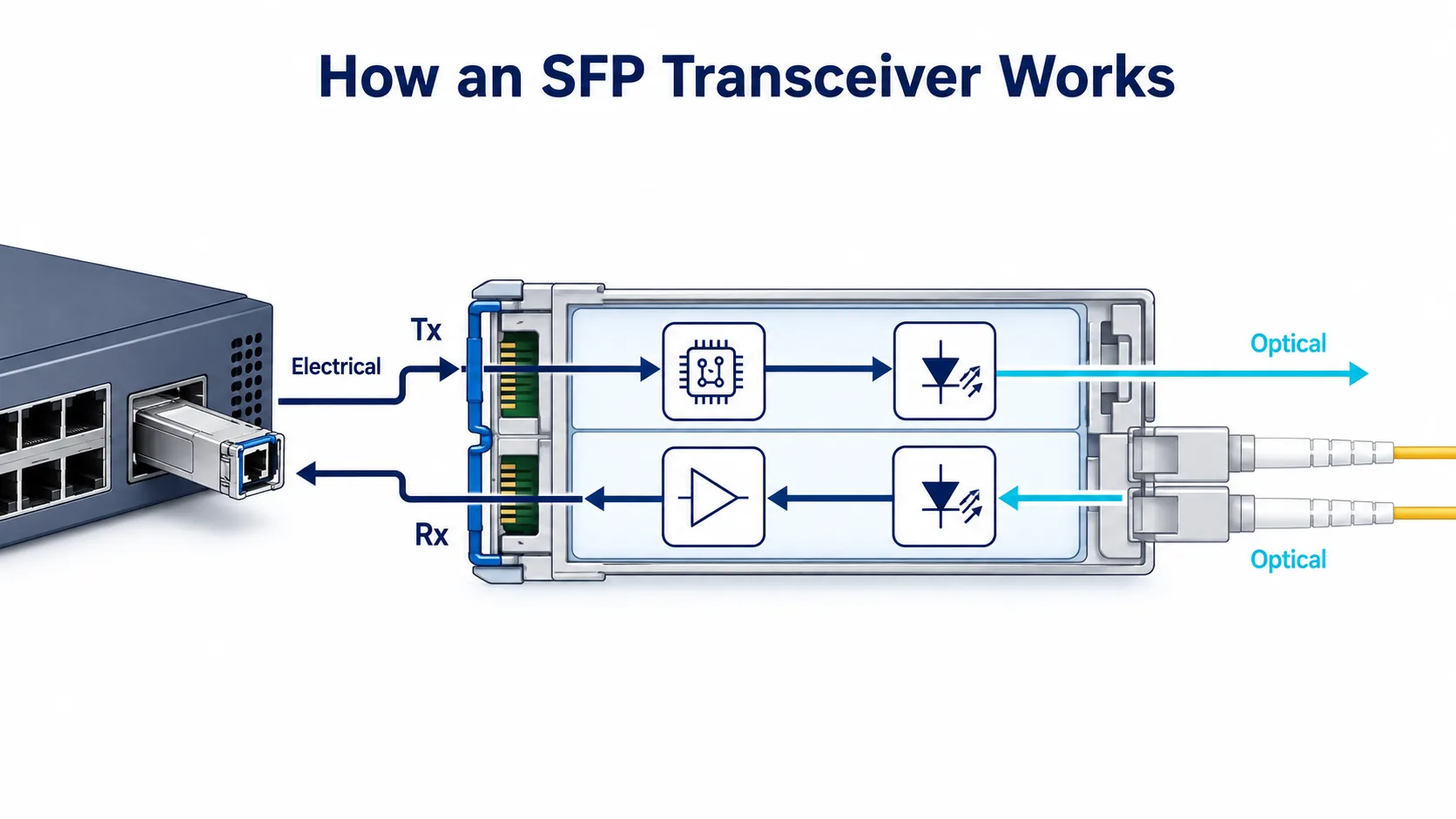
The term “transceiver” combines transmitter and receiver, referring to any device that does both jobs. Every optical SFP is an optical transceiver module, but not every optical transceiver uses the SFP form factor. SFP+, SFP28, QSFP28, and OSFP are other members of the broader pluggable transceiver family. SFP was introduced as a half-size successor to the older GBIC module, doubling port density on switch faceplates, and it remains one of the most widely deployed pluggable formats in history.
Because SFP modules are hot-pluggable, they can be inserted or removed while the host device is running, so links can be reconfigured without downtime. Inside the module, a laser diode converts outgoing electrical data into modulated light, while a photodetector converts incoming light back into an electrical signal. The optical interface is typically a duplex LC connector using two fiber strands, one for transmit and one for receive; BiDi variants use wavelength division multiplexing to run both directions over a single fiber. Package dimensions, the 20-pin edge connector, and digital diagnostic monitoring are standardized through the MSA and the SFF-8472 specification maintained by the SFF Committee, which is what allows SFP modules from any compliant vendor to interoperate.
The SFP Family: Built for Rising Bandwidth
The SFP family has evolved through successive generations, SFP, SFP+, SFP28, and SFP56, each delivering more bandwidth in the same compact footprint to match the pace of network growth.
| Type | Typical Lane Rate | Common Applications |
|---|---|---|
| SFP | 1 Gbps Ethernet; up to 4.25 Gbps for Fibre Channel variants | Gigabit Ethernet, Fibre Channel, SDH/SONET |
| SFP+ | 10 Gbps | 10GbE and storage networks |
| SFP28 | 25 Gbps | 25GbE and 5G transport |
| SFP56 | 50 Gbps using PAM4 | 50GbE server and access links |
This progression is not accidental. Each generation was driven by a bandwidth inflection: gigabit enterprise LANs made SFP ubiquitous, 10G server links made SFP+ the data center workhorse, and 25G and 50G lanes became the building blocks of modern cloud networks. Many SFP+ ports can accept 1G SFP modules, but backward compatibility depends on the switch hardware, firmware, and supported port configuration.
Across the family, module selection still comes down to the same physical variables. Most SFP modules are designed for fiber optic cables: multimode variants at 850 nm cover short indoor runs, while single-mode variants at 1310 nm or 1550 nm reach across campuses, metro areas, and long-haul spans. Copper RJ45 SFP modules also exist for connecting fiber-equipped switches to legacy twisted-pair equipment over about 100 meters.
Why Networks Are Moving Beyond SFP to High-Speed Optical Transceivers
Networks are moving beyond SFP because single-lane packages top out at 25G to 50G per module, while AI clusters, hyperscale data centers, and DCI links now demand 400G, 800G, and beyond, speeds that require multi-lane form factors.
Three forces are accelerating this shift:
- AI and machine learning workloads synchronize thousands of GPUs across a fabric, creating east-west traffic patterns that saturate 10G and 25G links and push spine-leaf designs toward 400G and 800G connections.
- Cloud data center growth favors higher bandwidth per port rather than more ports, because each additional port consumes faceplate space, power, and cabling complexity.
- Data center interconnect (DCI) links between campuses and metro sites concentrate enormous aggregated traffic onto single high-speed wavelength connections.
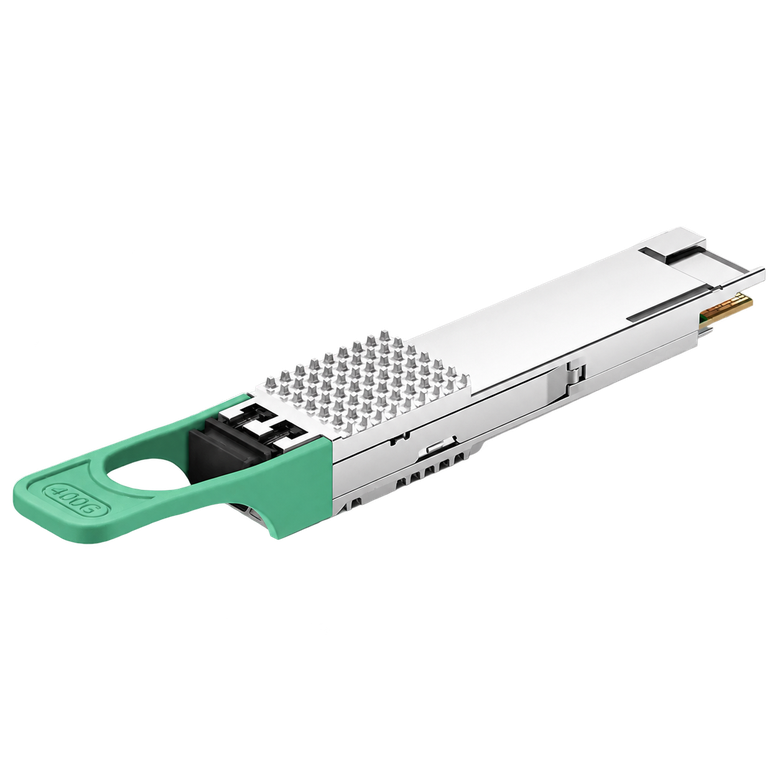
To reach these speeds, the industry moved from single-lane SFP packages to multi-lane form factors. QSFP28 combines four 25G lanes for 100G, QSFP-DD and OSFP scale to 400G and 800G using eight parallel lanes, and modern designs use PAM4 modulation to push 100G or more per lane. A current-generation 800G optical transceiver delivers vastly more bandwidth than the original 1G SFP while maintaining a compact, hot-pluggable design.
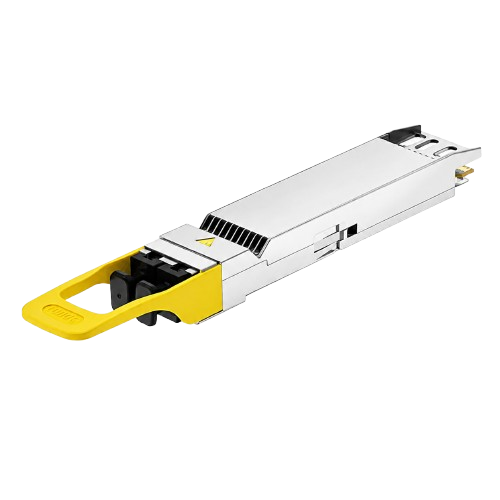
None of this makes the SFP form factor obsolete. SFP28 and SFP56 remain the standard for server access, top-of-rack, 5G fronthaul, and industrial deployments, and enormous installed bases of SFP and SFP+ ports continue to serve enterprise networks reliably. The practical takeaway is that SFP is now the entry tier of a bandwidth ladder that extends upward through QSFP and OSFP modules.
What Are SFP Transceivers Used For?
SFP transceivers are used to provide flexible, swappable fiber or copper interfaces on network equipment, and they remain the default choice wherever port-level flexibility matters more than maximum speed.
Typical deployments today include:
- Enterprise and campus networks connecting wiring closet switches to cores over single-mode fiber
- Data center access layers running 10G SFP+ and 25G SFP28 links from servers to top-of-rack switches
- Telecom access and 5G fronthaul connecting base stations and aggregation sites
- Industrial networks using hardened modules rated for extended temperatures in factories and outdoor cabinets
- Storage and Fibre Channel fabrics linking servers to storage arrays
In each case, the hot-pluggable SFP port functions as a future-proofing mechanism: the switch hardware stays in place while the transceiver determines the media, reach, and, within the port’s capability, the speed of each link.
How to Choose Between SFP, 400G, and 800G Transceivers
Choosing between an SFP-family module and a high-speed optical transceiver comes down to matching the module to the link’s role: SFP for flexible access connectivity, and 400G or 800G modules for aggregation, spine, and interconnect layers where traffic concentrates.
A practical selection sequence:
- Determine the required data rate from the switch port and the application, not from marketing terminology.
- Measure the physical distance and select the reach class and fiber type accordingly, multimode for short runs, single-mode for everything beyond a few hundred meters.
- Assess traffic growth: if a link is expected to multiply in bandwidth within its lifecycle, weigh the total cost of upgrading SFP tiers repeatedly against deploying a high-speed module once.
- Verify standards compliance, including MSA compatibility and SFF-8472 diagnostics support.
For access and edge connectivity, SFP+ and SFP28 remain the most economical and widely supported options. For spine links, DCI, and AI fabric connections, planning should start with a 400G Optical Transceiver Module or 800G-class hardware. Understanding where the SFP Optical Transceiver family ends and quad-lane QSFP packages begin is the key to budgeting ports, power, and cabling correctly across both generations.
FAQs
Is the SFP optical transceiver still relevant in 400G and 800G networks?
Yes. Even hyperscale facilities running 800G spines still deploy large volumes of SFP28 and SFP56 modules at the access layer, because server and appliance ports simply do not require 400G. SFP remains the most flexible and cost-effective format for low-to-medium speed connectivity, and its installed base guarantees long-term support.
Are SFP optical transceivers from different vendors interchangeable?
In most cases, yes. Any module compliant with the SFP MSA will physically and electrically fit a standard port. Some equipment vendors apply proprietary validation that can warn against third-party modules, so interoperability policies should be confirmed before large deployments.
What is the typical lifespan of an SFP optical transceiver?
A quality SFP module typically lasts many years of continuous operation, since solid-state laser and photodetector components have no moving parts. Actual lifespan depends on operating temperature, optical power stress, and insertion cycles. Tracking DDM parameters such as rising laser bias current helps predict degradation before link failures occur.