
A pipeline right of way, a rail corridor, a perimeter fence and a power cable route share one property: the asset is measured in tens of kilometers, and the events that matter last a fraction of a second. Point sensors cover a few meters each, so coverage is bought one instrument at a time, and the gaps between instruments are exactly where most failures begin. Fiber already runs along many of those routes, which is why distributed acoustic sensing systems have moved from research instruments into routine monitoring.
Distributed acoustic sensing (DAS) is a fiber optic measurement technique that turns an ordinary single-mode fiber into a continuous array of acoustic and vibration sensors. It does this by reading the phase of Rayleigh backscattered light, which changes in proportion to strain wherever the fiber is disturbed, and by timing each return to place the disturbance on the cable. One interrogator at one end therefore returns thousands of independent measurement channels along tens of kilometers, reporting both where an event happened and what it looked like in the time domain.
The sections below follow the technology from the physics of a single pulse through to the specification sheet a buyer has to sign.
What Is Distributed Acoustic Sensing and What Does It Measure?
DAS measures dynamic strain, and the rate of change of strain, along a fiber, sampled continuously in space and time. The fiber is both the transmission medium and the sensing element, so a single instrument returns a dense set of channels rather than a set of point readings.
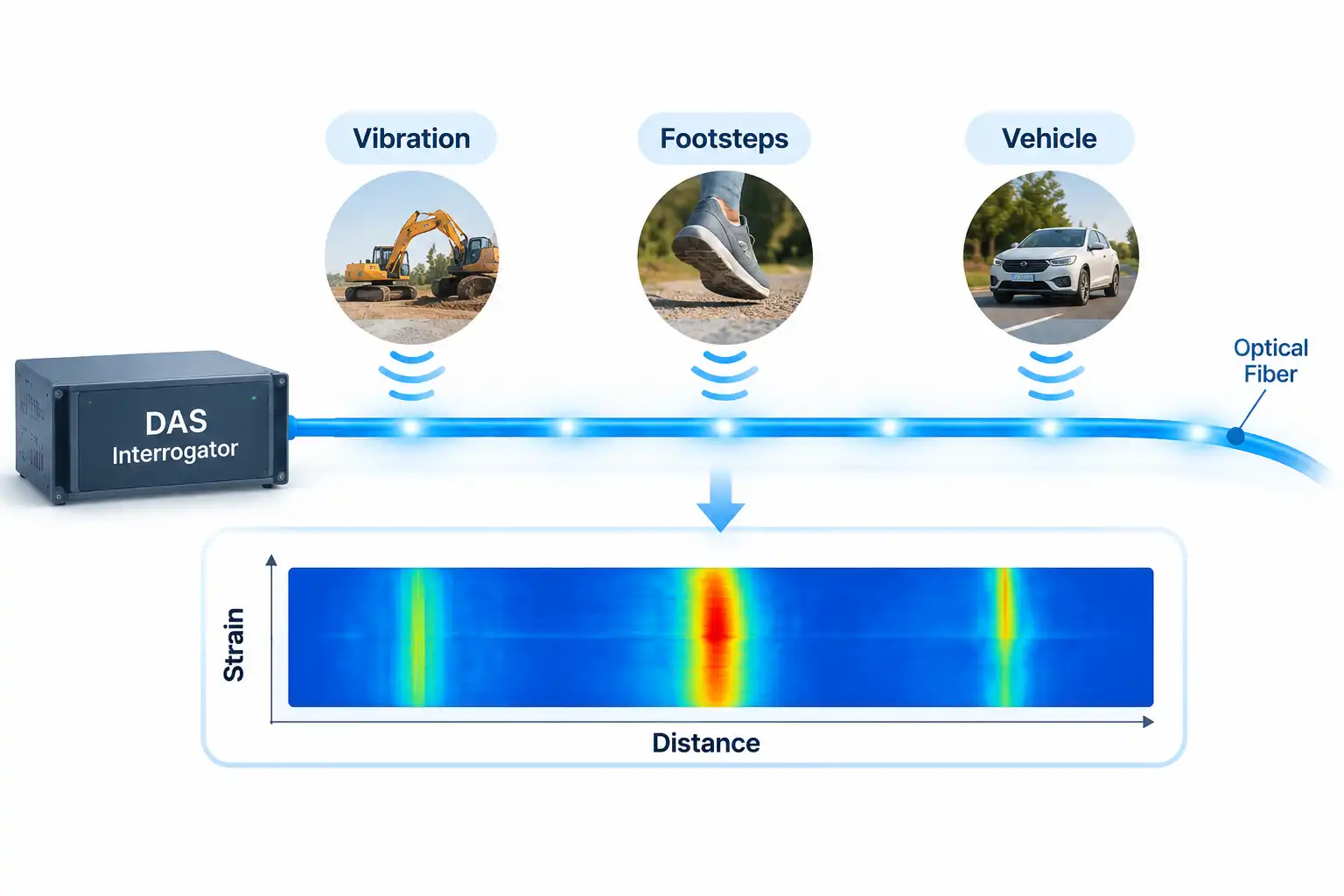
It helps to place the technique inside the wider family of types of fiber optic sensors. Point sensors such as fiber Bragg gratings return a high-accuracy value at an addressed location, and a single fiber can host dozens of them. Distributed techniques give up that per-point precision in exchange for continuity: distributed temperature sensing reads a static thermal profile, distributed vibration sensing reads the presence and location of disturbance, and DAS reads the full waveform of the disturbance.
Strain, Not Sound Pressure
The word acoustic in the name is a convenience rather than a physical description. A fiber does not measure pressure the way a microphone does. It measures how much its own length changed, and it reports the result as strain, often normalized to nanostrain per second because the changes are tiny and fast. Converting that number into acceleration or sound pressure requires a transfer function measured for that specific cable and that specific ground, which is why two installations with identical interrogators can differ by an order of magnitude in apparent sensitivity.
How Does a DAS System Work?
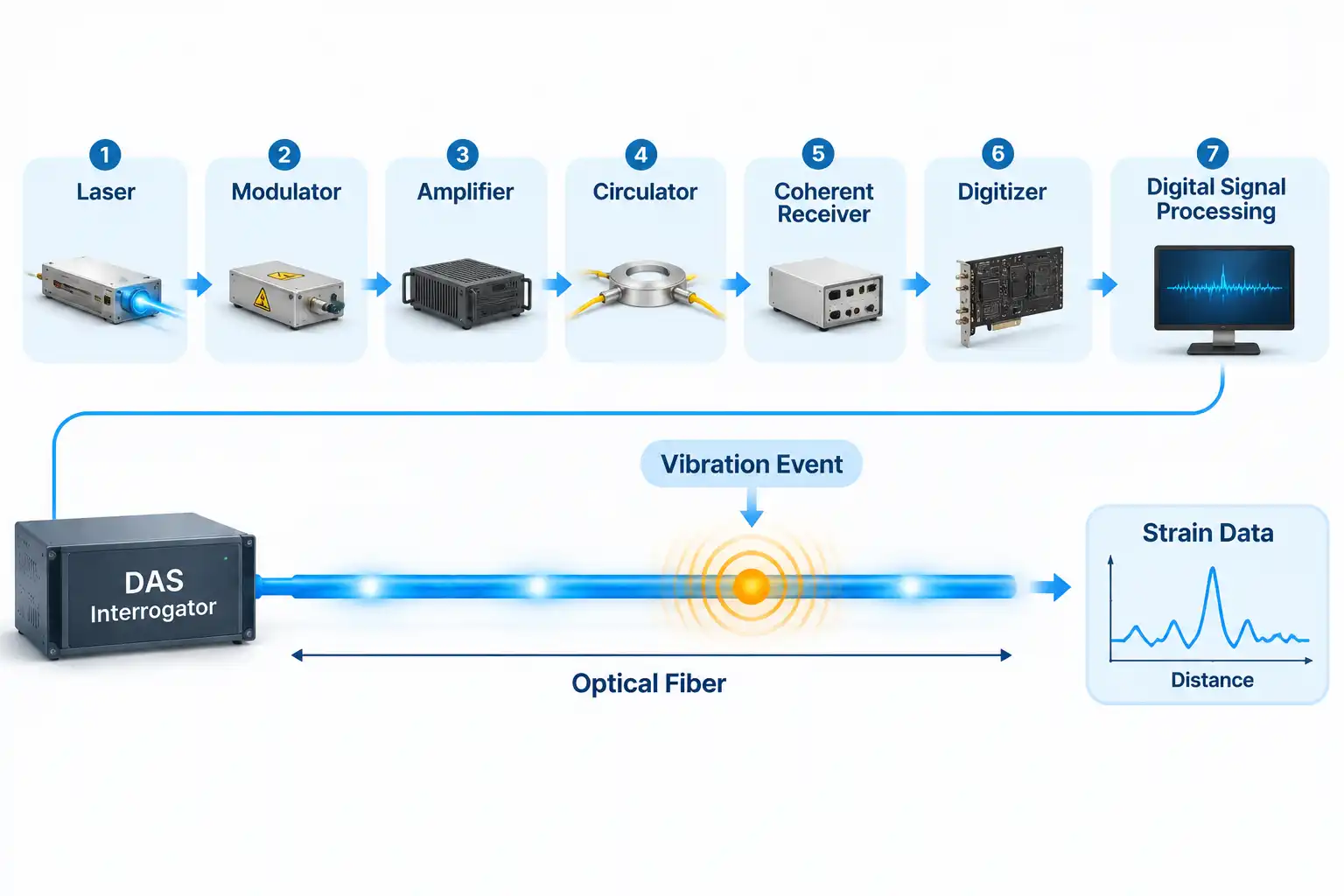
A distributed acoustic sensing system launches short, highly coherent laser pulses into the fiber and records the light that scatters back from every point along it. Microscopic density variations in the glass form a fixed pattern of scatterers, so each section of fiber behaves like an interferometer with a fixed optical path. When the fiber stretches, that path changes, and the phase of the returning light shifts in proportion to the strain.
Position comes from time of flight, because the delay between launch and return maps onto distance. Strain comes from the phase difference across the gauge length, and repeating the measurement thousands of times per second turns one-dimensional profiles into a record of strain against distance and time.
The physical layer is short: a narrow-linewidth laser, an acousto-optic modulator that carves the pulses, an optical circulator, a coherent receiver and a fast digitizer, all housed in the DAS interrogator. The measurement layer is not. Pulse shape, chirp and phase unwrapping decide whether the record is usable, and the published standard for interrogator terminology, IEEE 3101-2023, exists largely because vendors once described the same behavior with incompatible words.
From Backscatter to Phase
Only a small fraction of the pulse returns, and launch power cannot be raised freely because nonlinear effects distort the pulse before range improves. The backscatter pattern is also random: some sections return almost no light at a given optical frequency, a condition known as fading. Interrogators counter it by probing several optical frequencies in sequence and combining the results. Because laser frequency noise enters the measurement as strain would, the source has to be stable to a few kilohertz.
What Determines Spatial Resolution, Range and Bandwidth?
Spatial resolution is set by pulse duration, the highest usable pulse repetition rate is set by the round trip time, and those two limits together cap the acoustic bandwidth that can be sampled without aliasing. Range then follows from optical loss.
A pulse of duration t resolves a length of about c times t divided by twice the refractive index, so a 100 ns pulse in standard single-mode fiber resolves roughly 10 m. The same pulse length sets the gauge length, the interval over which strain is integrated. Only one pulse can occupy the fiber at a time, so the repetition rate cannot exceed the inverse of the round trip, and bandwidth cannot exceed half of that rate.
| Fiber length under test | Round trip time | Maximum pulse rate | Unaliased acoustic bandwidth |
| 5 km | about 49 microseconds | about 20.4 kHz | about 10.2 kHz |
| 10 km | about 98 microseconds | about 10.2 kHz | about 5.1 kHz |
| 50 km | about 490 microseconds | about 2.04 kHz | about 1.02 kHz |
Loss closes the loop on range. Standard single-mode fiber at 1550 nm attenuates by roughly 0.2 dB per kilometer, and because the light makes a double pass the effective penalty is about 0.4 dB per kilometer, a figure set out in the FOA fiber optic guide. Without amplification, practical sensing range lands between 40 and 80 km per channel. Amplification or back-to-back interrogators extend coverage past 100 km.
Gauge Length Is a Specification, Not a Constant
Gauge lengths between 1 m and 10 m cover most security and integrity work, and 20 m or more is common on very long routes. A longer gauge integrates more scatterers, which raises signal-to-noise ratio and stabilizes the phase, but it also low-pass filters the data, so short, sharp events lose definition. Channel spacing can be set finer than the gauge length, which produces a smoother spatial picture without adding independent information. Specifying both numbers prevents a system that looks good on paper and disappoints on site.
What Is Distributed Acoustic Sensing Used For?
Distributed acoustic sensing is used wherever an asset is long, buried or inaccessible, and wherever the event of interest has a vibrational or acoustic signature. Third-party excavation near a pipeline, an approach at a fence line, a train entering a block and a wavefront crossing a seismic array all qualify.
| Sector | Typical events | Why fiber fits |
| Pipeline integrity | excavation, leak noise, ground movement | the route usually already carries a cable |
| Perimeter security | approach, climb, cut, vehicle movement | no power or electronics along the fence |
| Rail and road | train position and speed, rockfall, track break | continuous coverage without trackside hardware |
| Power cable | partial discharge, dig-in, joint failure | the trench fiber is already installed |
| Seismic and research | ground motion, ocean waves, microseisms | existing telecom and submarine cables |
The seismic case is the clearest demonstration that the sensing medium need not be purpose-built. Experiments on seafloor telecommunications cables have shown that ordinary repeaterless spans can record earthquakes and ocean-solid Earth interactions across tens of kilometers of ocean floor, reported in Nature Communications. The same logic applies on land: a route that already carries traffic can often surrender a dark fiber, so marginal sensing cost falls to the interrogator and analytics.
DAS vs Point Sensors and Other Distributed Technologies
A point sensor returns an absolute, three-component measurement at a known location. DAS returns a relative, single-axis strain measurement everywhere along a line. Neither replaces the other, and mature installations use both: the fiber for coverage and event location, the point sensors for calibration and for confirming amplitude.
The economics differ as much as the physics. One interrogator can replace hundreds of geophones, hydrophones or accelerometers, and it removes the power, telemetry and enclosure cost that dominates a dense point network. What it does not remove is the cable, the civil works to reach it, and the processing that turns terabytes of strain data into a few alarms.
| Technology | What it measures | Reuse of existing cable | Characteristic use |
| DAS | phase, giving strain and strain rate | yes, readily | intrusion detection, leak and geohazard monitoring |
| DVS | intensity change only | yes, readily | threshold alarms, camera-triggered perimeter systems |
| DTS | absolute temperature via Raman scatter | usually needs a suitable fiber | cable hotspots, tunnel fire detection, leak detection |
Why DVS Is Not a Synonym for DAS
Vendor material sometimes lists the two as one product. Both derive from the same phase-sensitive reflectometry platform, but DVS demodulates intensity rather than phase. Its output is not proportional to the amplitude of the disturbance, it carries no phase coherence between channels, and it cannot tell whether the fiber was stretched or compressed. DAS keeps the full waveform, which is what allows frequency-domain classification of a digging tool against a footstep. Where the only question is whether something touched the fence, DVS is cheaper and adequate.
What Are the Limitations of Distributed Acoustic Sensing?
Most distributed acoustic sensing limitations come from geometry and from the cable rather than from the instrument. A fiber feels strain only along its own axis, and it feels only what the cable is mechanically coupled to.
Each constraint has an engineering response:
- Directional sensitivity. A wave arriving broadside to the fiber generates very little axial strain, so a single cable is a poor detector for some source geometries. Crossing cables or a serpentine layout restores coverage at extra cost.
- Coupling. Cable grouted into a trench or bonded to a pipe reads far more than cable lying loose inside a duct. Sensitivity is established by a short test section, not inferred from a datasheet.
- Fading. Random backscatter leaves some channels blind at a given optical frequency. Multi-frequency probing mitigates it but never removes it.
- Temperature cross-sensitivity. Thermal expansion produces strain that looks like a slow mechanical event. Long-period trends need independent temperature data.
- Data volume. A single fiber generates hundreds of gigabytes per day. Edge filtering and event-driven storage decide whether the deployment is operable, since only a fraction of the record is worth keeping.
How Is a DAS Project Specified and Deployed?
A DAS project succeeds or fails on the fiber audit and the specification sheet, months before any classifier is trained. The instrument is rarely the variable that decides the outcome.
A workable sequence looks like this:
- Audit the candidate fiber with an optical time domain reflectometer, confirming continuity, total loss, splice quality and the position of every reflective event.
- Run a test section of a few hundred meters with a known disturbance source, and measure the response at several offsets to establish real coupling.
- Write the specification around the application: gauge length, channel spacing, range, bandwidth, dynamic range and the strain resolution required at the far end.
- Confirm power, communications and housing at the site, and decide whether a second unit is cheaper than amplification.
- Design the data pipeline before commissioning: what is filtered at the edge, what is retained, what triggers an alarm and who receives it.
- Accept the system against repeatable tests on the actual route, not against laboratory figures, using the same disturbance at several positions and checking detection rate and location error.
For teams comparing hardware against an application rather than against a brochure, the same six steps apply to any fiber optic monitoring system, and they are worth completing before a budget is built around new civil works.
FAQ
Three questions tend to arrive once the specification is settled and the budget has to be defended.
Can DAS Share a Fiber That Is Already Carrying Live Traffic?
Sometimes, and the decision is as much contractual as technical. Sensing occupies a narrow band around 1550 nm, so a wavelength division multiplexer can combine the interrogator with traffic on a separate channel, provided the link budget, connector losses and amplifier configuration leave room. Operators are understandably cautious about injecting high-power pulses into a revenue-bearing span, and many will only release a spare dark fiber. Where a spare strand exists, sensing is straightforward; where none does, a new cable usually dominates the business case.
What Does a DAS Deployment Cost?
A distributed acoustic sensing deployment splits its cost into three parts that scale very differently. The interrogator is a fixed capital item, so long routes dilute it quickly. The fiber and its installation dominate whenever new cable must be laid, and that line item makes or breaks a project. Analytics, integration and operating labor are recurring. Because published per-kilometer figures usually assume existing fiber in easy terrain, the only reliable number comes from an itemized quote.
Does DAS Need a Special Sensing Fiber?
Standard single-mode fiber detects events perfectly well, which is why existing telecom cable is so often reused. Enhanced-backscatter fiber, or fiber with weak gratings written at intervals, raises the returned signal and improves performance on long or lossy routes. Cable construction matters more than the glass: tight-buffered and armored designs couple to the ground better than loose-tube designs intended for duct installation.