
Modern data centers run on light. Every server-to-server transaction, every storage replication job, and every step of an AI training run travels over fiber optic cabling, from rack-to-rack links inside a hall to metro routes between campuses. As facilities scale to hundreds of thousands of fiber connections, one physical reality becomes a growing operational risk: fiber is silent. A cable carries traffic without complaint until the moment it fails, and when it fails, the network team often has no idea where to look.
Fiber monitoring matters for data centers because it turns this invisible physical layer into a visible, managed asset. By continuously testing optical fibers with tools such as an OTDR, a fiber monitoring system detects breaks, degradation, and tampering in real time, pinpoints faults to the meter, and alerts operations teams before a small fault escalates into a full service outage. For facilities bound by strict SLAs, that early warning is often the difference between a minutes-long blip and an hours-long disruption.
The sections below explain what fiber monitoring is, how it works, the risks it addresses, and where it delivers the most value across a data center environment.
What Is Fiber Monitoring?
Fiber monitoring is the continuous, non-intrusive surveillance of optical fiber links using light-based measurement. Instead of waiting for traffic to fail and then searching for the cause, the system actively tests each fiber, compares results against a reference baseline, and raises an alarm the moment performance deviates.
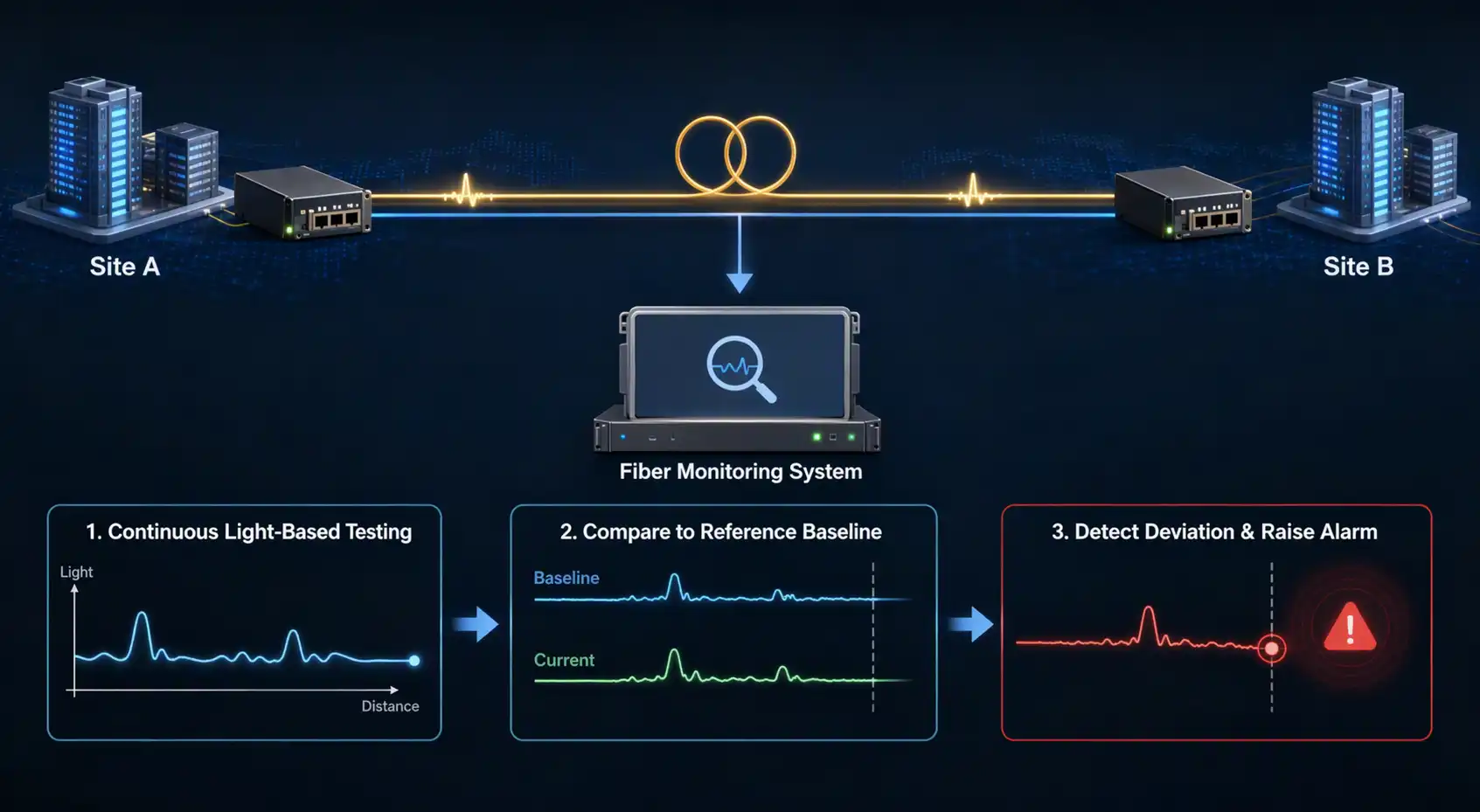
Traditional fiber maintenance is periodic and reactive. Technicians run manual test sweeps during scheduled windows, or worse, troubleshoot only after users report an outage. Continuous monitoring replaces that cycle with 24/7 automated testing. It works on both live fibers carrying production traffic and dark fibers held in reserve, without disturbing either. A typical Optical Fiber Monitoring System combines measurement hardware, an optical switch that lets one unit cover many fibers, and software that converts raw traces into dashboards, alerts, and long-term trend data. The result is a fiber plant that effectively reports its own health.
Why Data Centers Depend on Fiber
Yes, fiber optics are essential for data centers. Nearly all traffic inside a modern facility moves over fiber, including rack-to-rack, hall-to-hall, building-to-building, and site-to-site links. Copper simply cannot deliver the bandwidth, reach, or density that 100G, 400G, and 800G connections demand.
The dependence deepens every year. AI training clusters push leaf-spine fabrics toward massive parallel fiber counts, while data center interconnect links tie campuses together across metro distances. Fiber is often perceived as inherently reliable and secure, but physical failures still happen: construction crews cut conduit routes, connectors collect dust, and glass slowly degrades under environmental stress. The consequences are measurable. In its Annual Outage Analysis, the Uptime Institute reports that outages linked to fiber and connectivity issues are rising and are more likely to cause extended disruptions, and 57% of respondents said their most recent major outage cost more than $100,000. When a single backbone fiber can carry the workload of thousands of servers, the physical layer deserves the same operational scrutiny as power and cooling.
Common Fiber Faults That Threaten Data Center Uptime
The most common fiber faults in data centers are cable breaks, connector end-face contamination, sharp bends, gradual aging, and physical tampering. Most develop silently and stay invisible to higher-layer network tools, which is exactly why dedicated fiber monitoring is needed to catch them.
| Fault type | Typical cause | Potential impact |
| Fiber break | Construction, cable pulls, rodent damage | Total loss of the link, extended outage |
| End-face contamination | Dust or oil on connector ferrules | Insertion loss, intermittent bit errors |
| Macrobend or pinch | Poor cable management, crushed conduit | Rising attenuation, degraded signal |
| Fiber aging | Long-term environmental stress | Gradual loss increase over years |
| Tampering or intrusion | Unauthorized access to ducts or cabinets | Security breach, possible tap risk |
What makes these faults dangerous is not their severity but their obscurity. A large facility contains thousands of fibers bundled through ceilings, trays, and underground ducts. Without distance-to-fault information, a failed link sends engineers tracing cables by hand, section by section, for hours while services remain down.
How Fiber Monitoring Works
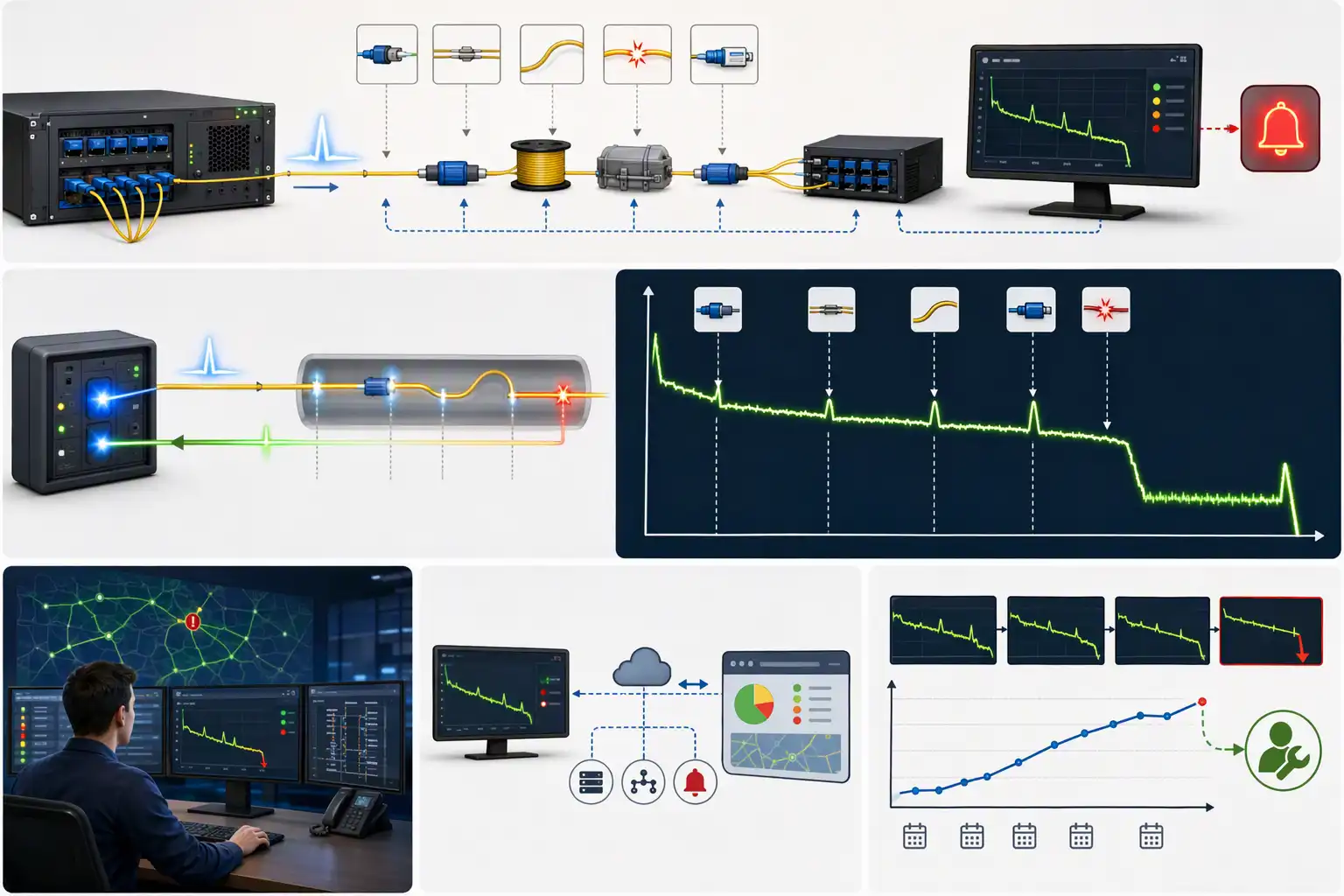
Fiber monitoring works by continuously injecting light into each fiber and analyzing what comes back. Automated OTDR testing maps every event along a link, classifies faults automatically, and pushes alerts to the operations team whenever a threshold is crossed.
OTDR-Based Fault Detection
The core technique behind fiber monitoring is optical time-domain reflectometry. An OTDR Solution injects short light pulses into a fiber and measures the light scattered and reflected back from every point along the link. Because the return time maps directly to distance, the resulting trace shows every splice, connector, and bend as a distinct signature. A break or degradation appears as a sharp change in the trace, allowing the system to localize the fault to within a few meters without touching live traffic.
An optical time-domain reflectometer was historically a handheld field instrument. In a monitored network, the same measurement runs automatically: embedded modules test fibers on a schedule, an optical switch rotates coverage across the plant, and each new trace is compared against a commissioning baseline. Deviations are classified automatically, so the system can tell a dirty connector from a fresh break without human interpretation.
Real-Time Alerts and Remote Visibility
Detection only creates value when it triggers action. Monitoring software applies thresholds, such as loss exceeding a set decibel value or a new reflective event appearing at an unexpected location, and immediately sends alarms to the network operations center. Alerts can integrate with existing NMS platforms through standard protocols, so fiber health appears alongside equipment health on the same screens.
Historical traces add a second layer of value: trend analysis. By watching a link’s loss creep upward week over week, teams can see a connector degrading long before bit errors surface, and schedule maintenance during a planned window instead of an emergency one.
What Fiber Monitoring Measures
A fiber monitoring system tracks a small set of optical metrics that together describe the full health of every link: optical power, insertion loss, reflectance, distance to fault, and any deviation from the fiber’s reference baseline. Read together, these measurements expose both sudden breaks and slow-moving degradation long before either reaches the service layer.
Each metric answers a different operational question. Optical power, measured in dBm, records the signal level arriving at the receiver, and a slow decline is an early warning that loss is eating into the link budget. Insertion loss expresses the total attenuation across the link in dB and confirms whether the link still meets its design budget, while return loss and reflectance capture the light bounced back at connectors and splices, where excessive reflection can destabilize or even damage transceivers. Distance to fault is the most actionable number of all, because it tells repair crews in meters exactly where to go, and baseline deviation flags any new event against the commissioning trace, separating normal link behavior from developing faults.
The baseline is what turns these raw numbers into operational insight. At commissioning, each link’s OTDR trace is stored as its reference signature, capturing every splice, connector, and bend exactly as built, and every later trace is compared against it, so a slowly accumulating contamination shows up as a growing loss event at a known location while a construction cut appears as a sharp break where no event existed before. The same logic covers the whole plant: single-mode interconnect routes and multimode runs inside the data halls are measured identically with thresholds set per link type, and both live and dark fibers are monitored non-intrusively. Modern Optical Fiber Sensing and Monitoring platforms then consolidate these readings into a single dashboard and rank alarms by severity, so a minor drift on a spare fiber is logged for review while a sudden break on an active backbone reaches the on-call engineer immediately, together with its exact location.

Key Benefits of Fiber Monitoring for Data Centers
The main benefits are shorter repair times, a shift from reactive to preventive maintenance, SLA protection, lower operating costs, and physical-layer security. Together, they turn the fiber plant from an unmonitored unknown into a managed asset.
- Faster MTTR. Meter-level fault location means repair crews walk straight to the problem instead of hunting through cable trays.
- Preventive maintenance. Aging fibers and dirty connectors are identified and fixed before they interrupt services.
- SLA and reputation protection. Fewer incidents and shorter blips keep uptime commitments intact.
- Lower operating costs. Automated monitoring replaces manual patrols and repeated truck rolls, and one monitoring unit can cover a large share of the plant.
- Physical security. Any attempt to open a cabinet, tap a fiber, or cut a cable in a monitored zone is detected and located as it happens.
Where Fiber Monitoring Matters Most
Fiber monitoring delivers the highest return on the links that are hardest to reach and quickest to fail: inter-building backbones, data center interconnect circuits, and leased dark fiber routes that leave the facility entirely.
Inside the campus, structured cabling between data halls and main cross-connects accumulates faults from routine work; every re-cabling or maintenance touch risks contamination and bends. Outside the fence, Data Center Interconnect links face construction zones, weather, and third-party infrastructure, and a fault on a metro route may sit kilometers from any staffed site, so GPS-level fault location becomes essential. Leased dark fiber is a special case: with no active equipment on the line, nothing reports loss at all, and monitoring is the operator’s only source of visibility.
Teams adopting fiber monitoring can follow a simple sequence:
- Capture baseline OTDR traces for every critical link at commissioning.
- Prioritize the links whose failure hurts most, such as interconnects and core backbones.
- Deploy centralized monitoring with defined loss thresholds and alert routing.
- Integrate fiber alerts into existing NOC workflows and maintenance planning.
Frequently Asked Questions
The following answers address the most common follow-up questions about fiber infrastructure and monitoring.
What are the three ”C“s of fiber?
The three ”C“s are the core, the cladding, and the coating. The core is the ultra-pure glass center that carries the light signal, the cladding surrounds it with a lower refractive index that keeps light trapped inside the core, and the coating is the protective outer layer that shields the glass from damage. Fiber monitoring effectively keeps watch over the health of all three layers, since faults in any of them show up in the optical trace.
Who provides fiber to data centers?
Fiber reaches data centers through several channels. Telecom carriers deliver lit services over their own metro and long-haul networks, dark fiber providers lease dedicated strands that the operator lights with its own equipment, and colocation providers often operate inter-facility fiber within their campuses. Large operators also build and own private fiber routes between their own sites.
What is the biggest downside to fiber optic cabling?
The biggest downside is that fiber is fragile and its faults are hard to locate. A glass strand can be severed by construction work or a tight bend, repairs require specialized skills and equipment, and a break somewhere along a multi-kilometer route is nearly impossible to find without distance-to-fault tools. Continuous fiber monitoring directly addresses this weakness by detecting and localizing faults automatically, often before users notice any impact.