
The rapid expansion of artificial intelligence workloads, hyperscale cloud services, and high-performance computing has pushed data center networks toward 800-gigabit-per-second links. At that speed, the optical transceivers that convert electrical signals to light and back become the densest powered devices in a switch, and their thermal and electrical budget is now treated as a first-order design constraint rather than a footnote in a datasheet. As rack densities climb and power-distribution limits tighten, engineers increasingly evaluate every watt an 800G optical transceiver module draws, because the same watt appears once at the wall and again, partly, in the cooling system that removes it.
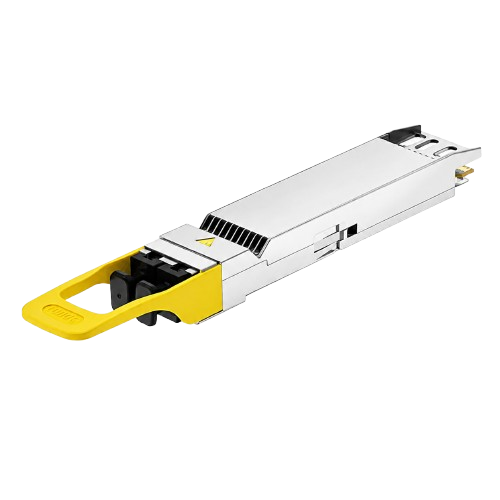
A typical 800G optical transceiver consumes between 14 and 20 watts, with the widely deployed 800G OSFP 2xFR4 specified at around 15W; standard short-reach optics sit in the 14-18W band, coherent 800G ZR modules rise to 20-30W for long-reach links, and linear pluggable optics (LPO) can cut that draw to roughly 6-9W by eliminating the module-side retiming DSP and relying on the host ASIC SerDes for equalization and signal compensation.
The breakdown below explains where those watts go, how the figure changes by module type, and why a few watts per port matters far more than a single spec line suggests.
How Much Power Does an 800G Optical Transceiver Use?
A standard 800G optical transceiver draws about 14-18W in its common short-reach variants, with coherent long-reach versions reaching 20-30W and linear (LPO) designs dropping to roughly 6-9W; the planning number is the typical consumption, while the maximum rating defines the cooling ceiling.
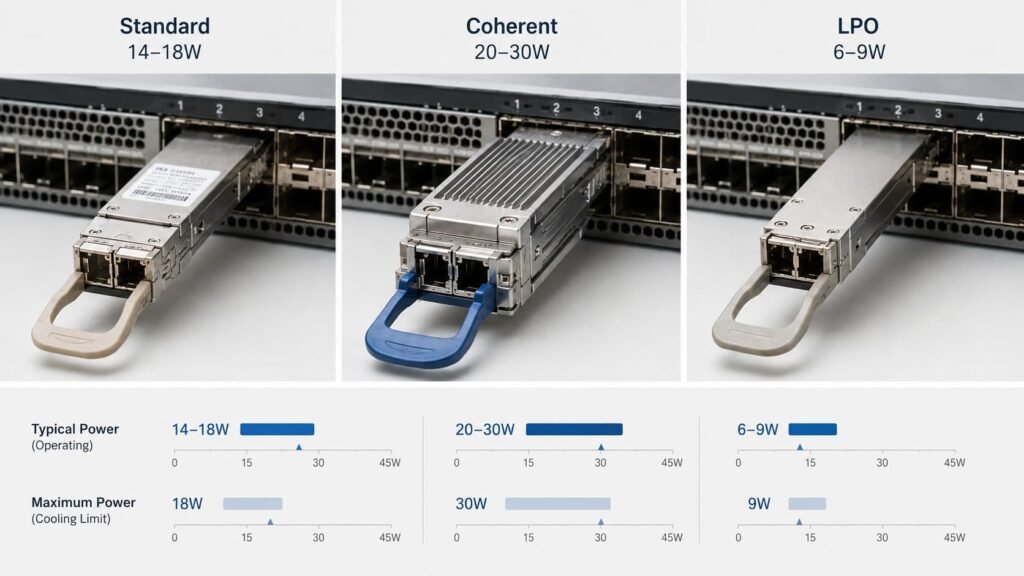
The exact figure depends on reach, modulation, and architecture. Multimode short-reach modules (SR8) sit at the low end of the conventional range because their VCSEL-based engines are relatively efficient over short distances, while single-mode direct-detect modules (DR8, 2xFR4) occupy the middle. Coherent modules that recover a clean signal over tens of kilometers need heavy digital signal processing, which pushes them to the top of the range. Understanding the types of 800G transceivers helps match the power envelope to the actual link budget rather than over-provisioning reach and paying for it in heat. Government and industry benchmarks commonly place a standard 800G module below 14.5W and an 800G LPO below 8.5W under normal operating conditions.
| Module type | Typical power | Max power | Reach / fiber | Architecture |
| 800G SR8 | 12-14W | 16W | 100m MMF | VCSEL |
| 800G DR8 | 14-16W | 18W | 500m SMF | PAM4 direct detect |
| 800G 2xFR4 | 14-16W | 18W | 2km SMF | Dual FR4 engines |
| 800G 2xLR4 | 15-18W | 20W | 10km SMF | CWDM |
| 800G ZR | 20-25W | 30W | 80km SMF | Coherent DSP |
| 800G LPO | 6-8W | 9W | 500m-2km | Linear (no DSP) |
Form factor also shifts the ceiling. OSFP gives the module more physical volume and a larger heat spreader, so it carries higher thermal headroom;, but its per-port power limits are slightly tighter, which is why many QSFP-DD 800G variants are rated a watt or two below their OSFP equivalents. In a fully populated 32-port 800G switch, optics alone can draw well over 500W before any cooling overhead is added, so the spread between a 13W module and an 18W module is not a rounding error at the rack level.
What Drives Power Consumption in an 800G Module?
The DSP, the lasers, and the drive electronics absorb the bulk of an 800G module’s power, and reducing it is mostly a matter of tighter integration and lower-voltage operation rather than a single breakthrough component.
An 800G 2xFR4 module typically receives eight ~100G PAM4 electrical lanes from the host and maps them onto two four-wavelength 400G optical interface, and runs enough digital signal processing to keep the link clean over distance. The DSP is the largest single consumer in conventional designs, followed by the laser drivers and the receive transimpedance amplifiers. Because optical transceiver speed is pushed up by raising lane rate and lane count rather than by improving any one part, the power budget scales with both the number of active lanes and the complexity of the equalization each lane needs.
Silicon photonics changes the balance by integrating much of the optical path, including modulators, waveguides, and detectors, onto a single chip. That removes the insertion losses and bias-current overhead that accumulate between discrete components, which is a large part of why a well-designed 800G 2xFR4 can sit meaningfully below the market-standard 15W instead of at it. Temperature is the other variable that is easy to underestimate: laser threshold current rises with junction temperature, and a module quoted only by its typical number can draw materially more when the case approaches its rated maximum. The honest way to read a datasheet is therefore to treat the typical figure as the planning value and the maximum as the cooling-design ceiling, then validate both against the actual airflow of the target switch.
400G vs 800G: How Does Power Compare?
An 800G module carries twice the data of a 400G module and typically draws about 60-80 percent more total power, yet it is more efficient per bit because it consolidates two 400G links into one device and removes the duplicated overhead.
The absolute number goes up, but the cost per transferred bit comes down. Moving from two 400G modules to a single 800G 2xFR4 halves the device count, the port count, and the duplicated laser and bias circuitry for the same 800G of throughput, so the network gets more bandwidth per watt and per port. When sizing a 400G optical module against an 800G upgrade, the relevant comparison is therefore power per terabit rather than watts per module.
| Metric | 400G (typical) | 800G (typical) | Change |
| Typical module power | ~10-12W | ~14-18W | +60-80% |
| Data per module | 400G | 800G | 2x |
| Power for 800G of throughput | ~20-24W (two modules) | ~15W (one module) | Lower |
| Devices per 800G of throughput | 2 | 1 | -50% |
The efficiency gain is why operators continue migrating upward even though each generation of optics draws more than the last: the watts per bit keep falling, and the saved ports and switch slots reduce the power spent on the surrounding infrastructure as well.
Why Power Consumption Matters at Scale in AI Clusters
In a hyperscale or AI cluster, a module’s draw is small next to a GPU or a switch, but there are thousands of modules running every hour for years, so a few watts per port compounds into significant energy, cost, and carbon every year of the deployment.
A single port saving four watts and running continuously saves roughly 35 kWh a year at the module alone. Data centers do not only pay for the module, though; they also pay to cool it, so the real figure scales with power usage effectiveness (PUE). At a PUE of 1.4, that 35 kWh becomes closer to 49 kWh per port per year once cooling overhead is included. Multiplied across ten thousand ports, the result is roughly half a gigawatt-hour a year, tens of thousands of dollars at typical commercial electricity prices, and over a hundred tonnes of CO2, not once but every year the cluster runs. With why 800G transceivers are popular as the default spine fabric for AI training, even small per-port differences stop being rounding errors and start shaping the operating budget.
How to Reduce 800G Power Consumption
The practical levers are linear pluggable optics, silicon-photonics integration, lower-voltage drive circuitry, and disciplined thermal planning, and most deployments combine several of them rather than relying on one.
Linear Pluggable Optics (LPO)
LPO removes the full retiming DSP from the module and leans on the host switch ASIC for signal conditioning, which can cut module power by roughly 40-50 percent compared with conventional DSP-based designs. The trade-off is tighter interoperability and shorter guaranteed reach, so LPO fits short-reach AI fabrics where the host can absorb the equalization work and where latency and power matter more than reach.
Silicon Photonics and Low-Voltage Design
Integrating the optical path onto a silicon chip removes discrete-component losses, and running the drive electronics at 0.85-1.0V instead of 1.8V directly lowers the power each lane draws. The combination is why several low-power 800G 2xFR4 modules sit below 11W typical rather than near the 15W market standard, without sacrificing the MSA-defined form factor or interface.
Thermal Planning and Deployment Hygiene
Treat the typical rating as the planning number and the maximum as the cooling ceiling, validate airflow and heat-spreader contact in the actual switch, and maintain clean, low-loss fiber connections to preserve optical margin and reduce BER, FEC events, and link instability. Power claims from a single sample are only useful if they hold across a full shipment, so consistency at volume, rather than a headline-best watt, is the part worth verifying during qualification.
FAQ
How many watts does an 800G QSFP-DD module typically draw?
A QSFP-DD 800G module commonly draws 13-18W depending on reach: short-reach SR8 variants are typically capped near 13W, DR8 around 16.5W, and 2xLR4 up to 18W, reflecting the tighter thermal envelope of the QSFP-DD form factor compared with OSFP.
Is 800G more power-efficient than 400G per bit?
Yes. Although an 800G module uses more total power, it carries twice the data, and consolidating two 400G links into one 800G module removes duplicated lasers, bias circuitry, and port overhead, which lowers the watts spent per transferred bit.
Does lower transceiver power improve link reliability?
It generally helps. Modules that run cooler see lower laser threshold drift and lower junction stress, and a modest reduction in operating temperature can meaningfully raise mean time between failures, so lower power also tends to improve long-term stability, not just the electricity bill.