
Telecom networks are under relentless pressure. Video streaming, cloud computing, 5G rollout, and AI-driven workloads keep pushing traffic volumes upward, while operators face steep costs and long permitting cycles every time new fiber must be laid. A single optical fiber carrying just one signal wastes most of the physical medium’s potential, which is exactly the bottleneck that dense wavelength division multiplexing was designed to eliminate. For carriers, enterprises, and data center operators alike, DWDM has become the foundational capacity engine behind nearly every long-haul, metro, and interconnect network in service today.
DWDM in telecom is a fiber-optic transmission technology that carries dozens of separate data streams simultaneously over a single fiber by assigning each stream to its own tightly spaced wavelength of light, typically in the 1550 nm region of the spectrum. Rather than transmitting one signal per fiber, DWDM combines up to 96 or more wavelength channels through a multiplexer, transports them together, and separates them at the far end, effectively turning one physical fiber into many virtual fibers and multiplying capacity into the terabit-per-second range without laying a single new cable.
The sections below explain how the technology works, what hardware makes up a complete system, and where DWDM fits in the modern telecom landscape compared with MPLS, CWDM, and the latest high-speed optics.
How DWDM Works in Telecom Networks
In operation, DWDM works by converting client signals into light at precise wavelengths, combining those wavelengths onto one fiber pair, amplifying them along the route, and separating them back into individual channels at the receiving end. The physics is simple light multiplexing, but the precision of the wavelength control is what makes the “dense” part possible.
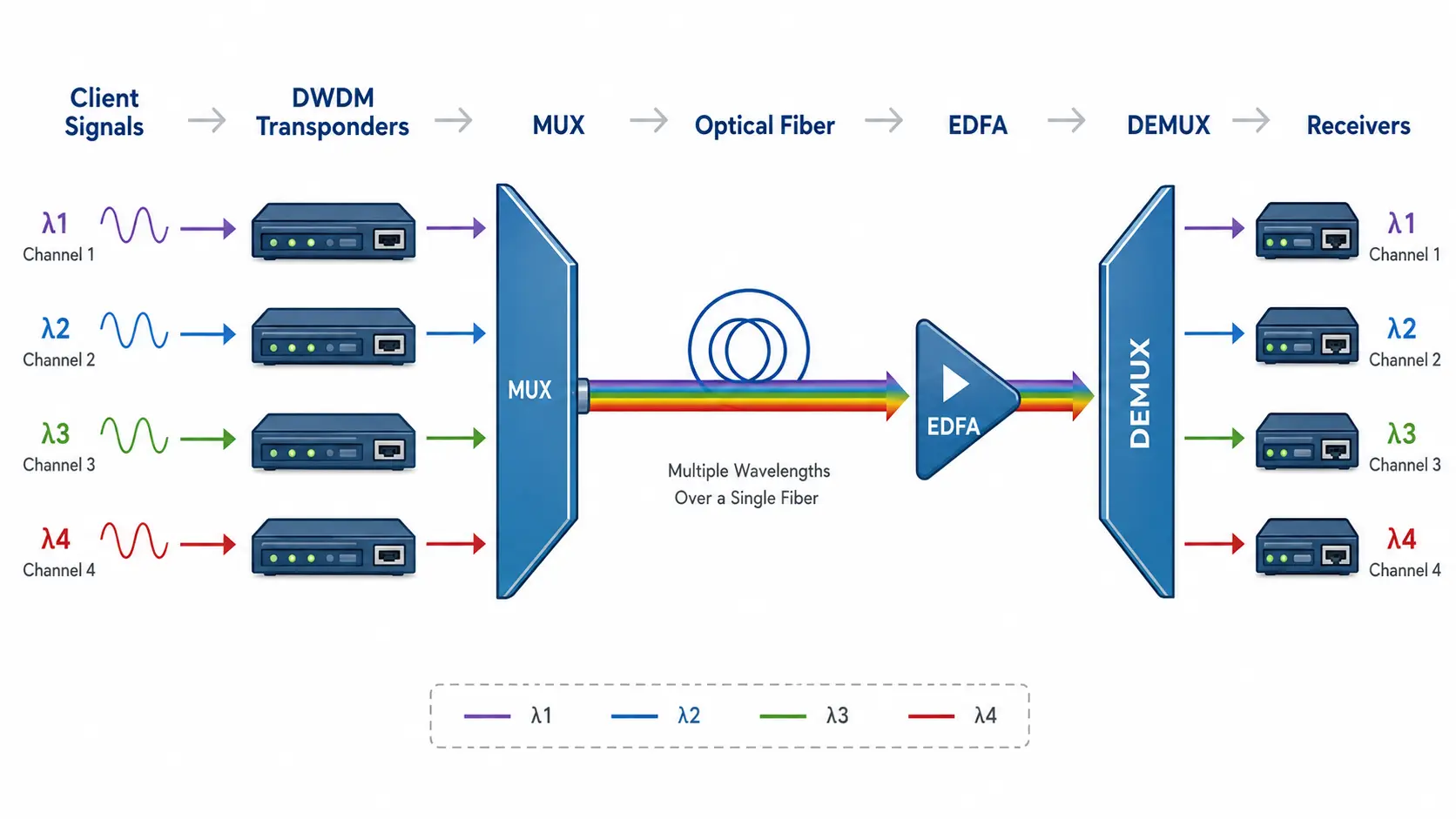
Each wavelength behaves like an independent lane on a highway. Because every channel is optically isolated from its neighbors, a carrier can transport Ethernet, OTN, Fibre Channel, and SDH/SONET traffic on the same fiber at the same time without the services interfering with one another. This protocol transparency is one reason DWDM became the universal transport layer for telecom networks.
A typical transmission chain follows these steps:
- Client signal intake. Routers, switches, or storage equipment hand off an electrical or optical signal to the DWDM layer.
- Wavelength conversion. A transponder converts the client signal to a precise ITU-grid wavelength using a laser tuned to the assigned channel.
- Multiplexing. An optical multiplexer combines all active wavelengths into a single composite optical signal.
- Line transmission. The composite signal travels along single-mode fiber, with optical amplifiers boosting it every 60 to 100 km to counteract attenuation.
- Demultiplexing. At the far end, a demultiplexer splits the composite signal back into individual wavelengths.
- Signal recovery. Receivers or transponders convert each wavelength back to the original client format and deliver it to the destination equipment.
For a more detailed walkthrough of each stage, including how amplification and dispersion compensation fit into the chain, see how DWDM works in practice.
What Are the 5 Components of a DWDM System?
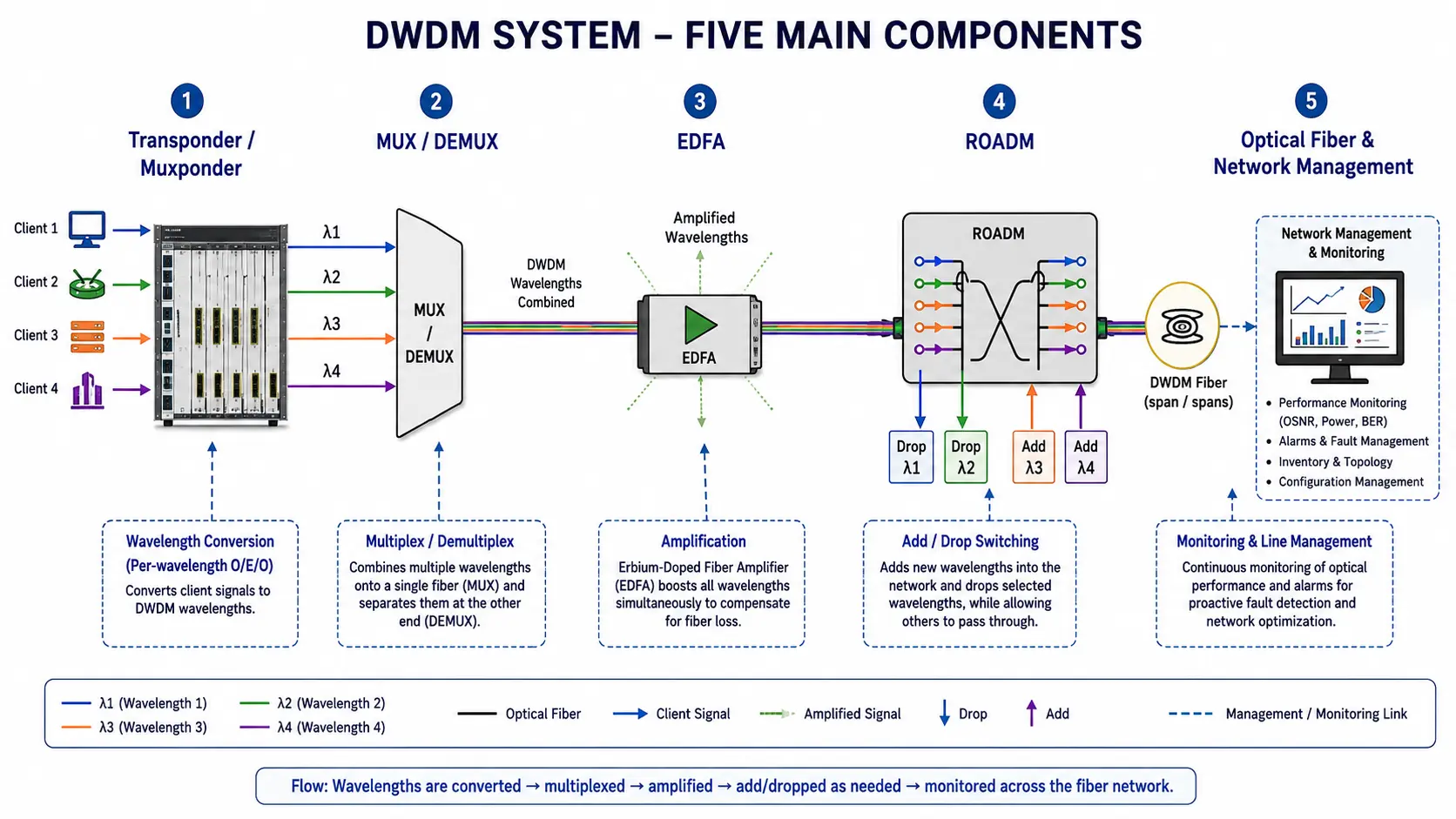
A complete DWDM system is built from five essential components: transponders or muxponders, an optical multiplexer and demultiplexer pair, optical amplifiers, reconfigurable add-drop multiplexers, and the fiber line itself together with its management layer. Each element handles one stage of the transmission chain, and removing any one of them breaks the end-to-end optical path.
Transponders and Muxponders
Transponders sit at the edge of the DWDM layer. They take in a client signal in its native format, such as 10G Ethernet or a 400G coherent stream, and re-transmit it on the exact wavelength assigned to that channel. Muxponders perform the same role but combine several lower-rate client signals onto a single high-speed wavelength, which improves fiber utilization when traffic is fragmented across many small services. These functions are typically delivered through pluggable optics, and modern DWDM transceiver modules span everything from 10G tunable SFP+ to 400G and 800G coherent form factors.
Optical Multiplexer and Demultiplexer
The multiplexer uses thin-film filters or arrayed waveguide gratings to merge individual wavelengths into one composite signal; the demultiplexer performs the inverse operation at the receiving site. Channel count and filtering sharpness determine how closely wavelengths can be packed, which directly governs total system capacity.
Optical Amplifiers
Erbium-doped fiber amplifiers (EDFAs) boost all wavelength channels simultaneously in the optical domain, with no need to convert signals back to electricity. This is the component that makes long-haul transport economical, since electrical regeneration at every span would be prohibitively expensive at 80 or 96 channels.
Reconfigurable Optical Add-Drop Multiplexers
ROADMs allow specific wavelengths to be added or dropped at intermediate sites without disturbing the channels that are simply passing through. To understand how reconfigurability changed metro and core network design, read about ROADM in DWDM deployments and their flexible grid architectures.
Fiber Line and Management System
The final component pair is the single-mode fiber plant itself and the network management software that monitors optical power, signal quality, and fault locations across the full line system. Together these five building blocks form what vendors package as integrated optical transport systems, ranging from compact metro boxes to multi-terabit long-haul platforms.
| Component | Primary Function | Typical Technology |
| Transponder / Muxponder | Client-to-wavelength conversion | Tunable lasers, coherent DSP |
| Mux / Demux | Combine and separate wavelengths | AWG, thin-film filters |
| Optical Amplifier | Boost all channels in-line | EDFA, Raman amplification |
| ROADM / OADM | Add, drop, or pass through wavelengths | WSS-based switching |
| Fiber + NMS | Transmission medium and monitoring | G.652 single-mode fiber, OTDR, telemetry |
DWDM Wavelengths, Channel Spacing, and Capacity
DWDM systems operate mainly in the C-band between approximately 1530 nm and 1565 nm, with channels spaced at 50 GHz or 100 GHz intervals on the standardized ITU frequency grid, and modern systems extend into the L-band to nearly double the usable spectrum.
The channel plan is defined by ITU-T Recommendation G.694.1, which specifies the dense wavelength grid used by virtually every commercial system. Narrow 50 GHz spacing allows 80 to 96 channels in the C-band alone, while flexible-grid systems that allocate spectrum in 12.5 GHz increments support fewer but much faster super-channels for coherent transmission.
| Channel Spacing | Approximate C-Band Channel Count | Typical Per-Channel Rate | Indicative Fiber Capacity |
| 100 GHz | 40 to 48 | 10G to 100G | 0.4 to 4.8 Tbps |
| 50 GHz | 80 to 96 | 100G to 400G | 8 to 38.4 Tbps |
| Flexible grid | Variable super-channels | 400G to 800G+ | 25 Tbps and beyond |
These figures explain why capacity planning rarely requires new fiber. An operator that lights additional wavelengths on an existing DWDM line system can multiply carried traffic several times over while the cable in the ground stays exactly the same, and per-wavelength rates continue to climb with each coherent optics generation, as documented in industry references on dense wavelength division multiplexing.
What Is the Difference Between MPLS and DWDM?
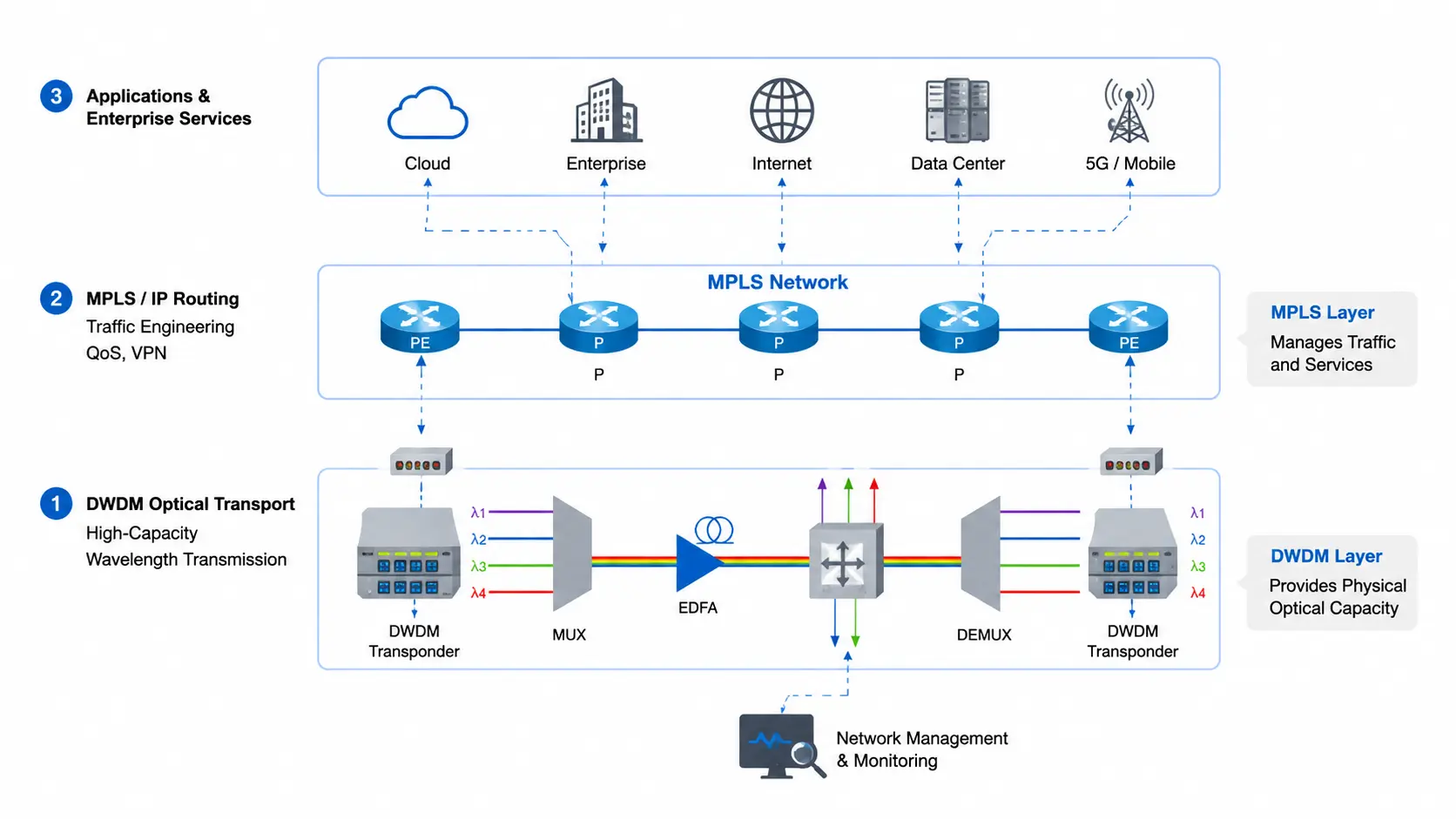
The difference between MPLS and DWDM is one of network layer and purpose: DWDM is a physical layer transport technology that moves massive raw capacity between two points as light, while MPLS is a packet-forwarding technique that intelligently routes, prioritizes, and manages traffic across a network. They solve different problems and in most carrier networks they work together rather than competing.
| Dimension | DWDM | MPLS |
| Network layer | Layer 1, optical transport | Layer 2/3, packet switching |
| Core function | Raw point-to-point bandwidth | Traffic engineering, QoS, VPNs |
| Capacity scale | Tbps per fiber pair | Gbps per LSP, aggregate dependent |
| Latency contribution | Minimal, fixed propagation delay | Slight processing overhead at each hop |
| Typical use | Long-haul, metro, DCI links | Enterprise WAN, service provisioning |
| Procurement model | Wavelength service or owned line system | Managed service from a carrier |
The practical takeaway is that MPLS services are usually delivered over a DWDM backbone. A carrier sells an MPLS VPN to an enterprise customer, and the labeled packets ride IP routers that are themselves interconnected by DWDM wavelengths, often framed within an optical transport network for management and protection. Choosing between them is therefore rarely an either-or decision: MPLS answers “how should traffic be steered and prioritized,” while DWDM answers “how do we move all of it at scale.” An introduction to optical transport network concepts helps clarify where these layers meet.
Is DWDM Still Used?
Yes, DWDM is not only still used, it remains the dominant transport technology in virtually every carrier long-haul network, most metro cores, and the interconnect links between hyperscale data centers, with investment actually accelerating because of AI and cloud traffic growth.
Far from fading, the technology keeps advancing. Each coherent optics generation has pushed per-wavelength rates from 100G to 400G and now 800G, which lets operators multiply capacity on fibers that were installed years ago. AI training clusters, in particular, generate enormous east-west traffic between data centers, making high-capacity DWDM for data center interconnect one of the fastest-growing segments of the market. Carriers building out 5G backhaul and fixed-access aggregation face the same physics, and dense WDM is almost always the most economical answer per transmitted bit.
The demand side of the equation reinforces this trend. Video, cloud workloads, and distributed AI infrastructure continue to grow at rates that outpace any single-wavelength upgrade path, so data center interconnect links and carrier cores will depend on DWDM line systems well into the foreseeable future.
Key Benefits and Applications of DWDM in Telecom
The core benefits of DWDM in telecom are massive scalable capacity on existing fiber, low cost per transmitted bit, protocol transparency, and minimal latency, which together make it the default choice for long-haul, metro, DCI, and 5G transport applications.
The main advantages can be summarized as follows:
- Capacity multiplication. Lighting 80 to 96 wavelengths turns one fiber pair into a multi-terabit transmission medium.
- Incremental scalability. Capacity grows by turning on new wavelengths rather than construction projects, which shortens upgrade cycles from years to weeks.
- Protocol transparency. Ethernet, OTN, Fibre Channel, and legacy TDM services share one optical infrastructure without conversion gateways.
- Low, deterministic latency. Because forwarding happens at the optical layer, DWDM adds essentially no queuing delay, which matters for replication and real-time workloads.
- Cost efficiency at scale. The cost per bit falls sharply as wavelengths are added, since the fiber and most line components are already paid for.
On the application side, four scenarios dominate. Long-haul and submarine networks rely on amplified DWDM spans to cross hundreds or thousands of kilometers economically. Metro and regional rings aggregate 5G backhaul, business services, and residential traffic onto shared line systems. Data center interconnect links tie campus pairs and metro clusters together at 400G and 800G per wavelength. Enterprise and utility networks use dedicated wavelengths for secure, high-capacity private backbones.
For shorter reaches and tighter budgets, coarse WDM offers a lower-cost alternative with fewer channels and no amplification, so operators weighing both options often start with a CWDM vs DWDM comparison before committing to a line system design.
FAQ
How far can a DWDM signal travel without regeneration?
With EDFA and Raman amplification plus dispersion compensation, a DWDM span can routinely reach several hundred kilometers between electrical regeneration points, and advanced coherent systems extend unregenerated reach to 1,000 km or more. Actual reach depends on channel rate, fiber quality, and the number of wavelength channels sharing the line.
How does DWDM relate to OTN?
DWDM provides the physical lightpath, while OTN provides the framing, multiplexing, management, and protection structure layered on top of it. In practice, client services are wrapped into OTN containers and then carried over DWDM wavelengths, which is why the two technologies are almost always deployed together in carrier networks.
What does deploying a DWDM system actually cost?
Costs split into the line system, transponders, amplifiers, and site work, with the largest variables being reach, channel count, and per-channel rate. Passive, unamplified configurations for metro point-to-point links are the most economical entry point, while long-haul systems with ROADMs and coherent optics carry proportionally higher upfront cost but a much lower cost per bit over the system’s lifetime.